"Outside a dog a book is man's best friend, inside a dog it is too dark to read!" -Groucho Marx========="The person, be it gentleman or lady, who has not pleasure in a good novel, must be intolerably stupid." -Jane Austen========="I don’t believe in the kind of magic in my books. But I do believe something very magical can happen when you read a good book."-JK Rowling========"I spend a lot of time reading." -Bill Gates=========“Ahhh. Bed, book, kitten, sandwich. All one needed in life, really.” -Jacqueline Kelly=========
Showing posts sorted by relevance for query west with the night. Sort by date Show all posts

Wednesday, July 6, 2016

West With the Night by Beryl Markham, a classic if I've ever read one.

Last  month my book club's selection was Circling the Sun by Paula McLain, It is a novelized memoir of Beryl Markham's life. After finishing that book my attention immediately shifted to the original, West With the Night by Markham herself. The book was published in 1942, and though it got good reviews it fell into almost immediate obscurity. I think the timing wasn't good with a war on and all.  It would have remained out-of-print and little known but in 1983 some papers of Ernest Hemingway were found by his son. In them Hemingway praised Markham's book and her writing to his publisher Max Perkins,
…As it is, she has written so well, and marvelously well, that I was completely ashamed of myself as a writer…she can write rings around us all… The only parts of it that I know about personally, on account of having been there at the time and heard the other people’s stories, are absolutely true… I wish you would get it and read it because it is a really a bloody wonderful book.
Markham was still alive living in poverty in Kenya in 1983 and the re-publication of her masterpiece allowed her to a live out her life in comfort.

Unlike most other memoirs I've read, West With the Night reads much more like an adventure novel, or a travel journal, or a collection of short stories not necessarily presented in chronological order. Markham was born in England in the early 1900s and moved to British East Africa (before Kenya was Kenya) with her father in 1903 as a colonist. He was a farmer, a businessman, a horse trainer. She was a wild thing who wanted more than anything to be a warrior, went a boar hunt which nearly killed her favorite dog,  and was "moderately eaten" by a pet lion. Each chapter represents a memory of Markham's life in Africa, or as a horse trainer herself, or as an aviator once she learned to fly. My favorites were the Africa stories.
“There are as many Africas as there are books about Africa -- and as many books about it as you could read in a leisurely lifetime. Whoever writes a new one can afford a certain complacency in the knowledge that his is a new picture agreeing with no one else's, but likely to be haughtily disagreed with by all those who believed in some other Africa. ... Being thus all things to all authors, it follows, I suppose, that Africa must be all things to all readers.
Africa is mystic; it is wild; it is a sweltering inferno; it is a photographer's paradise, a hunter's Valhalla, an escapist's Utopia. It is what you will, and it withstands all interpretations. It is the last vestige of a dead world or the cradle of a shiny new one. To a lot of people, as to myself, it is just 'home.” 
If a hunter goes on a safari in Africa he/she only knows that part of of the continent's story. If missionaries go to Africa to win souls, will they really experience the soul of the land? Markham would argue that few people outside of Africans themselves would ever know and understand this incredible land because they come to it with ulterior motives.

We know, or think we know, quite a bit about Markham's contemporaries: the Baron Bror von Blixen and his wife Karen and their friend, Denys Finch-Hatton because of the famous book and film, Out of Africa. Though Beryl had an affair with Finch-Hatton, she only talks about him a little in this book and only about his flying and his death.
“Denys (Finch-Hatton) has been written about before and he will be written about again. If someone has not already said it, someone will say that he was a great man who never achieved greatness, and this will not only be trite, but wrong; he was a great man who never achieved arrogance.”
She writes more about her friendship with Bror von Blixen because she becomes a pilot spotter for his elephant safari business. The chapters about elephant hunting where they worked together were the most difficult of all to read because, of course, elephants are now endangered and no one should be hunting or killing them. But I had to remind myself continually that Beryl and the Baron were doing this in the 1930s before people understood the fragility of the animal kingdom in the face of human incursions.

The title of the book West With the Night was in reference to Markham's remarkable flight from England to New York, via Nova Scotia in 1936, the first female to make this solo flight across the ocean, she said she was almost continually flying with the night.

Unlike Circling the Sun, readers will learn nothing from this book about Markham's love life, her husbands, or about her son, who lived in England with his father. So really the book isn't about Beryl Markham it is really about three things: horse training, flying, and Africa itself. Markham is just the story-teller.

I would be remiss if I didn't mention that there are quite a few scholars who believe that Markham didn't actually pen this book. They believe that it was ghost written by her third husband, Raoul Schumacher. I was asked by other book club members if it bothered me if indeed it wasn't written by Markham. After a brief pause I decided it didn't. The book is exquisitely written and the stories belong to Markham. Markham's biographer, Mary Lovell, asked Markham about the controversy because she had always maintained that she was the sole author of her book.
Beryl herself was totally unconcerned about the theory that she had not written the book. When I discussed the subject with her, she dismissed it, 'Oh, that darn thing again?" Asked how she answered her detractors, she shrugged and said, 'I don't bother...' (Lovell, 1987)
That settles it for me.  Just because someone doesn't have a lot of formal education doesn't mean they are stupid. Shakespeare is a case in point.  Markham also wrote a few short stories, published in a book called  The Splendid Outcast which adds to the proof, in my mind anyway, that the gal could write.

Markham mused on the first line of the book, How is it possible to bring order out of memory?  West With the Night is her attempt to do just that. And for her memories I am grateful because now I too can travel to Kenya through the beautiful words on a page and live with her as she recalls a few precious memories of a time gone by.

Source: half and half: Print edition checked out from a school library in my district; Audio edition checked out from the public library.

Rating: 5 out of 5.

West With the Night fulfills another selection from the Women's Classic Literature event.


Monday, July 25, 2016

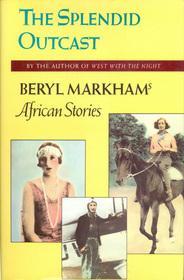
Splendid Outcast: Beryl Markham's African Stories

As you know, if you are a faithful reader of this blog (does such a person exist? I don't actually know.) Anyway, if you have read my blog infrequently over the past several months, you should have noted that I have been on an African kick. It started with Circling the Sun by Paula McLain, which led to West With the Night by Beryl Markham, a look at Out of Africa by Isak Dinesen (the movie and a bit of the book) and finally to The Splendid Outcast, African Stories also by Markham.

The Splendid Outcast was published in 1987, after Markham had died. Each short story highlights events that Markham either experienced herself or she drew from her own experiences and just made them into a fictional account. Markham's biographer, Mary S. Lovell, commented before each story with information about what was happening in Markham's life at the time the story was written, where it was originally published, and if the story was drawn from Markham's own life how the facts were altered. I found these editorial comments very helpful. In addition, Lovell wrote a lengthy introduction to the collection which I also found insightful and helpful in understanding Markham. Even though Markham wrote West With the Night about her own experiences growing up in Kenya, becoming first a horse trainer and then an aviator, she didn't give us many details about her personal life. Lovell fills in a few blanks here. Among the most interesting to me was Lovell's assurance that Markham did indeed pen West With the Night, not her third husband, as some scholars believe.

The Splendid Outcast is a collection of eight short stories, four of them were written in the 1940s by Markham with editing help from her husband. Her best stories are about horses and horse racing. Three of the stories were probably written by her husband but with material he had gleaned from Markham. The quality and descriptions were quite different that the other five stories, not really as good. The last story, "The Quitter" was written by Markham herself without editing help from her husband. It was published in 1946 and may have been written for purely financial reasons. It, too, wasn't as good as the first four stories in the collection. Apparently Markham and her husband, Raoul Schumacher, made a good writing team, and when one or the other wasn't involved the effort fell a bit short.

My favorite story in the collection is "The Captain and His Horse". In the story, which I think is actually true, Beryl is allowed to ride a captain's horse, Baron, out with the hunting party. Beryl was quite young. The Baron is so smart it is easy to assign human intelligence to him. In fact, because of Baron's quick intelligence and action Beryl is saved from sure death. Here is a quote from this story, a brief descriptive paragraph about the colors of Africa which I think is simply spectacular,
"To say that it was a clear day is to say almost nothing of that country. Most of its days were clear as the voices of the birds that unfailingly coaxed each dawn away from the night. The days were clear and many-colored. You could sit in your saddle and look at the huge mountains and at the river valleys, green, and aimless as fallen threads on a counterpane---and you could not count the colors or know them, because some were nameless. Some colors you never saw again, because each day the light was different, and often the colors you saw yesterday never came back."
Oh man, that quote just gives me shivers it is so lovely. I wish I had the ability to write as well as Markham so when I see that special sunset, or the light dappled through the leaves, or the animal squinting in the sun, I could capture the moment with such beautiful prose.

I don't know how easy this book is to find. I found a copy at a used bookstore in a neighboring town. Check your public library, perhaps they have a copy you could borrow.

My rating, a 4, is because of the inconsistent quality of the writing. I liked all the stories but I loved the writing on only the first four.

Source: print, I purchased the book.

A 2016 year-long challenge to read classic literature by women authors.


Wednesday, March 29, 2023

Weekly Blogging Challenge, 3/29/23

Today's blogging challenge: Best Nonfiction Books I've Read

This is an impossible task for me. I read a lot of nonfiction and I am fascinated by a variety of topics. Instead I have identified 15 17 nonfiction titles I have enjoyed a lot and either have or would like to reread.

I recommend them all without hesitation!


And unpictured --
(Click on titles for my reviews if hyperlinked)
 
My nonfiction reading tastes are very eclectic, as you can see from the list above. I like books about --
  • Sports: Boys in the Boat; Seabiscuit; All Thirteen.
  • Memoirs: Teacher Man; I Am, I Am, I Am; West With the Night; Lab Girl.
  • Science: A Dog in the Cave; Lab Girl; Around the World in 80 Trees; A Short History of Nearly Everything.
  • Written in verse: Brown Girl Dreaming
  • Graphic/illustrated: Faithful Spy; Brazen; Around the World in 80 Trees.
  • Essays: The Anthropocene Reviewed
  • About Social issues: Just Mercy; Brown Girl Dreaming
  • By favorite authors: John Green; Frank McCourt; Atul Gawande; Bill Bryson
  • About medical issues: Being Mortal; I Am, I Am, I Am
  • Adventure/Exciting: All Thirteen; Boys in the Boat; Seabiscuit; West With the Night
  • Feminists: Brazen; Lab Girl
  • Historical: West With the Night; Boys in the Boat; Seabiscuit; Brazen; A Dog in the Cave
  • Humor: Bill Bryson
  • YA: Faithful Spy; The Dog in the Cave; All Thirteen; Brazen; Brown Girl Dreaming; Just Mercy has a YA version.
  • The Beatles: Dreaming the Beatles
  • Where I learn something that has impacted my life: all of them!


-Anne

Wednesday, December 21, 2016

2016 End of the Year Book Survey

Hosted by Jamie at The Perpetual Page-Turner

Number Of Books You Read: 115, likely I will finish three more books before year's end.
Number of Re-Reads: 3
Genre You Read The Most From: YA


1. Best Book You Read In 2016?

  • Best biography: West With the Night by Beryl Markham
  • Best YA: The Passion of Dolssa by Julie Berry
  • Best Adult: The Brief Wondrous Life of Oscar Wao by Junot Diaz

2. Book You Were Excited About and Thought You Were Going To Love More But Didn’t?

  •  The Readers of Broken Wheel Recommend by Katarina Bivald
  • Man in the High Castle by Philip K. Dick (I love the Amazon Prime series but the book isn't really like the series. )
  • Harry Potter and the Cursed Child. I just had so much trouble with the format. I am not into reading plays.

 3. Most surprising (in a good way or bad way) book you read?  

  • Little Women by Louisa May Alcott. Some books read in childhood shouldn't be reread. 

 4. Book You “Pushed” The Most People To Read (And They Did)?

  • Apparently, outside of my library recommendations made as part of my job, I have not pushed many books this year. I mentioned how much I liked West With the Night to a lot of people but I don't think many actually read it because of me.

 5. Best series you started in 2016? Best Sequel of 2016? Best Series Ender of 2016?

  • Started: Rebel of the Sand by Alwyn Hamilton, #1 in the series
  • Best Sequel: Winter by Marissa Meyer, #4 in the series (It really is the series ender but another book was published after it.)
  • Series Ender: The Raven King by Maggie Stiefvater, #4 and last book of The Raven Cycle series

6. Favorite new author you discovered in 2016?

  •  Beryl Markham.  I spun off into an Africa phase of reading after reading about her in Circling the Sun by Paula McLain and then reading her biography West With the Night

7. Best book from a genre you don’t typically read/was out of your comfort zone?

  •  Not exactly out of my comfort zone but this book falls into a category from which I have rarely read books, books on reading books: The Art of X-Ray Reading by Roy Peter Clark.

8. Most action-packed/thrilling/unputdownable book of the year?

  •  Most unputdownable: My Lady Jane by Hand, Ashton, Meadows

9. Book You Read In 2016 That You Are Most Likely To Re-Read Next Year?

  •  Ten Poems to Change Your Life by Roger Housden
10. Favorite cover of a book you read in 2016?
  •  Jazz Day by Roxane Orgill

11. Most memorable character of 2016?

  •  Lady Jane Grey in My Lady Jane

12. Most beautifully written book read in 2016?

  •  In the Shadow of the Banyan by Vaddey Ratner and
  • The Yearling by Marjorie Rawlings

13. Most Thought-Provoking/ Life-Changing Book of 2016?

  •  Just Mercy by Bryan Stevenson

14. Books you can’t believe you waited UNTIL 2016 to finally read? 

  •  The Yearling by Marjorie Rawlings and
  • And Then There Were None by Agatha Christie

15. Favorite Passage/Quote From A Book You Read In 2016?

  • “Passed years seem safe ones, vanquished ones, while the future lives in a cloud, formidable from a distance. The cloud clears as you enter it. I have learned this, but like everyone, I learned it late.” 
    ― Beryl MarkhamWest with the Night
  • “From the time I was a baby, my mom took me to the library at least once a week. Librarians were like Mary Poppins to me. They always knew how to match a book to my mood or to whatever I was going through at the time. I could always find peace in books.” 
    ― Rachel CohnThe Twelve Days of Dash and Lily

16. Shortest; Longest Book You Read In 2016?

  • Shortest: Last Stop on Market Street by Matt de la Pena, 32 pages
  • Longest: Winter by Marissa Meyer, 832 pages

17. Book That Shocked You The Most

  • Girl at War by Sara Novic (about children fighting in the Bosnian conflict)
  • Running the Rift by Naomi Benaron (about the Rwandan Genocide)

18. OTP OF THE YEAR (you will go down with this ship!)

  • Lady Jane Grey and Guildford Dudley (from My Lady Jane)
  • Miel and Sam (from When the Moon Was Ours)

19. Favorite Non-Romantic Relationship Of The Year

  •  Dolssa and Botille (from The Passion of Dolssa)

20. Favorite Book You Read in 2016 From An Author You’ve Read Previously

  • The Raven King by Maggie Stiefvater 

21. Best Book You Read In 2016 That You Read Based SOLELY On A Recommendation From Somebody Else:

  • The Secrets of Mary Bowser by Lois Leveen. It was recommended by a gal in book club.

22. Newest fictional crush from a book you read in 2016?

  •  Cooper (from The Memory Book by Lara Avery)

23. Best 2016 debut you read?

  • The Reader by Traci Chee
  • The Serpent King by Jeff Zintner

24. Best Worldbuilding/Most Vivid Setting You Read This Year?

  •  Railhead by Philip Reeve

25. Book That Put A Smile On Your Face/Was The Most FUN To Read?

  •  My Lady Jane by Hand, Ashton, and Meadows.  I am still smiling about this book.

26. Book That Made You Cry Or Nearly Cry in 2016?

  •  In the Shadow of the Banyan by Vaddey Ratner
  • The Memory Book by Lara Avery
  • The Yearling by Marjorie Rawlings
  • When Breath Becomes Air by Paul Kalanathi
  • Girl at War by Sara Novic

27. Hidden Gem Of The Year?

  • Flannery by Lisa Moore (A wonderful coming-of-age tale, published by a small publisher in Canada. A true gem.)

28. Book That Crushed Your Soul?

  •  Just Mercy by Bryan Stevenson

29. Most Unique Book You Read In 2016?

  •  Vassa in the Night by Sarah Porter

30. Book That Made You The Most Mad (doesn’t necessarily mean you didn’t like it)?

  • Just Mercy by Bryan Stevenson


1. New favorite book blog you discovered in 2016?

  •  Um. Once again. I can't remember names of other's blogs. Sorry.

2. Favorite review that you wrote in 2016? Here are a few:

3. Best discussion/non-review post you had on your blog?

4. Best event that you participated in (author signings, festivals, virtual events, memes, etc.)?

  •  The GKHS Mock Printz Workshop, an annual event; Jane Austen week; Poetry Out Loud Competition. 

5. Best moment of bookish/blogging life in 2016?

  • When my blog attracted the attention of Julie Berry, the author of my favorite YA book of the year.

6. Most challenging thing about blogging or your reading life this year?

  • I fell into a writing slump in September and had a hard time pulling myself out. I went for about two months without reviewing any books. 

7. Most Popular Post This Year On Your Blog (whether it be by comments or views)?

8. Post You Wished Got A Little More Love?

9. Best bookish discover (book related sites, book stores, etc.)?

10.  Did you complete any reading challenges or goals that you had set for yourself at the beginning of this year?


1. One Book You Didn’t Get To In 2016 But Will Be Your Number 1 Priority in 2017?

  • Upcoming Book Club Selections: The Life We Bury (Ersken) and Big Rock Candy Mountain (Stegner)
  • Potential Printz Award books: Rani Patel in Real Life (Patel); Girl Mans Up (Girard); The Female of the Species (McGinnis); Scythe (Shusterman); and The Sun Is Also A Star (Yoon)
 That pretty much sets my reading list for January!

2. Book You Are Most Anticipating For 2017 (non-debut)?

  • The Underground Railroad by Colson Whitehead

3. Series Ending/A Sequel You Are Most Anticipating in 2017?

  •  The second book in the Rebel in the Sands series.

4. One Thing You Hope To Accomplish Or Do In Your Reading/Blogging Life In 2017?

  •  Generate more discussion blogs...not just reviews and memes

What did 2016 look like for you in terms of reading and books.  Feel free to copy the questions, give credit to Jamie at the Perpetual Page-Turner, and fill out your survey.


Sunday, June 12, 2016

"This really is a bloody wonderful book": Circling the Sun

Circling the Sun by Paula McLain is a novelized memoir about Beryl Markham who lived in British East Africa ("before Kenya was Kenya") for most of her life. The story focuses on Markham's early years through her twenties. She tells her story as a remembrance while in the cockpit of her airplane, a plane she is attempting to fly across the Atlantic from East to West in 1936. Spoiler alert, she makes it, well, sort of, and goes on to write her memoir, West with the Night, in 1942.

Markham lived a very colorful life. She was abandoned by her mother at a young age and was raised by her father, a racehorse trainer. Her best friend as a child was a native boy and she wanted to be a Kipsigis Warrior when she grew up. What she did become was the first female horse trainer in Africa, maybe the world, and an accomplished pilot. Both of these things shocked the folks in high society of the 1920s. Markham always seemed to be either in or out with these folks and her fortunes rose and fell. She had two divorces (unheard of in those days) and several other affairs.

Her most famous alliance was with Denys Finch-Hatton, an adventurer and big-game hunter, who was played by Robert Redford in the 1980s film, Out of Africa, which was based on the memoir written by Karen Blixen, aka Isak Dinesen. Apparently Hatton and Markham had an affair as his affair with Blixen was waning. It was Denys who got Beryl interested in flying and her interest didn't wane even after he died in a plane wreck on a flight she was supposed to be on.

Beryl Markham mythologizes many events in her life which gave her a sense of  invincibility. She had scrapes with horses, snakes, lions, and airplanes. All of them could have killed her but didn't. Her memoir, West with the Night, sold only modestly and then went out of print. Her life would have become a complete unknown had it not been for Ernest Hemingway who read her book and wrote in his notes, "This really is a bloody wonderful book". When Hemingway died his son found the note and located Markham, still living in Kenya and eeking out an existence as a horse trainer. Her book was republished and was well received. She lived out the rest of her life in relative wealth.

I have to confess that I am a little obsessed with Beryl Markham right now. After finishing Circling the Sun I paid $3.99 to rent the video Out of Africa starring Redford and Streep. Though Karen Blixen didn't mention Beryl Markham in her memoir she was their contemporary and friend. Watching the film made me see again what Markham's early life would have been like. I've checked out Blixen's memoir from my library and borrowed West with the Night for the summer from the only school in the district which had it. I've only read a few pages of each of the books but I am fully prepared to complete both of them.

Paula McLain did it again. My obsession with Markham right now is very similar to the obsession I had with Hemingway after I read her other novelized memoir, The Paris Wife. In that novel we meet Hemingway at the beginning of his writing career and his first wife, Hadley Richardson. After I read that book I had to read several books by Hemingway and did lots of Internet-type research on his life and about other famous folks he hung out with, Fitzgerald, Stein, and Joyce, to name a few. That novel focuses narrowly on Hemingway and his associates. This novel, Circling the Sun, not only focuses on Markham and her doings, but also on the culture and the beauty of Kenya and of Africa. It really makes the reader feel as if they are right there in Kenya, before it was Kenya.

This book is also a "bloody wonderful book". Not to be missed.

Disclaimer: I borrowed the audiobook from my public library, with Katharine McEwan narrating. What a wonderful treat it was to hear this book read aloud with all its Kenyan names and places. It was a blessing to have someone who knew what she was doing to deal with the pronunciations. I recommend this format.

Friday, June 28, 2024

Review: NIGHT WATCH -- Where I try to figure out why this book won the Pulitzer? (+Book Club Discussion Questions)

To the shock of just about the whole world, Night Watch by Jayne Anne Phillips won the 2024 Pulitzer Prize for Fiction this year. No one was talking about this book. It wasn't on anyone's end-of-year best books of 2023 lists. (Fact check:  this compilation.) Awarding this high literary honor to Night Watch and the other two finalists felt like a minor league team won the world series without anyone knowing they were even in the playoffs.

So why did Night Watch win the Pulitzer? Let's see if I can figure anything out.

Night Watch is set in West Virginia before, during, and after the Civil War. Instead of focusing on slavery or on the death tolls of the battles, this book examines the horrors citizens had to endure in the aftermath of the conflict. It also shines a light on one example of enlightened treatment of the mentally ill during this time period.

ConaLee, the twelve-year-old daughter of a man who went off to war and never returned, opens the book with her first person narration. The point of view switches throughout the book as other characters come in and out of focus, but ConaLee is the only one who tells her own story. She was born after her father left for war and her mother, Eliza, is raising her alone in the mountains of Appalachia, with the help of a neighbor, Dearbhla, an Irish healer who acts like her grandmother.  At some point a terrifying man arrives and tells ConaLee to call him 'Papa'. She thinks this man is her father. He is not, but he stays on and tyrannizes Eliza to the point where she has a complete mental and physical breakdown. There is a horrifying rape scene which is so graphic I cringe to think of it. Finally this terrible man dumps both ConLee and her mother at the Trans-Allegheny Lunatic Asylum. This ends up being a good thing because the director is following the moral practices of  Dr. Thomas Story Kirkbride, an actual historical person. Under the care of the director of this facility, Eliza starts to recover and ConaLee, who is posing as her nurse, find solace from their tortured life outside. While inside they meet a cast of characters among them is the Night Watch, a man with a history of his own.

Kirkus Reviews describes the book as having "haunting storytelling and a refreshing look at history." The Guardian sums up its review with "Night Watch is tough, even excruciating at times, but small notes of grace make an appearance throughout the novel." While Dwight Garner, writing a review of the book for the New York Times said, "Jayne Anne Phillips’s new novel...is sludgy, claustrophobic and pretentious. Each succeeding paragraph took something out of me." And Greg, a vlogger at Supposedly Fun, had this to say, "I hated, hated, hated this book." He explains several of his issues deal with the confusing way Phillips tells the story, dribbling out details, moving backwards and forward in time, including unnecessary characters and information that does not move the story forward. He thinks the Pulitzer Committee made a mistake in selecting Night Watch.

Wow. Some good and some extremely eviscerating comments from reviewers who know a whole lot more than me about what makes a book a good one. I was especially shocked by the NYT times reviewer calling the book sludgy and claustrophobic. Is such a negative review even allowed? 

So why did the Pulitzer Committee select Night Watch over standouts like North Woods, Tom Lake, Absolution, and The Heaven and Earth Grocery Store? Greg, from Supposedly Fun, criticizes the clandestine process the Pulitzer uses to select their winners. No one even knows who the judges are until after the process. No short list of books are announced ahead of time. Each year's panel of judges can use, and do use, whatever set of selection guidelines they choose. These guidelines, therefore, change every year. 2023 Pulitzer prize went to the two top books of the year so Greg wondered it this year's committee decided to do the opposite and give the award to a more obscure book. In fact, Michael Chabon, one of the jurors this year, wrote, "Beyond the winner and 2 runners-up, I want to shine a light on three excellent books, among the many nominees I deeply dug, by less well-known, less heralded writers." This tells me that at least Michael Chabon was focused on bringing forward less well-known works to light in his role as a Pulitzer judge. How maddening is that? Ann Patchett, James McBride, Alice McDermott were all at the top of their game and they and their books get shoved aside because Night Watch was less well-known. That seems like a ludicrous reason to select a book for this award.

In January I created a tiered ranking list of all the Pulitzer novels I've read. I created the categories myself, from BEST to DIDN'T LIKE and several levels between. Right now, if I were to place Night Watch onto my tiered ranking list, it would be on the bottom level, 'Didn't Like', with Tinkers, A Visit From the Goon Squad, and Breathing Lessons. I wouldn't go as far as Greg, who hated the book, or Dwight who thought the book sucked the life out of him. But I doubt I will tell anyone to read the book and might even go into details why I hope they don't. I'll start with a warning about the rape scene. Ugh. Shivers. 😖

The publisher has not prepared any discussion questions that I could find, so a friend and I came up with our own questions before our meeting. Here they are. Help yourself:

Night Watch Discussion Questions:

  1. What did you think of Night Watch by Jane Anne Phillips?
  2. Kirkus Reviews describes the book as having "haunting storytelling and a refreshing look at history." What do you think were its moments of “refreshing storytelling?"
  3. The Guardian sums up its review with "Night Watch is tough, even excruciating at times, but small notes of grace make an appearance throughout the novel." List a few of the grace notes in Night Watch.
  4. Dwight Garner, writing a review of the book for the New York Times said, "Jayne Anne Phillips’s new novel...is sludgy, claustrophobic and pretentious. Each succeeding paragraph took something out of me." Describe Night Watch in one or two sentences.
  5. How did this book add to your knowledge of the Civil War and its effects on soldiers and families?
  6. How did the lack of quotation marks add to or detract from the story?
  7. Which characters did you find the most compelling and why?
  8. The Trans-Allegheny lunatic Asylum was a real place and used moral treatment. What did you think of the strategies used to treat the patients?
  9. When did you suspect that the night watch was ConaLee's father? Did Eliza know earlier on? 
  10. Did you find the ending realistic or contrived? Why? 
  11. What importance and structure did Dearbhla provide to the story? 
  12. How necessary was it to portray graphic rape or war violence in a book about the Civil War? Is the brutality necessary to our understanding of the conditions of this time? 
  13. Night Watch won the Pulitzer Prize. Do you think it deserved it? What does its winning do to your regard for the selection process?
  14. Where would you rank Night Watch among the other Pulitzer Prize novels you’ve read? [These are the Pulitzer Prize winners we've read: March; Sympathizer; Goldfinch; Nickel Boys; Less; Night Watchman; Demon Copperhead; Night Watch.]

2024 Twenty Books of Summer Challenge

8 / 20 books. 40% done!


Friday, December 30, 2016

TTT: Favorite books of 2016


In alphabetical order, here are my favorite books in each category that I read in 2016.

The Art of X-Ray Reading by Roy Peter Clark
(Informational Nonfiction)

The Brief Wondrous Life of Oscar Wao by Junot Diaz
(Adult Fiction)

In the Shadow of the Banyan by Vaddey Rattner
(Best Book Club Selection and Discussion)

Jazz Day: the Making of a Famous Photograph by Roxane Orgill
(Children's Poetry)

Just Mercy by Bryan Stevenson
(Narrative Nonfiction, Adult)

The Life We Bury by Allen Eskens
(Mystery, Adult)

March, Book Three by John Lewis
(Graphic Biography)

My Lady Jane by Cynthia Hand, Brody Ashton, and Jodi Meadows
(Humorous YA Fiction)

The Passion of Dolssa by Julie Berry
(Historical YA Fiction)

The Raven King by Maggie Stiefvater
(Audiobook and Book In a Series, YA Fiction)

The Sympathizer by Viet Thanh Nguyen
(Audiobook, Adult)

West With the Night by Beryl Markham
(Autobiography)

The Yearling by Marjorie Kinnan Rawlings
(Classic)

     It is both a fun and a frustrating exercise selecting a list of favorite books. It is fun looking back on the books read during the past year and thinking about what else was happening during the same period when the book was being read. For example, Don and I listened to the audiobook Just Mercy on our way to and from a vacation at Whistler, B.C. and The Sympathizer during a long weekend in Oregon to watch a football game. This events undoubtedly enhanced my feelings about the books. 
    The frustration comes from not being able to put every book one likes on the list and finding some niche for it. A case in point is selecting In the Shadow of the Banyan as my favorite book club selection when there were so many other great books which deserved notice: The Life and Times of the Thunderbolt Kid and The Secrets of Mary Bowser were two which I thought led to especially fun and insightful discussions, also. Ultimately In the Shadow of the Banyan won out because the book was so beautifully rendered.
     The length on time since I finished reading the book also undoubtedly impacts its selection. I just finished listening to The Life We Bury this week so it is fresh in my mind. It is a thrilling murder mystery but would it be on the list if I read it February? No wonder movies released in December often win Academy Awards. 
     Quite often I find myself liking books which others have liked in the past. It makes sense that an award book has literary merit and should be a favorite of mine, too, even if I read it years after it won the award. This is the case with The Yearling, which won the Pulitzer Prize in 1939 and The Brief Wondrous Life of Oscar Wao in 2008. My positive feelings about award winners led me to want to read this year's winner, The Sympathizer, which, by the way, is excellent. But I listened to the audiobook and my friends, who read the print edition, did not find it as pleasant. If you are ever casting about trying to decide what to read next I recommend you give one of the Pulitzer Prize winners a try. I haven't been disappointed yet reading from that list.
     Only four or five young adult books (YA) have percolated to the top of my thoughts this year and that is surprising considering how many I have read. The Passion of Dolssa is my absolute favorite, hands down. It is the story of a thirteenth century mystic living in Southern France. Instead of being revered she is hunted in one of the earliest Catholic Inquisitions. Good fiction should not only entertain but it should also educate and this book does both in spades. Another YA historical novel, My Lady Jane, takes an actual historical figure, Lady Jane Grey who was queen for nine days, and reworks the story into a farcical and funny retelling with a happy ending. I laughed my way through that book from start to finish. Was it well-written and worthy of literary acclaim? I don't know. I was too busy laughing to notice. The Raven King is the fourth book in the Raven Cycle series by Maggie Stiefvater. It is a complex series with lots of characters and twisted plots but this last book was a satisfying and sometimes thrilling conclusion to the whole series where Stiefvater showed her skills at weaving lots of plot lines together in the end.
     Nonfiction books usually change my life more than fiction ones and this year was no exception to this rule. The Art of X-Ray Reading is one of those very readable books which helped me become a better reader and writer. I continue to utilize skills I learned from that book in my blog writing and book analysis for my reviews. Just Mercy and March, Book Three both have to do with civil rights and have caused me to stop and think and rethink what I know about this topic. I highly recommend both of them. And though it is a children's illustrated book, Jazz Day is about a remarkable event which occurred in the late 1950s when a photographer got most of the famous jazz musicians of the day together for a photograph. I'd never heard of or seen the photograph before reading this book. 
     Lastly, the book which impacted me the most in 2016 was Beryl Markham's West With the Night. I had tried reading it back in the early 1990s but apparently wasn't ready for it then. Markham lived in East Africa (now Kenya) in the early part of the twentieth century. Her stories about her life in Africa are so vivid I was transported in my mind to another time and place. That book began for me what I've called my Africa Phase. I read book after book about Africa and that time period after consuming West With the Night. It is truly a remarkable book, not to be missed.
     So there is my  favorites of 2016 reading list explained in a nutshell. I am sure if I created this list last week or next week it would contain a different set of books but one has to stop somewhere and put type to page with a period at the end. 2016 was a good year in reading. I wonder what 2017 will hold?

What were your favorite books of 2016?

Top Ten Tuesday is hosted at The Broke and Bookish.


Friday, December 16, 2016

The Women's Classic Literature Event Finale Update

I had a very successful year reading classics by women authors. Please click on the links to see my original review of each of the books.

1. The Yearling by Marjorie Rawling (1938)/Jan. 13, 2016
     This book just blew me away. Rawling really wrote a fabulous coming-of-age book about a lonely boy and his pet deer. Of all the books on this list the writing was the most vivid and descriptive. Nearly a year after reading it I can still picture scenes clearly.

2. The Age of Innocence by Edith Wharton (1920)/April 16, 2016
     When I created my original list of books I'd like to read this year I focused first on Pulitzer Prize winners so I could kill two birds with one stone since I am attempting to read as many past Pulitzer winners as I can. The Age of Innocence was the first book written by a woman to win the Pulitzer and it did not disappoint.

3. And Then There Were None by Agatha Christie (1939)/June 19, 2016
     2016 marks the year I finally read something by Agatha Christie. We actually read this book for my SOTH book club. We had a fun discussion on it, too. One of the gals shared a story how she once purchased enough of the books for her honors class, then ripped out the last chapter from each of the books. The students got to the end of the book and just about died not knowing how it ended up. Of course, those were the days before the Internet. She was teased the students and required a writing assignment before giving them the last chapter to read. What fun. 

4. West With the Night by Beryl Markham (1942)/June 24, 2016
     I became obsessed with Beryl Markham and her writing this past year. I first read a book about her, Circling the Sun, and then two books by her. She describes her life in Kenya and I was just swept up in her prose.

5. A Good Man Is Hard to Find and Other Stories by Flannery O'Connor (1955)/July 7, 2016
     I hadn't done my homework on Flannery O'Connor before I launched into reading her short story collection here. I wasn't prepared for her Southern Gothic style or her racism. But despite this I was captivated by her use of foreshadowing and other literary techniques. I have actually thought about her stories much more than I thought I would after I finished the book.

6. The Splendid Outcome by Beryl Markham (1987)/ July 24, 2016
     This is a collection of eight or nine short stories by Markham. I didn't like them as much as her book West With the Night but a few of them really touched me with their African-ness.

7. Out of Africa by Isak Dinesen (1937)/ October 23, 2016
     I really struggled to finish Out of Africa by Dinesen. I slogged my way through it finally and then didn't even write a review of it. The first part of it and the last chapters are quite good and touching but the middle bits just did not spark my imagination. I'm afraid I went to the well one too many times on my Africa phase. What I find so interesting is how famous this book and Karen Blixen's story are yet West With the Night, set at exactly the same time in Kenya, is by far the superior book.

8. Little Women by Louisa May Alcott (1868)/ November 27, 2016
     It isn't always advised to reread books one loved as a child. Rereading Little Women provided case in point. What I fondly remembered from my childhood seemed to lose a bit luster on the reread plus most of the moralism and piety just irritated me. 

Should I stick with all women classics again in 2017 or should I add back in the option of reading any classic authored by both men and women?

Sunday, June 12, 2016

Sunday Salon: June 12, 2016

GKHS has been pranked. Senior prank 2016

Weather: fine. A few greyish clouds are floating by but it looks like work-in-the-yard weather, not too hot, not too cold.

History Made: This week, for the first time in America's history we have nominated a female candidate from one of the two major political parties to be President of the United States. Finally! history is being made. If you haven't see this video, I recommend it. It is very inspiring.


Praying for Orlando, Florida, for the families of all the victims of terror and gun violence: This wasn't a good weekend for Orlando. Friday night Christina Grimmie, a young musician and a one-time contestant on The Voice, was gunned down by some guy (a spurned fan?) and Sunday morning over 100 people were killed or wounded in a domestic terrorism attack on people partying in a gay club. My heart is breaking.

Elizabeth Warren explains the importance of the Judiciary branch and how Donald Trump and the Republican party are trying to mess with it.  This is long (30 minutes) but is is very revealing. I don't usually use this blog as a spot for politics but this week with Trump calling a decision made by a Federal Judge to be erroneous because the judge is a Mexican (he's not), made my blood boil. Click the link here, but please open in a new tab.

We've been pranked: the school year is coming to an end (six more days) and you know what that means: senior pranks. This year the senior class outdid themselves. They booby trapped the whole school with saran wrap, balloons, and crepe paper. It was hilarious.  They just stood around watching everyone try to figure out how to get up the stairs or down the halls.  Good job Class of 2016. You got us! See photos.  
The main staircase is blocked with saran wrap and balloons
Crepe Paper and Saran Warp block off part of the Commons
Even the hallways were criss-crossed with crepe paper. 2016 prank.

We didn't really need this sign. We knew who had pranked us.

Books currently reading:
  • West With the Night by Beryl Markham---a memoir of a fascinating, eccentric woman who was a contemporary of Karen Blixen and Denys Finch Hatton of Out of Africa fame.
  • The Serpent King by Jeff Zentner---a YA audiobook. The story revolves around three teens, one, Dill, has a father who preaches in a church which dances with poisonous snakes. It is an odd topic I've never read about before.55%
  • The Lie Tree by Frances Hardinge---another YA novel, this one is a mystery set in the late 1800s. 40%.
Finished reading this week:
  • Circling the Sun by Paula McLain...a book club selection and a novelized memoir of Beryl Markham (See note above about West with the Night.) This book has become my new obsession. Read my review here.
Pressure washing the deck:  Yesterday Don and I pressure washed half of our back deck. It is made of that recycled material called Trex. It isn't the world's best product for the Northwest since it does it discolored and allows moss to grow on it.  My job was to brush the cleaner before Don power washed it.  Then I would follow behind him using a paint scraper to get up the moss and lichen which had grown between the slats. It was a very wet winter as Don kept reminding me.

A quirky reading habit: yesterday on this blog I identified a quirky reading habit of mine. Do you have any quirky reading habits yourself? Check out that blog post, here.

Scones: We decided to have brunch after church but had to deal with the foodstuffs we had on hand. We dug out this old scone recipe book. I think the last time it was used was 1997. Carly selected and made the most delicious scones I've ever had, Classic Cream Scones.


My thoughts and prayers are in Orlando right now.