"Outside a dog a book is man's best friend, inside a dog it is too dark to read!" -Groucho Marx========="The person, be it gentleman or lady, who has not pleasure in a good novel, must be intolerably stupid." -Jane Austen========="I don’t believe in the kind of magic in my books. But I do believe something very magical can happen when you read a good book."-JK Rowling========"I spend a lot of time reading." -Bill Gates=========“Ahhh. Bed, book, kitten, sandwich. All one needed in life, really.” -Jacqueline Kelly=========
Showing posts with label Book Reviews 2017. Show all posts

Sunday, December 31, 2017

The 57 Bus: A True Story of Two Teenagers and the Crime that Changed Their Lives by Dashka Slater

Argh! There are so many reviews I've wanted write for books read in 2017. I'm out of time. It is time to call UNCLE and admit they will not get written unless I give them less-than-full reviews. Here is the second of three.

The 57 Bus: A True Story of Two Teenagers and the Crime that Changed Their Lives by Dashka Slater
      Sasha is a white genderqueer teenager who likes to wear skirts and refer to self as "their, while Richard is a black teen who likes to goof around with his pals and has seen more than his fair share of deaths due to gun violence. They both were teens living in Oakland, California but lived very different lives. Then one day, for a mere 8 minutes the two came into the same sphere, on the 57 bus. While Sasha slept, Richard, egged on by his peers, lit Sasha's filmy sweater on fire with a lighter. Sasha sustained severe burns to his legs and had to go through months of agonizing treatments. Richard was arrested and charged with a hate crime and was remanded to be tried as an adult. Richard, who had been in juvenile detention previously, was deeply sorry for what he did. He even wrote several letters to Sasha expressing this. Several people advocated on behalf of Richard, asking the courts to try Richard as a juvenile. The case gained international attention. One thoughtless act changed the lives of two teens forever.
     Dashka Slater initially wrote an article for the NY Times about the crime on the 57 bus. She extended her research and wrote this compelling account of a crime and its victims in book form. She writes in a journalistic style which I found easy to read. Though, as a librarian, I was bothered by the lack of a works cited page/no source notes. After reading as a judge for the Cybils in the Nonfiction category, I was used to scrutinizing books for correct attributions and references that are useful to student researchers. Though she did cite some of her sources within the text of her writing, many specifics were omitted. I expected see notes about this in the professional publication reviews of the book, but found none. I must be the only person bugged by this. Once I figured this out, I relaxed into the book and found it interesting and compelling.
     One more thing. Sasha refers to self and wants to be called by the pronoun "their". Slater used the pronoun "their" when referring to Sasha. I'll tell you the truth, it got me completely confused. I kept thinking the author was talking about plural people. No matter how many times I coached myself, I was confused the whole time I was reading.  This really isn't the correct time to address this but I will just make a comment anyway.--- I empathize with the Sashas of the world who don't feel like they fit within our language. We need gender neutral singular pronouns in English that don't confuse speakers and readers. The use of "their", which is a plural but neutral pronoun, when referring to a single person is confusing and breaks with grammar rules. It can be changed, as evidenced by the change from Mrs./Miss to Ms. Come on language creators. Let's get this done. Enough said.

Source: Print edition, checked out from the public library.
The 57 Bus by Dashka Slater, Garrar Straus Giroux, 2017.


All the Crooked Saints---a delightful tale full of magical realism


All the Crooked Saints by Maggie Stiefvater
     Everyone wants a miracle yet most fear what it will require to receive one.
     The Soria family is all about miracles. Pilgrims arrive to their ranch in Bicho Raro, Colorado in search of a miracle. The first step is easy, the second is hard. So the pilgrims stay until they can discover what they need to do to receive that second miracle so they will be cured of what ails them. The problem is that the Sorias cannot help them with the second step because contact past the initial miracle will destroy them. So the pilgrims and the Sorias live in constant tension. That is until two men arrive, one of them doesn't need a miracle and suddenly the way forward starts to become clear. In order to help others, one must pay attention to needs of self.
     I am a fan of Maggie Stiefvater and her books, with this one being no exception. Yet, All the Crooked Saints has been up and down on the reviews. Some of the negative reviews talk about the book not being appropriate because it isn't written in OwnVoice, a new delineation of writing authentically from within one's culture. Stiefvater is not Latina so how can she authentically write from that perspective? I say pish-posh to that criticism. If we took that OwnVoices thing to an extreme no one would be able to authentically write about anyone from an opposite gender or have a cast of multicultural characters in their books. That is silly. I honestly think that Twitter is responsible for this reaction to the book. One bad review and suddenly everyone is afraid to say they like the book. Sigh.
     When asked, Maggie Stiefvater said that her motivation for writing All the Crooked Saints was about 'dubious advice'. She said,
"I wanted to explore the thoughts I’d had over the years about the dubious wisdom of asking obviously flawed people like myself for dubious life advice, and how giving advice changes the advice giver, and how changing yourself for the better sometimes can be done alone and sometimes requires other people."
     I know what she means about dubious advice. Doesn't it always seem to be the case? We ask for help from people who also need help. Ha!
     What I like about All the Crooked Saints is all the magical realism that is used to highlight points. If you aren't comfortable reading magical realism because it confuses you, think about the magic as a literary technique that is showing the reader a truth without being obvious about it. On the the Bicho Raro Ranch all the Sorias are bound up in their own issues so much that they are living very small lives to the point that interacting with the pilgrims is dangerous. When Daniel Soria falls in love with a pilgrim he thinks of it as a death sentence so he wanders off into the desert to die. While in the desert he goes blind. Even as he feels the presence of the curse creeping up on him, he is given water by long dead family members who encourage him on. Now stop and think. Is he really blind? Is really given water by dead people? No. This is the magical part of the story. The reader has to take a moment to see the blindness and the thirst for what it is. He is blind to self and he thirsts for what his ancestors had---normal relations with pilgrims that didn't involve death. See? Reading magical realism is fun. It just takes time to let the brain kick in and help untangle the messages hidden within.
     I listened to the the audiobook of All the Crooked Saints, read by Thom Rivera, a Latino actor. I loved listening to him read. I loved the way he pronounced words with accented English. Coyote (kīˈōtē or kīˌōt) becomes (Coy-yo-tay). It made the listening experience delightful.
     I gave All the Crooked Saints five stars on Goodreads. I loved the whole experience of reading and listening to this book.

Source: Audio CDs checked out from the public library.
All the Crooked Saints, Scholastic Audio. 2017.


Wednesday, December 27, 2017

A prequel to a wonderful series...La Belle Sauvage (The Book of Dust #1)

La Belle Sauvage, the first book in a three-part prequel to His Dark Materials series by Philip Pullman, is a magical trip back in time and back to a favorite series. It tells the story of baby Lyra, protagonist of the first series, and her rescuer, Malcolm, owner of the little green boat named La Belle Sauvage.

Malcolm, son of the innkeeper in Oxford, becomes interested in Lyra when she is given into the care of the kindly nuns who live across the river from his home. When he witnesses the strange behavior of a man near the convent, Malcolm becomes embroiled in a mystery that is certainly bigger than his young years should have to handle. It puts him right into the path of the dastardly villain, Bonneville, who is determined to kidnap or kill the baby Lyra. When the Thames overflows its boundaries due to a rain storm of the century, Malcolm rescues young Lyra with a crazy plan to float her down the swollen river to safety with her father in London. Little does he know how dangerous the journey would be. Bonneville pursues the small craft with preternatural speed, strength, and resolve. Not surprisingly, Malcolm seems to be guarded by some supernatural beings which allow him to navigate the flooded Thames, with its many obstacles, in relative safety.

La Belle Sauvage isn't just a book with an exciting chase scene, however. In it we meet important characters and concepts from the original series. We are introduced to the golden compass, an alethiometer, which is powered by dust and can determine the answer to a plethora of questions. We meet Lyra's father, a great adventurer, and her mother, a brilliant but decidedly dark individual with motives as yet unknown. We are also reminded about the wonderful daemons, attached to each person, acting as conscience, guide, and protector. Lyra's daemon is Pantalaimon or Pan. Malcolm's daemon is Asta. Neither Asta or Pan have settled yet and can change into a variety of creatures at will. One of the ways that the reader knows that Bonneville is a villain is because he beats his own daemon, a hyena. The daemons play an important role in the story.

One of the things that makes La Belle Sauvage so special is that it quite clearly gives a nod to children's literature that came before it. Set in Oxford, we are left with the feeling that Alice is likely to pop up at any time. And, as you know, C.S. Lewis lived and wrote in Oxford. The adventures into Narnia with the supernatural elements weren't far from my mind as I read this book, too. One cannot embark on a water journey without giving a small nod to the Odyssey. It is as if Pullman wanted his readers to know that this book, this series and his characters fall safely into the confines and rules of good storytelling.

I read His Dark Materials series years ago and LOVED the books. I was always disappointed that I couldn't talk more of my students into reading the series when I was a librarian at a high school library. Perhaps La Belle Sauvage, and the whole The Book of Dust series, will revive an interest in the original series. I certainly hope so. I can't decide if this is a good place to start or if you should start with the Golden Compass, the first book in the His Dark Materials series. Usually I recommend that readers start and read the books in the order that the author wrote them. So I will stick with that advice. Pick up The Gold Compass (US title) or Northern Lights (U.K. title) and be ready for a wonderful and exciting fantasy. And while I am offering advice, let me offer one more suggestion---avoid the movie "The Golden Compass". It is terrible and will put you off from wanting to read the books.


Saturday, December 9, 2017

Three nonfiction reviews about girls, by girls!

My Cybils reading has taken a bit of a backseat to the rest of my life lately, so I thought I would pause, take a breath, and let you know about three books I am really excited about. Three books about girls by girls. I am inspired and I hope teen readers out there will be, too.

Girl Code: Gaming, Going Viral, and Getting It Done by Andrea Gonzales and Sophie Houser
      Andrea and Sophie meet while they are attending a summer camp for girls on how to create computer code. The girls decide to work on their final project together---to create a web-based game. As the girls talk about their interests and hopes for their projects they realized they had similar ideals. They wanted to create a game that would make a difference for girls around the world. They decided, after gaining permission from their program director, to create a game called Tampon Run. As offensive as that sounds, they decided that girls around the world were often not allowed to do things, like go to school, because of taboos around menstruation. The game is not only fun to play, it is educational, as well. Even after graduation from their program the girls continued to work on the game. After its launch the game went viral and the girls were thrown into the spotlight even though they were both high school students who still needed to fulfill their class requirements. Both girls are now in college and wrote the book in alternating chapters about the challenges of being a girl in a male-dominated field.
      I loved this book. It was so real. Girls wanting to make a difference and being willing to break into a field, computer coding, dominated by males. The end of the book even has some basic coding suggestions for girls to use to get started coding themselves. As I read it I couldn't help but think about the AP Computer Programming class at my old school. The class was taught by a male teacher and was dominated by male students. I think the teacher should consider using this book to inspire his students, mainly the girls, to continue in the field.
     (Harper Collins eBook, 2017, checked out remotely from Overdrive)

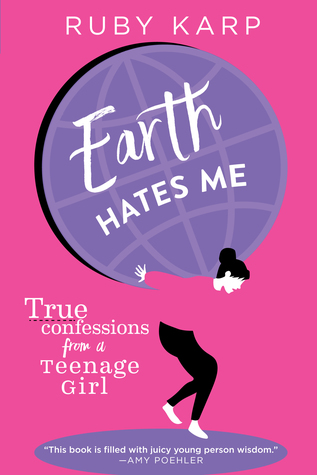
Earth Hates Me: True Confessions From a Teenage Girl by Ruby Karp
     Ruby Karp is a sixteen-year-old is a comedian, performing at the UCB Theater in New York, an author, writing for Hello Giggles, and a high school student. Earth Hates Me is her first book. It is a combination of memoir and self-help book for teen girls. Ruby has a great sense of humor and this book reflects it.
Ruby advises her peers on the importance of feminism ("not just the Spice Girls version"), how to deal with jealousy and friend break-ups, family life, and much more. The book takes an in-depth look at the effect of social media on modern teens and the growing pressures of choosing the right college and career. Amy Poehler says, "This book is filled with juicy young person wisdom."  With Ruby's powerful underlying message "we are more than just a bunch of dumb teenagers obsessed with our phones," Earth Hates Me is the definitive guide to being a teen in the modern age (GoodReads).
     Even though I am not a teenager, I enjoyed this book immensely. Karp speaks authentically to teenagers and her humor helps the advice she offers to not come across with a heavy-hand or a preachy-voice. I hope that all high school librarians reading this post add this book to their next book order!
     (Running Press eBook, 2017, checked out from Overdrive)

How Dare the Sun Rise: Memoirs of a War Child by Sandra Uwiringiyimana
     When Sandra was ten-years-old she had a gun held to her head when the refugee camp where she and her family lived was invaded by local terrorists. These men had already killed her younger sister and wounded her mother. Somehow she escaped and was reunited with remnants of her family. Eventually Sandra and her family were granted visas to move to the Untied States as war refugees. Once here she met with new types of problems--- poverty, racism, language, and lack of community. The death of her sister haunted Sandra, also, and she wanted to do something to help refugees around the world and especially in her beloved home country of The Democratic Republic of Congo. With the help from her college and her church Sandra found her voice and became a potent advocate for refugees, even making presentations for the U.N. and the PressCorps where she met Michelle Obama.
     This book is quite different than the other two I highlighted above. It is very inspiring, but also tremendously depressing to read about all the hate in the world and to learn about how it affects children. But I do encourage folks to read it, if for no other reason that to find how one person can make a difference if that person is willing to speak out!
     (Katherine Tegen Books eBook, 2017, checked out from Overdrive)

I am not sure if any of these titles will pass out of Round 1 judging for the Cybils Award but I do encourage you to read all of them. It warms my heart to read three wonderful and empowering books written about girls, by girls.


Thursday, November 30, 2017

Review: Uprooted: The Japanese-American Experience During World War II

Last year marked the 75th year since the bombing of Pearl Harbor which catapulted America into the Second World War. Our efforts in that war were marked by bravery and sacrifice both in the Pacific theater and in Europe. However, at home less than honorable things were happening. The government, by order of President Roosevelt, rounded up over 100,000 Japanese-Americans and essentially imprisoned them in internment camps, not too far from what the Germans did with their prisoners who were place in concentration camps.

The year was 1941. The Japanese had just attacked Pearl Harbor and killed over 2400 people, while sinking or damaging a good portion of the Pacific fleet. People at home were understandably angry and scared. With pressure from others, Roosevelt signed Executive Order 9066 to evacuate and detain persons of Japanese descent living on the West Coast of the United States. Japanese-Americans, many of them who were born in the USA, were given very little notice to vacate their homes, were moved into holding facilities, and finally relocated to quickly erected camps in various locations around the country. Behind barbed wire and guarded day and night, Japanese-Americans were treated like they were the ones who attacked Pearl Harbor, like the U.S.A. was at war with them. To make this all the more galling, no similar camps were set up to imprison German or Italian-Americans even though we were clearly at war with them, too.

In Uprooted: The Japanese-American Experience During World War II author Albert Marrin takes a close look at the racism in America that led to the internment of its citizens and back-fills the events with historical events that led to that fateful decision. He also allows to reader to get up close and personal with life within the internment camps and introduces us to many of the prisoners in a personal way.

Even though I was on vacation in China I was determined to keep up with my readings for Cybils judging. As we traveled from Beijing to Xi'an via a bullet train, I settled in with my Kindle to read Uprooted. I expected to only learn a few things about Japanese history and then onto the American story, but I was surprised to find myself reading about Chinese history in the opening chapters of the book. Apparently Japanese history is very tangled up with its neighbor to the west, China. As I was rocketing past the Chinese landscape at 300 km/hr I learned about how WWII started in China in 1931 when Japan invaded Manchuria in Northeast China and eventually drove further south and west attempting to capture the whole country and all its resources.  This long involvement in China is what ultimately led to Japan invading us at Pearl Harbor. Their commanders thought that involving the USA in a war would allow them to get the fuel they needed to prevail in China! How fascinating to be reading about this while I was in China! When I mentioned some of what I had learned to our guide the next day, he was quite impressed that I was so interested in their history.

Though we weren't at war with China, many Chinese-Americans felt the racism directed at them after Pearl Harbor, too. It really was not our best moment as a country and our ugly racism surely showed itself for what it was.  After the war ended, those who were interned were just released. No reparations were made for the businesses and homes they lost during the internment years. Many had to return to communities where they were met with the continual ugliness of racism. Not until 1988 did the government officially apologize to the 100,000 Japanese-Americans who were treated so unfairly. They also received a small monetary compensation of $20,000 each, which barely touches all they lost.

I cannot begin to tell you how much I like this book. It is superbly written and researched. The photos added to an understanding of how much devastation was done to a race of people even though they were American citizens. I highly recommend it to all readers, not just to the target young adult audience. May this book serve as a reminder that we will never again do such a dreadful thing to our own citizens.


Tuesday, November 28, 2017

The Book That Made Me: a Collection of 32 Personal Stories

The Book That Made Me: a Collection of 32 Personal Stories edited by Judith Ridge is my kind of book. So when I saw it on the list of nominated titles for the Cybils, I jumped at the chance to read it.

32 authors and illustrators each wrote an essay for this collection highlighting a book, or several books, that came along sometime during their formative years and really spoke to them or changed things for them, possibly starting them on the path that led to writing.  The power of the written word--- it never ceases to amaze me how it changes lives!

Below are a few of my highlights from a book fulling of reading/bookish highlights...

Randa Abdel-Fattah was born in Australia but is of Muslim-Palestinian Egyptian heritage. As a young girl she loved books but always found herself reading books about girls who looked nothing like herself. "And then I read Melina Marchetta's Looking for Alibrandi...I read it in one sitting. And then I read it again. And again. Something inside me changed." For first time in her life she found a character who didn't "fetishize" a migrant's upbringing. She identified with the character's world and challenges. "I couldn't believe that I'd opened a young adult book that spoke to my life. It was wildly empowering and gratifying."
There are books you read that make you hold your breath. It's only when you get to the end that you realize you need to come up for air. In fact, the origins of the word inspiration stem from the act of inhaling. There is something sensuous and visceral in the experience of being inspired. It felt it with Looking for Alibrandi (7).
Mandy Hager is a young adult New Zealand author who found her voice for activism when she read Nineteen Eight- Four by Orwell.
One of the characters in  Nineteen Eight- Four says: 'Until they become conscious they will never rebel, and until they have rebelled they cannot become conscious.' I say, rebel and be conscious! Let's all have a damn good stab at proving him wrong and making sure his dystopia can be forgotten as we work to build a utopia instead! (35)
Bernard Beckett is a drama teacher and playwright from New Zealand. One day when he was in the car with his preschool-aged twin sons he popped an audiobook into the CD-player of George's Marvelous Medicine by Roald Dahl, read by June Whitefield. The audiobook delighted his sons and they giggled away in the back seat. "And that moment reminded me of something that I, as a writer, should never have needed reminding of. That storytelling in its purest form---some words, a voice---is compelling in a way that no other medium can be" (55).
Who was it who said that 'literature in the only art form in which the audience provided the score'? I don't remember, and Google is being unhelpful. Never mind, the point is an important one. When we read a story, or indeed listen to one, the only way to comprehend it is to fully engage with it. The words must become alive in our heads... We own the story because we are, to such a large extent, creating it (56).
Ambelin Kwaymullina is a native Aboriginal person from Australia. She believes in the power of storytelling to pass on important information and traditions.
I want everyone who will come after me to inherit an earth bursting with diversity...and I know that the future is a story to which we all contribute. So look. Look ahead. Dreams matter. Every story matters, and we all have the power to influence the future (67-8).
Jared Thomas is a Nukunu person from Australia and a playwright. He identified The Power of One by Bryce Courtney as a book which helped him see racism for what it is and helped him on his professional path as a writer hoping to highlight injustices around the world. I honed in on this example because I, too, was deeply touched by The Power of One.

Shaun Tan is an artist, writer, and filmmaker. His drawings are distributed throughout this book. Each illustration captures one of the aspect of why he loves books so much. Below is just one of those as an example.


This book, which was first published in Australia in 2016 is a treasure, for sure. One criticism is that none of the highlighted authors are from North America. Though each of the 32 highlighted authors have important messages about the power of books to change lives, I wonder, as a librarian in the USA, how my students will relate to it, if they aren't familiar with the authors themselves.


Saturday, November 18, 2017

The March Against Fear by Ann Bausum, a review and a call to action

My nonfiction reading for the Cybils Award is progressing nicely. So far I have read 35 of the 64 books nominated. There are so many good books on a variety of topics. I am just blown away by the quality of writing and the topics which are covered. Today I want to talk about one of those books which has percolated toward the top of the list for me due to strong writing and the coverage of the topic.

The March Against Fear: The Last Great Walk of the Civil Rights Movement and the Emergence of Black Power by Ann Bausum.

The year was 1966. The setting was Mississippi. In the beginning the march started out as a walk. James Meredith, the black student who integrated Ole' Miss University a few years earlier, decided he wanted to walk from the Tennessee border to Jackson, Mississippi in support of voter registration and to prove that he was not afraid. But by the end of the second day things turned around after Meredith was shot at point-blank range by a man with a shot gun. He survived but had to spend a long time in the hospital and recuperating afterwards. When members of the Big 5 of the Civil Rights Movement found out about Meredith's situation, they picked up the goal and turned it into a march.

Often called the March Against Fear, King, Carmichael, and many others started toward Jackson, stopping off to register black folks to vote in the towns along the way. The march took over 20 days and the marchers met lots of opposition along the way. In Greenwood, Carmichael was arrested for attempting to set up the tent where the marchers slept. When he was released, he spoke to the assembled crowd about the need for black power. His words became a chant. With these words the Civil Rights Movement seemed to turn, from nonviolence to something else. Suddenly supportive whites from the North turned their backs on the movement.

Thus this march was historic on many sides: it was the longest and most expensive march of the movement; it was the first time that revolutionary words of Black Power were spoken; and the movement never again held a march of any magnitude. In a lot of ways people want to forget it.  There was no happy ending to it, like Selma or the March on Washington.

A year after the march Martin Luther King, Jr. wrote, "It is necessary to understand that Black Power is a cry of disappointment. For 12 years I, and others like me, had held out radiant promises of progress. I had preached to them about my dream...I had urged them to have faith in America and white society. Their hopes had soared...They were now hostile because they were watching the dream that they had so readily accepted turn into a frustrating nightmare" (Bausum).

I read this book with my mouth agape. I had never heard of this event from the Civil Rights Movement and how things dissolved from here out. I know from my history lessons how things continued to degrade to the point of the race riots of 1968 and beyond. In fact, today we are still seeing the ugliness of racism in our country with the resurgence of the white supremacists movement and the negative reaction to the slogan "Black Lives Matter." It makes me feel sick.

I am so grateful for authors like Ann Bausum who continue to write about events from our past so that we can hold them up to examine and, hopefully, make some needed changes. After the election of 2016 when Trump was elected and the events that have followed it is very obvious that we cannot ever take out eyes off the prize. We must all hold voting as dear and not abdicate our responsibility to vote and allow others to do so, too.

I don't think this will be everyone's favorite book, but it is good to read books to educate ourselves and to make us squirm. Maybe that will cause us to get up out of our chairs and do something to better mankind! Read it! And, I want to point out if you are a teacher, Ann Bausum has a whole lot of resources on her webpage that you can use with your classes on this topic. Check it out.


Thursday, November 9, 2017

The Whydah: A Pirate Ship Feared, Wrecked, and Found


I am having so much fun a a Cybils Award, Round 1 judge. I have read over twenty books so far in this capacity and have learned so much along the way.

This book, The Whydah: A Pirate Ship Feared, Wrecked, and Found by Martin Sandler is one that provided me with tons of new knowledge. This book, aimed at young teens, is enlightening on many levels.

During the years of 1650 to 1730 piracy was a big problem on the seas. Everything of any weight or volume had to be transported by water which included gold and gems. It didn't take long before unscrupulous men realized that there was a treasure to be got with fairly easy pickings.  We think of pirates taking their treasures and burying them on some island in the Caribbean, thanks to books and movies we read/watched in childhood. And because of these we also have an idealized idea about pirates as handsome and daring or as a drunk with a parrot. This book about the Whydah sets the record straight.

The Whydah was a slaving ship which would travel on the Trading Triangle (West Africa, Caribbean, England) in the early 1700s. After it had disgorged its despicable cargo of human beings in the Caribbean, and was loaded with money and goods it was commandeered by Black Sam Bellamy. Bellamy was the greediest pirate who ever sailed the open seas. He not only took treasures but encouraged crew members from the ships he commandeered to join him and would often take the ships themselves, always looking for bigger, faster vessels.

In 1717 loaded down with treasure the Whydah and the other ships in its flotilla were heading up the Eastern Seaboard toward Maine when they got caught in a Nor'Easter off Cape Cod. The Whydah sunk and Bellamy drowned. For almost three hundred years people have been looking for the wreck, knowing it was laden with treasures. Then in 1984 some marine archaeologists found it and have been bringing up items from the Whydah ever since then...enough to fill a whole museum. Along with the items they have been discovering aspects of piracy unknown to historians until now. It is fascinating what they have discovered from the wreckage.

This book is a treasure in its self. It is perfect for the young teen boy or girl who likes to read about real life adventures or who is obsessed with pirates. But it is also fascinating for anyone, adults included, who likes to read to find out new information about topics which they thought they already knew plenty.

Since I read The Whydah as part of my quest to discover an award book, I should spend a minute talking about the author. Martin Sandler is an award-winning author for a YA history series, he has been nominated for a Pulitzer Prize twice, and has won five Emmy awards for his writings for television. This guy can write! As I was reading The Whydah: A Pirate Ship Feared, Wrecked, and Found I turned to my husband and exclaimed, "Finally, a well-written YA nonfiction books. Just what I've been looking for."

So I guess you can tell that I like this one and highly recommend it for you and your family.  And if you live in or are traveling in Massachusetts, stop at the Whydah Pirate Museum in Cape Cod and see for yourself the treasures from the Whydah, the only pirate wreck ever found and recovered. I know I will visit it myself if I am ever in that part of the country.


Wednesday, November 8, 2017

Isaac Newton is one of the most important scientists that ever lived. His ability to think outside the box of the traditional thinking of his day led to what is now called the Age of Reason. His laws gave order to the universe, explained by mathematical formulas that he unlocked. Isaac's laws would one day make it possible for us to predict the path of satellites and how much rocket power it would take to get to the moon. He correctly predicted that the force of gravity would diminish as an object got further from Earth. His laws have laid the framework for the physics of today. But before Isaac Newton put his thoughts down in a remarkable book named Mathematical Principles of Natural Philosophy, he was just a kid who enjoyed nothing more than thinking deep thoughts and recording them in big or little notebooks. A lot of his scribbling had nothing to do with science but a lot to do with alchemy.

As a boy Isaac Newton was sent to live with another family and the father of that household was an apothecary who allowed Issac to read his books and to assist with his experiments. Surprisingly, the man we think of as a father of science was actually more interested in magic in the beginning. As he grew into an introverted young man, eventually ending up at Trinity College in Cambridge, he read more and more about alchemy and he even started his own forge and conducted experiments hoping to discover the secrets which would allow him to make gold from lead and to discover the philosopher's stone. It is shocking that he lived to a ripe old age of 84 before he died since many of his experiments involved mercury, which we know today is highly poisonous.

Isaac the Alchemist: Secrets of Isaac Newton, Reveal'd by Mary Losure is more about alchemy than about science. It is about Isaac Newton as he develops into the famous man who brought order to our thinking about the universe. It is about the deep thinker who wrote things down in shorthand so that years later his scribblings could be discovered for what they were---often they were not fantastic formulas but just lists of sins he wanted to get off his chest.

This book, written for young teens, is a perfect introduction to Isaac Newton. It is filled with illustrations found in old books available during Newton's lifetime (1643-1727) and it shows pages from Newton's own notebooks, though the marks' meanings are not identifiable. The paragraphs are short, as are the chapters and it is very readable. We learn about Isaac's odd education and come to understand that the way he isolated himself from others allowed him to sit and think about the universe. It was during one year when the bubonic plague caused his school, Cambridge, to close down, that Newton sat at home and pondered mathematics coming up finally with what he called fluxion, but we know today as calculus. That year, 1666, is now called the Year of Wonders, because that was when Newton discovered so many things: optics (prisms), gravitation, calculus, and motion.

John Maynard Keynes, who was a famous economist, bought some of Newton's papers in 1936 and he was surprised to learn that many of them had to do with magic, not science. He famously said that Newton was "not the first of the age of reason, but the last of the magicians." If this is true, then Losure contends that
this magician, this last sorcerer---the greatest of all alchemists---was the same man who banished magic from the scientific world. The alchemist is someone [afterall] who transforms one thing into another. And this, Isaac had done (127).
I liked this book so much. The format, the illustrations, the writing all come together to create a book which is very accessible for teen readers but holds great interest for readers of all ages. I recommend it highly.

Saturday, November 4, 2017

My Beatlemania...Part Three

The Fab Four after the Beatles:
The Beatles broke up in April 1970. But the music never stopped for any of the Fab Four. Even after their breakup The Beatles music has never really gone out of fashion and has remained popular. "Let it Be" and "The Long and Winding Road" made it to #1 on the charts even after the break up. (April and June 1970) And "Lucy in the Sky With Diamonds" was re-released in January 1975 and it made it to #1 at that time.

Paul McCartney was the 9th most popular artist of the 1970s and the 45th in the 1980s. His first #1 hit after the break up was "Uncle Albert" in Sept 1971. In June of 1973 his second #1 hit was "My Love", and his third #1 song was with "Band on the Run" in 1974. (He eventually ended up with 5 for the decade) He had three more #1 hits in the 1980s, two as collaborations with Stevie Wonder and Michael Jackson. By the 1990s "critics began to concede that his solo career was stunning in its own right. He was the ex-Beatle who went on to cover the most stylistic ground—from reggae, soul, disco, country, trance, demented techno, bagpipe campfire sing-alongs, and psychedelic swamp-rock freak-outs with his side project The Fireman to full-length symphonies and ballets." As Bob Dylan once said of Macca (Paul's nickname), “His melodies are effortless, that’s what you have to be in awe of … He’s just so damn effortless.” 

Though Paul and John's relationship was strained after the Beatles broke up, Paul would not give up on making contact with John. He would call when he was in New York. But John was often mean or demeaning: "You're all pizza and fairy tales," John spat at him. But Paul's persistence paid off and soon they were back to just hanging out. "It was lovely" said Paul simply.

John Lennon was the 18th most popular artist in the 1970s and surprisingly was the 185th most popular in the 1980s even though he died in December 1980. His first #1 hit came out in Nov. 1974 with "Whatever Gets You Through the Night". Though wildly popular with the peace movement, "Give Peace Chance" and "Imagine" did not reach the coveted #1 spot on the charts. They peaked at #14 and #3 on the US charts. His song "Starting Over" hit #1 right before his death in December of 1980. His song "Woman" hit #2 after his death in 1981.

John was clearly the most angry of The Beatles about the breakup of his beloved band and it took him years to say anything nice about the group or any of his band mates. But after Sean was born and Lennon took over the care taking role as a parent (after 1975), "John reflected back on his time in a softer light. 'When I slagged off the Beatles thing, it was like divorce pangs, and me being me, it was blast this, fuck the past,' he said. 'Why haven't I ever considered the good times instead of moaning about what we had to go through?'" (Partridge) In a rare and honest moment his life and his music can be consolidated down to this statement: "I want people to love me. I want to be loved." Just a few hours before he was murdered, John said, "The thing that the sixties did was show us the possibility and responsibility that we all had. It wasn't the answer. It just gave us a glimpse of the possibility." [Civil rights moved into multicultural awareness. The hippie movement spawned the environmental protection, alternative medicine, and the peace movement. Questioning social norms led to feminism and gay liberation.] (Partridge)


George Harrison was the 45th most popular artist in the 1970s. He had the first #1 of the Fab Four after the break up with "My Sweet Lord" in Dec. 1970. His second #1 song came out in June 1973, "Give Me Love." George's post Beatles album All Things Must Pass is regarded as the best album produced by any of the Fab Four after the split. George expanded his musical talents to become a film producer and a some time composer of movie music. He was a cinephile. "After befriending the Monty Python crew, Harrison created the production company HandMade Films to produce their Christ-figure comedy Monty Python's Life of Brian. Harrison sold his interest in HandMade in 1994, but by then it had already produced some of the most successful and influential works in recent British film history, along with its fair share of turkeys." (Houston Press)

Ringo Starr had a #1 hit with "Photograph" in Nov 1973 and again in Jan 1974 with "You're Sixteen." Ringo, now 77 years old, just published a new album this year, Give More Love. I am listening to one of the catchy tunes from that album right now, "We're On the Road Again." Paul, his old band mate, is playing the bass on this number. These two guys still have it!


This got me thinking of Paul as a bass player. Some say that he is such a talented bass player that even if the Beatles had never made it big, "McCartney would still be deified for his catchy, lyrical bass guitar playing." (Dashow) Here are three of his songs which really highlight his bass playing:
  1. "Come Together" ...the bass line is dominant in this class, popular hit.
  2. "Goodnight Tonight" (1979 with Wings). John said he didn't like anything about this song except McCartney's bass line. This song really shows off Paul's musical versatility.
  3. "Taxman"...lots of times I have trouble hearing the bass line but I can hear it clearly on this song.
All of the x-Beatles members had trouble with drugs and alcohol. John very famously got involved in heroin use with Yoko and then just as famously the two went through withdrawal cold-turkey one three-day period of time in 1970. He spent the first half of the 1970s drunk and high on alcohol and other drugs./ Ringo said that he wasted two decades in a "lost" haze of alcoholism after the Beatles' breakup./ Paul said he started down the road to alcoholism after the Fab Four split up. He admitted that he turned to "the Bevvies" and considered leaving music during those dark days. / George's 1974 tour in the USA was a flop in part because of the mountain of cocaine he was snorting. By the end of the tour his voice was shredded. He never toured alone again, with one exception in 1991. George was not shy in blaming his throat cancer on his tobacco use. All four of the Beatles eventually made their peace with drugs and found their way back to a level of sobriety before their death (John and George) or before they were able to continue making music into their seventh decade (Paul and Ringo.)

On song writing: 
John and Paul could write up a whole new song in a few hours. It would take other artists days or weeks to do the same. They were the most successful and prolific song-writing team of all time.

"In their songwriting, Paul often came up with the tender, sweet lyrics about love, while John moaned about how bad the world was treating him" (Partridge). This ying and yang of song writing worked in the beginning but often caused conflicts near the end of their songwriting partnership. John would complain endlessly that Paul was too pop, too frilly. One critic, who must have agreed with John, ranked Paul's "Good Day, Sunshine" as the worst song every recorded by the Beatles. Why, I wondered to myself when I read that remark, because it is a happy, upbeat song?

The Beatles--- Paul, John, Ringo and George---had something magical together. Some have criticized that Ringo wasn't at the same level as the other three, but actually I disagree. It was the music that they made, all four of them, that we all love so dearly. Perhaps they could have gotten a more talented drummer but then the group and the music wouldn't have been the same.
Musically, [The Beatles] intuitively tuned in to one another, effortlessly getting in synch the moment they began playing. Paul was the best all-around musician, great on the bass, drums, guitar, or piano. George could give any rock'n'roll guitarist a run for his money. John wasn't technically very good, but as he put it, he could make the guitar 'fucking howl and move.' With Ringo on the drums and George [Martin] in the studio, it wasn't a question of if a release would hit number one---just a question of how fast (Partridge).
Many thought the Beatles would never last. They would come and go just like so many musical groups of their day. But when Bob Dylan heard them, he said of the Beatles: "They were doing things nobody was doing. Their chords were outrageous, and their harmonies made it all valid...it was obvious they had staying power." He was right, in spades.

George Martin, the producer of the Beatles music and oft used arranger, visited John once after the breakup. During their conversation John said he'd do over everything he'd recorded as a Beatle, even "Strawberry Fields Forever," which Martin thought was John's best, a masterpiece. "Most of what the Beatles did was rubbish," John said. George Martin said later, about that conversation, "John's vision was always better than the reality. Everything inside him was greater than its expression in the outside world. That was his life." Other musicians wanted to heard. That wasn't enough for John. He wanted to be felt. (Partridge).

And you know what? That is what we do when we listen to the Beatles songs today. We feel. We remember. We sigh. We blush. We do all these things because the Beatles have been playing in the background of our lives since 1962. Their music is our music. We fell in love to their songs. We played house and dress-up as little girls, imagining we were married to one of them. We played their songs loud on the car stereo when we got our drivers licences. We may have had one of their songs sung at our wedding (as my cousin did.)We have followed their careers---we've wept when they died, and cheered when we see them on TV or, if we are really lucky, in person, as the folks in Brooklyn did just last month at a McCartney concert.


Almost all the quotes in this blogpost came from the very excellent book John Lennon: All I Want Is the Truth: A Photographic Biography by Elizabeth Partridge. It won a Printz Honor in 2006. This was a reread for me but I read it as for the first time. I am so obsessed with the Beatles right now I am always looking around for any new crumbs of information not gleaned previously. She does a well-rounded job with the highlights of John's life. from start to finish, and I highly recommend it. John was such a tortured soul. He was so hurt by the death of his mother and the abandonment by his father that it nearly haunted him all his days. But you know what? If he hadn't been tortured internally, he probably never would have been compelled to make such great music and the Beatles would never have been formed.  The phrase "Screwed up people make great art" certainly applies to John Lennon.


Wednesday, November 1, 2017

Bernie Sanders Guide to Political Revolution

High school librarians: Get out your order forms. Add this book, Bernie Sanders Guide to Political Revolution, to your next order. Then think about which of your Social Studies teachers you can talk into reading the book and sharing with his/her classes. This book will be a treasure trove for Civics and Government classes.

Social Studies teachers: demand that your school library get a copy, or more than one, of Bernie Sander's new book. The chapters are organized by topics: the economy, health care, education, the environment, social justice, and immigration. It could be useful tool to assist you as you teach these concepts to your classes. It is written at a very accessible level so that high school students could easily understand the concepts. It utilizes charts and lists that are fun and enlightening.

Public librarians: make sure you put Bernie Sanders Guide to Political Revolution in prominent places around your library so that readers of all ages see it and can grab it easily.

Teens: You are the hope for our world. Bernie Sanders's campaign was proof that your generation wants a change and knows that change has to happen if there will be a world worth fighting for in the future. Demand that your favorite library purchases this book or, better yet, purchase your own copy so that you can mark it up and reread chapters as you need to remind yourself about the concepts he espouses. In addition, at the end of each chapter, Bernie has outlined actions you can take right now. He has listed organizations you might want to look into or actions you can take to make a difference. So, for example, if your "thing" is environmentalism that chapter gives specific actions you can take to make a difference. It is organized in a very cool way to be helpful for you!

Parents: Is it time to start talking to your children about what is happening right now in the USA around politics, the environment, health care, economics? This would be a great tool for you. Buy it and read the book together. I bet you will have some great discussions together.

Adults: Even though this book is being marketed to teens it is very accessible for adults, too. Have you ever listened to discussions about tax cuts and wondered what the big deal is about. This book will answer that question for you. Have you ever thought that raising the minimum wage wasn't a big deal? Read that chapter and see if you have a new understanding. How about health care? Are you completely clear on all the details. I recommend you read this book, too.

Bernie Sanders: Thanks for all you do and for writing this book.  Just one question. Did you do the illustrations, too? I like them. (Oh wait, I see that Jude Buffum did them!)


Tuesday, October 24, 2017

My Beatlemania...Part Two

As promised (You haven't been holding your breath, I hope) here is my second installment or report on the progress of my latent Beatlemania. (In case you missed it, here is the link to the first Beatlemania report.)

Since Sirius Radio introduced a Beatles Channel in May I've been all about the Beatles...again. I say AGAIN because I was all about the Beatles when I was young and then, like almost everyone, I got over their breakup and got on with my life. But I decided that this new Beatlemania brings me back to the original question, "Why, oh why, did the Beatles breakup?" Ultimately, I have decided, that is the question people want an answer to and yet no answer is adequate because, after all, whatever the answer they never got back together.

Several years ago a married couple whom we were good friends with suddenly got a divorce. We were in shock. We didn't know anything was wrong with their marriage, yet they were unwilling to reconcile and that was it. We were  devastated. It was as if we were thrown out at the same time as the divorce. Of course we looked around to blame someone for our loss and decided it was the wife's fault, since she had been unfaithful to her husband. Whoever was guilty, the relationship was over and we never had any chance at a good resolution as far as our friendship was concerned.

I tell this sad little tale just to remind myself that is what happened to most of us when the Beatles broke-up in 1970. None of us saw it coming and we weren't prepared for it. We loved all four of the Beatles but we needed to blame someone so for many people it was either Paul's fault or John's. We let our anger reside on that person and looked around for confirmation of our position. I decided that I needed to read about the Beatles to find our what I could to answer the breakup question once and for all.

The first book I read was The Beatles: the Biography by Bob Spitz. The print edition of the book is nearly 1000 pages yet the audiobook I listened to was only eight discs long. That means I listened to a deeply abridged version of the book. Though I learned quite a bit, especially details of the boys beginnings:  John's abandonment by his parents and his mother's early death; the death of Paul's mother at a young age; Ringo nearly dying several times from diseases we seem to have conquered today; George's seemingly regular life to a loving mother; and the early iterations of their band with several other friends playing other instruments, even though none were particularly musical. I learned a bit about how their summer gigs in Hamburg really laid the framework for the band we know today because of the sheer volume of music they had to put out. They had to play for four to six hours a day. Can you imagine?

When the boys returned to England, George because he was too young,  Paul and Pete (their drummer) because of fighting, followed eventually by John, they played the Liverpool scene and caught the attention of Brian Epstein, who became their manager and was the one who got a recording session organized. And the rest is history.

Here are a few other things I learned as I listened to this biography:
  • None of the boys could read music. John and Paul would write the words to their songs down on a scrap of paper and compose a tune which they would teach to George and Ringo. The producer, George Martin, of the music studio  where they recorded their music was the one who wrote out the music and the orchestration. This blows me away. Such talent and yet no musical training.
  • Brian Epstein was a closeted gay man and would act out on his impulses, which caused him great anguish. He also took tons of prescription pills like amphetamines. Ultimately it was these drugs that killed him on August 27, 1967. His death was probably the beginning of the unraveling of the Beatles since they tried to operate without a manager after his death placing responsibility on Paul's shoulders to keep the Fab Four together. This caused resentment
  • Both John and Ringo married their first wives because of pregnancy (Cindy and Maureen), Paul dated Jane Asher for five years but they broke up due to his infidelities after they had announced their engagement. George asked his first wife, Pattie Boyd, to marry him the first day he met her, on the set of "A Hard Day's Night."
  • Drug use really did play a role in The Beatles demise. They were introduced to pot by Bob Dylan in 1965, LSD by a dentist who had them over for dinner and he "spiked" their dessert with it. cocaine and uppers were common as was alcohol. John and Yoko were smoking heroin around the final year of the Beatles. I have to believe that drugs played a bigger role in the breakup than anyone wants to admit.
  • Song-writing jealousy and competition played as a wedge in the relationships. Lennon, McCartney and Harrison were all composing so many songs that there is no way all of them could find a way onto an album. Lennon-McCartney, the most prolific song writing duo of all time, weren't used to sharing the limelight with Harrison. That caused resentment, obviously. In the beginning Lennon and McCartney would compose their songs face to face, working out with guitars facing each other, later on they would compose a song and then get minimal tweaks from the other.
  • Paul is credited with breaking up the Beatles, but he was really the last to go. Before that Ringo had quit and then come back (during the recording of the White Album); George had walked out and had to calm down before returning; John was now with Yoko Ono who pushed her way into recording sessions, etc., had told the group he wanted a 'divorce' but was talked into staying through the release of the album. When Paul finally threw in the towel over management of the group, he was the very last to want to go. It was just a three-on-one situation at that point and he was odd man out.

The second book I read was Wonderful Tonight by Pattie Boyd. It was a autobiography by the woman who was the muse for the wonderful Harrison hit, "Something" and later two hits by Eric Clapton, "Layla" and "You Look Wonderful Tonight". Since this book wasn't specifically about the Beatles but about a person tangentially related to them I didn't learn that much about the Fab Four but did gain some insights about George Harrison, her husband. One thing that struck me as I read this book---George and all the Beatles were so young when they got started. In 1960, when they officially became the Beatles John was 19, Paul 18, and George 17. Ringo didn't join them until 1962. But when they formed up in the groups that predated the Beatles, John was 16 and Paul was only 15. I say this because when I think about all the immature behavior that is reported in this book, I have to remind myself how young the boys were. No wonder they fell into such a wild lifestyle.  We know about George's interest in Indian music and meditation, for example, but Pattie reports here that he would meditate for days, then emerge and binge on cocaine. It doesn't sound like they had the happiest marriage, for obvious reasons.

My next selection, which I confess I skimmed, was Lennon Remembers: The Full Rolling Stone Interviews of 1970 by Jann Wenner. Less than twelve months after the breakup, Rolling Stone magazine meets with Lennon several times and writes it up in interview format. It was too soon. Lennon was angry and egotistical. He wasn't ready to think of anything outside himself and he spoke with no filter. He pretty much slammed everything and everyone except himself. Did McCartney write any good songs? Well, maybe "Yesterday" was pretty good. That's it. Pete Townsend? Terrible?  Just about everyone involved in music in the 60s? Rubbish.  He had just recorded his first single album and was talking up his song "Mother", which he felt would be his next big hit. It may not have been a huge hit but it revealed Lennon's deep sadness and anger at being abandoned as a child. Yet, I didn't feel any pity for Lennon after reading this book but it did confirme what I was thinking about 'divorce.' Lennon was sad that the Beatles dissolved but he wanted to blame others and not look inward at all. I'd say skip this book unless you want a rude awakening.


Lastly I spent a little time with a graphic biography called The Beatles: All Our Yesterdays. No new ground was plowed here and I am not even sure that all the facts are reported correctly but it was fun to "see" The Beatles according to Jason Quinn's imagination. One thing I did like was the lists of special Beatles stats. For example: at one point in April 1964, they had five songs in the top five slots on the charts.

I still have one book in the wings, Sgt Pepper at Fifty. Enough on The Beatles for one night. Do you have any good books on the Fab Four that you recommend?


Saturday, October 21, 2017

Girl Rising...another nonfiction book review

Several years ago a documentary film was made called "Girl Rising." The producers of the film traveled around the world looking for girls who were eager for education but unable to go to school for a variety of reasons, usually economic. They eventually told the inspiring story of nine of these girls. Tanya Lee Stone, a nonfiction author watched the film with growing excitement. "I had a sense of the enormity of the topic." As she thought about this, she said her "book brain" clicked in. She wondered how many girls the producers interviewed before narrowing down to nine. She started thinking of ways to explain the obstacles to education and to highlight more stories untold my the documentary. With permission from the producers, Stone used their resources, added some of her own research, and wrote this nonfiction narrative inspired by the film.

Girl Rising: Changing the World One Girl at a Time is divided into three parts: the stakes, the stories, and the solutions.

The stakes: In many impoverished families worldwide girls are not sent to school. If there is a little extra money, families are much more likely to send sons for an education. But if a girl is educated:
  • with seven years of schooling, she is likely to delay marriage by four years, and will have 2.2 fewer children.
  • and delays child-bearing until after age 19, her babies are more likely to survive.
  • she is much less likely to be forced into an early marriage. Girls, aged 10-14 and married, are five times more likely to die in childbirth compared to women in their twenties.
  • she has increased earning potential. For every extra year of primary school her earning potential goes up 10-20%.
  • she will make sure that her own children are educated.
"The act of educating girls is the single most powerful tool societies have to make the world a safer, healthier, and more functional place."

The stories: Every girl has a story. Yet often they are not valued as much as boys and not offered the same opportunities as their brothers. There are also lots of obstacles which keep girls out of the classroom: modern day slavery where girls are sold into servitude by their parents, sometimes at very young ages; early marriage; limited access to required fees due to poverty. Over twenty girls have their stories told in this book. All of them have had some sort of assistance to help them get to school.

The solutions: What can we, just regular people, do to help? This is a very short section of the book but contains several powerful examples of solutions a few people have found to help. And there are success stories, too. Girls who have been educated, giving back to their communities as nurses, teachers, radio programmers. The book is inspiring and a call to action.

When I retired last June everyone asked me what I planned to do with my time and I didn't know. I knew what I didn't want to do, but I didn't know what I did want to do. I got very excited about this idea proposed in the solution section of this book. Is there something I can do to help make sure that girls around the world have the opportunities they deserve to be educated? The idea is taking hold and I am ready to start my own research process to discover how I can get involved. I want to start by looking into the UN's program, GirlUp; Room To ReadLet Girls Learn, an Obama initiative; and, of course, Girl Rising. Maybe I have found my new vocation. We'll see.

All quotes from----Girl Rising: Changing the World One Girl at a Time by Tanya Lee Stone. Wendy Lamb Books, New York. Print.

My rating: 5 stars


Sunday, October 15, 2017

Alexander Hamilton, compare and contrast reviews

This past week my daughter, who lives in New York, finally got to see the Broadway musical: Hamilton. She has entered the daily lottery for tickets since her arrival in the NYC last year and finally won the chance to buy two tickets. She and her roommate readjusted their schedules, headed into the city to see the show and loved it. This musical has done more for an interest in US history than just about anything before this time. Alexander Hamilton, the face on the 10 dollar bill, now has come alive in our minds and imaginations. Suddenly we are interested in what happened during those founding days of our country. We knew a little bit about George Washington, Thomas Jefferson, and Benjamin Franklin, but not much else. Now we know a whole lot more...or at least those people lucky enough to see the musical know a whole lot more. A person who played a big role in those opening years of our country was Alexander Hamilton. In fact, without this man and his prolific writings we might not even have a country, or a country as we know it today.

While Carly and Jennifer were enjoying the musical, I was home in Washington State reading two different books about Alexander Hamilton. It was just a weird coincidence that we were doing something related to Hamilton at the same time. (Something tells me that Carly had more fun than me, though.) The two books I read were Alexander Hamilton: The Hero Who Helped Shape America by Teri Kanefield and Alexander Hamilton: Revolutionary by Martha Brockenbrough. Both books have been nominated for a possible Cybils award in the JH/SH Nonfiction category for which I am a judge. Since I read two books one right after the other they are a little muddled in my brain. Therefore I thought I'd do one of those school-y activities: a compare/contrast of the two books.


 Compare (Similarities):
  • Both books did a nice job outlining details of Hamilton's early life on St. Kitts/Nevis in the Caribbean. He and his younger brother were illegitimate, which was a much bigger deal in those days compared to today. His mother and father were not married. His father abandoned them and when his mother died, the boys were left on their own. Hamilton distinguished himself working in the office of one of the island's sugar traders. His first published work was an article about a hurricane which devastated the island.  Because of this and his strong work-ethic, Hamilton was offered a scholarship to go to school in New York. Hamilton was always concerned/self-conscious about his lowly beginnings.
  • Each author did a nice job making readers familiar with the time line of Hamilton's life and accomplishments from his early days in school where he finished his program in two years which would normally take a person four years; as a personal assistant to General George Washington during the Revolutionary War; as a prolific interpreter of the US Constitution, writing more than 50 essays compiled today in a document known as The Federalist Papers; his role as the first Secretary of the Treasury; and as a family man and well-regarded lawyer in New York.
  • Both told us about the duel with Aaron Burr which ended Hamilton's life.
  • The Hero Who Helped Shape America and Revolutionary were both very readable and interesting. History was brought to life in these two books.
Contrast:
  • Kanefield's book is marketed to middle grade students, grade 5-8. Brockenbrough's book is targeted at older readers, high school aged students and above.
  • Both books used old illustrations and maps, but Brockenbrough's book had many, many more of them than Kanefield's. I thought that was odd since the latter book is aimed at younger readers so one would think it would use more illustrations than the book designed for older readers.
  • A controversial aspect of Hamilton's life was his affair and attempted cover-up with a Mrs. Reynolds. This problem played a pivotal role in Hamilton's life. Kanefield did not mention it at all in her book for middle school students. Brockenbrough's book was full of it and the consequences that affair had on Hamilton and his reputation. It colored everything up to the end. Can't middle school kids handle this kind of information?
  • Though both books covered the life-ending duel, only in Brockenbrough's book do we learn about why Hamilton would agree to the duel, especially since it was illegal. His motivations to be thought of as an honorable man colored all his decisions.
  • The Hero Who Helped Shape America is 208 pages long; Revolutionary is 372 pages long. Though much longer, the second book has much better end-notes, bibliography, and appendixes on a variety of related topics. These are helpful tools for prospective researchers.
  • Oddly, Brockenbrough's book, Revolutionary, is printed using brown ink. I wonder if the publisher thought that color ink would make readers feel like they were reading an old document. Also, irritatingly, the book did not give attributions to most of the artists of the illustrations. There was a tiny, little note of where most of the illustrations came from, but no particulars of the artists were given, with one or two exceptions. This really irritated me.
  • Kanefield's book about Hamilton wasn't as attractive or as inviting as the other. There were many pages full of text only and the quality of the paper and the illustrations were poor.
Overall: I wouldn't hesitate to recommend either of these books to teen readers. I liked Brockenbrough's book better, but that may be because I tend to think of high school researchers and I think her book is a better research tool. I learned a lot about this famous American from reading these books. Now if I could just score a few tickets to see the musical!

Carly outside the Hamilton theater on Broadway.
Until them I will have to satisfy myself with listening to YouTube videos like this one. Enjoy!