"Outside a dog a book is man's best friend, inside a dog it is too dark to read!" -Groucho Marx========="The person, be it gentleman or lady, who has not pleasure in a good novel, must be intolerably stupid." -Jane Austen========="I don’t believe in the kind of magic in my books. But I do believe something very magical can happen when you read a good book."-JK Rowling========"I spend a lot of time reading." -Bill Gates=========“Ahhh. Bed, book, kitten, sandwich. All one needed in life, really.” -Jacqueline Kelly=========

Friday, March 18, 2022

Review and quotes: RECITATIF


Title:
Recitatif by Toni Morrison

Book Beginnings quote: 

My mother danced all night and Roberta's was sick.

Friday56 quote (actually from page 16):

I was trying to fill the coffeepots and get them all situated on the electric burners when I saw her. 

Summary: Twyla and Roberta have known each other since they were eight when they shared a room at a shelter for four months because their mothers couldn't care for them. Later in life they meet by chance three times, each time on opposite sides of every problem. One girl is black, the other white, but which is which?

Review: Recitatif is Toni Morrison's only published short story. She wrote it as "an experiment in the removal of all racial codes from a narrative about two characters of different races for whom racial identity is crucial." The story is written from Twyla's perspective and as a reader I found myself quite sure that I knew which race each girl was until a new set of facts were presented, then I'd change my mind. Morrison never divulged which girl was which race.

In the introduction by Zadie Smith, which was as long or longer than the actual story, she too grapples with the which is which question concluding with, "Recitatif reminds me that it is not essentially black or white to be poor, oppressed, lesser than, exploited, ignored." As I am learning every single day as my eyes are being opened to more and more racial exploitation in this country, race is a social construct. If one assigns attributes to one race (lazy/hard-working; undeserving/deserving, thuggish/law-abidding) it doesn't make those attributes true in all or even many cases. By removing these attributes from the story one has to conclude that people are just people.

The title of this short story had me a bit confused, but Zadie Smith helped clear up my confusion. The word 'recitatif' has two meanings: One is the spoken part of an opera, or words sung on the same note. Two is the tone or rhythm of a spoken language. In Recitatif Morrison had to play with language so that each spoken word was placed exactly on the line between white and black vernacular. Every word had to be spoken on one note since often our racial clues are learned through language. Though not a favorite short story by any means, I am grateful it was written and it certainly has provided some new and interesting ideas and food for thought.

Book Beginnings on Friday is hosted by Rose City Reader. Share the opening quote from current book.
Th
e Friday56 is hosted at Freda's Voice.  Find a quote from page 56 to share. 

Visit these two websites to participate. Click on links to read quotes from books other people are reading. It is a great way to make blog friends and to get suggestions for new reading material.  


-Anne

Tuesday, March 15, 2022

Classics Club Spin


Classics Club Spin is here again!

What is the spin and how you can participate:

It’s easy. Before next Sunday 20th March, 2022, create a post that lists twenty books of your choice that remain “to be read” on your Classics Club list, or classic books you still want to read.

This is your Spin List.

You will have to read one of these twenty books by the end of the spin period.

When making your list try to challenge yourself. For example, you could list five Classics Club books you have been putting off, five you can’t WAIT to read, five you are neutral about, and five free choice (favourite author, re-reads, ancients, non-fiction, books in translation — whatever you choose.)

On Sunday 20th, March, The CC team will post a number from 1 through 20. The challenge is to read whatever book falls under that number on your Spin List by the 30th April, 2022. That’s a six week reading window for this spin. You may like to stack your list with books that you know are do-able for you within that time frame.

What’s Next?

  • Pick twenty books classic books you want to read.
  • Post that list, numbered 1-20, before Sunday, 20th March on your blog or other social media accounts.
  • The CC Team will announce a number from 1-20. And I will repost that number here.
  • Read that book by 30th April, 2022.

This is meant to be a fun, social way to read another book from your classics club list. It is very relaxed about how you set it up, they simply want you to read more classics!

My Classics Spin List (I've decided to be a bit more general this time, selecting authors mostly rather than that many specific titles)

  1.  One Flew Over the Cuckoo’s Nest by Kesey 
  2.  Something by Faulkner 
  3.  Something by Anne Bronte 
  4.  Grapes of Wrath by Steinbeck 
  5. Something by George Elliot 
  6. Something by Shakespeare 
  7. Something by Virginia Woolf 
  8. Something by DuMaurier 
  9. Something by Elizabeth Gaskill 
  10. Something by Pym 
  11. The Secret Garden by Burnett 
  12. Something on my Pulitzer Prize list 
  13. Frankenstein by Shelley 
  14. Something by Christie 
  15. Something by Bradbury 
  16. Something by Steinbeck 
  17. Something by Wodehouse 
  18. Something on my Pulitzer Prize list 
  19. Something on my Pulitzer Prize list 
  20. The Adventures of Sherlock Holmes by Sir Arthur Conan Doyle -Anne 

The winning number is 11. The Secret Garden it is.


Monday, March 14, 2022

TTT: My Spring Reading List


Books on my spring reading list. 
(Below the fold, check out how I did on my winter reading list.)
 
Book Club Selections:
  1. The Pioneers by David McCullough (April, Group #1)
  2. The House on the Cerulean Sea by TJ Klune (April, Group #2)
  3. So You Want to Talk About Race? by Ijeoma Oluo (May, Group #1)
  4. Maid by Stephanie Land (June, Group #1)
  5. TBA (June, Group #2)

Books I've recently placed on hold at the library:

  1.  The Woman They Could Not Silence by Kate Moore
  2.  The Heart's Invisible Furies by John Boyne
  3.  Unthinkable by Jamie Raskin
  4.  The Owl and Other Fantasies by Mary Oliver
  5. 100 Poems to Break Your Heart by Edward Hirsch, editor
  6. O's Little Book of Happiness edited by the Oprah Magazine
  7. Bright Wings: An Illustrated Anthology of Poems About Birds
Challenge books:
  1. Past Pulitzer Prize winner: 
  2. 2022 Printz Award/ Honor book:
  3. Classics club selection:  (From this list)
  4. Narniathon (books in the Chronicles of Narnia by C.S. Lewis)
    1. Voyage of the Dawn Treader
    2. The Silver Chair
    3. A Horse and His Boy
    4. The Magician's Nephew


How did I do on my winter reading list?

Book Club Selections: 5/5

  1. The Dutch House by Ann Patchett (a re-read) (January, Group #1) ✔
  2. Olive, Again by Elizabeth Strout (February, Group #1) ✔
  3. Beautiful Country  by Qian Julie Wang (February, Group #2) ✔
  4. The Silent Patient by Alex Michaelides (March, Group #1) ✔
  5. The Lincoln Highway by Amor Towles (March, Group #2)  ✔

Books I've recently placed on hold at the library: 5/7

  1. Under a White Sky by Elizabeth Kolbert ✔
  2. Crying in the H Mart by Michelle Zauner  ✔
  3. The Story of More by Hope Jahren ✔
  4. Harlem Shuffle by Colson Whitehead ✔
  5. The Woman They Could Not Silence by Kate Moore (Audiobook currently checked out)
  6. Peril by Bob Woodward
  7. Furiously Happy by Jenny Lawson ✔ but DNF

Challenge Books: 2/6

  1. Past Pulitzer Prize winner: The Grapes of Wrath by Steinbeck
  2. Past Pulitzer Prize winner: The Road by Cormac McCarthy
  3. Past Pulitzer Prize winner: The Orphan Master's Son by Adam Johnson
  4. 2022 Printz Award:The Firekeeper's Daughter ✔
  5. Classics club selection:  Murder on the Orient Express ✔
  6. Classics Club selection: 
Cybils AWARD High School nonfiction: 5/5
  1. Everything You Wanted to Know About Indians But Were Afraid to Ask by Anton Treuer ✔
  2. The Rebellious Life of Mrs. Rosa Parks by Jeanne Theoharis ✔
  3. Punching Bag by Rex Ogle ✔
  4. In the Shadow of the Moon by Amy Cherrix ✔
  5. The Power of Style by Christian Allaire ✔


I had really high goals for myself in terms of my challenge books and didn't get anywhere near accomplishing them. Most of January was dedicated to reading Cybils finalists and book club selections. But other than that I feel fairly good about how many books I did tackle on my winter reading list.

-Anne

Sunday, March 13, 2022

Sunday Salon -- Spring ahead

Ian eating green eggs and ham on Dr. Seuss day at preschool.

Weather:
I've been thinking about the term: Spring ahead. It is part of a phrase that reminds us that we are to set our clocks ahead to daylight savings time this weekend. But what if it really means Spring is ahead? I like that thought. I'd say that is what is going on. Spring is ahead around here. The weather is starting to be quite springish, as a matter of fact: cool mornings, often with fog, followed by sunny/rainy days. Our yard is coming to life with early bulbs blooming and the flowering plum trees, that line the sidewalks in our neighborhood, are just about ready to burst out in bloom.

In a bit of a funk: I'm not really in a human funk, just a reading/blogging funk. I can't make myself do either very reliably these days. My last Sunday Salon was two weeks ago and I've only blogged four times since then. On the reading front, I was working away on a pile of books for several weeks. Oddly I didn't really want to read any of them but I slogged along and now that I've finished (or decided to not-finish) that pile I am just meandering along in the third book of the Narnia series, The Voyage of the Dawn Treader, for the Narniathon March book.  I had a big "talk" with myself about what happens when I select books not on my TBR and then wonder why I don't enjoy them. Sigh. 

What I have read the past few weeks (Okay, I admit, it looks like I've read a lot of books😕)

  •  Footnotes from the Greatest Bookstores by Bob Eckstein. Illustrated with short, funny stories about the stores and its patrons. Print.
  • Measuring Up by Lilly LaMotte. The 2022 Cybils winner for MG Graphic Novels, about a young Taiwanese girl whose family has moved to the US. She wants to help raise money to bring her grandma over for a visit. She does it by entering a cooking contest. Print.
  • The City of Mists: Stories by Carlos Ruiz Zafon. A short story collection published after the author's death in 2020. Print.  I didn't finish this one.
  • A Psalm for the Wild-Built by Becky Chambers. A novella about a future time when robots and humans do not co-habitat and yet... Print.
  • The Book of Form and Emptiness by Ruth Ozeki. An odd book partially narrated by a book itself. A long book at 548 pages. Audio. I did love this one.
  • Recitatif: a Story by Toni Morrison. Morrison's only published short story where she attempt, successfully I might add, to remove all racial identifiers so that the reader does not know which girl is black and which is white. Print.

What I've blogged during that same time: 

A Christmas gift from our daughter: On Thursday night Don and I went to the theater, a gift from our daughter. THE THEATER. We love going to shows and it is the first show we've been to since COVID times. We went to see "The Band's Visit", put on by a Broadway touring group, and loved it. It is the story of an Egyptian musical group that goes to Israel to play at an Arab Cultural Center but accidentally takes the bus to the wrong town. (Have a listen on Spotify)

Speaking of our daughter: Carly is all moved into her apartment and starts her new job tomorrow. She has been staying with us while we all worked on getting her settled, pictures hung, new needed items purchased until yesterday when she and her kitties moved over. It has been fun having her back. She and I both love playing board games and we played something every day, usually more than one game.

Dialogues on Race: I am taking a class at church called Dialogues on Race. The class is on Zoom and so far it has been very good. I hope to blog about the insights I am gaining from the book. So stay tuned. Here is a link to the book, if you want to look for it.

Ukraine. Links to articles that give a glimmer of hope:


And on the lighter side:

“There are three stages in scientific discovery. First, people deny that it is true, then they deny that it is important; finally, they credit the wrong person.”  ~ Bill Bryson
 

-Anne

Thursday, March 10, 2022

Review and quotes: THE BOOK OF FORM AND EMPTINESS


Title:
The Book of Form and Emptiness by Ruth Ozeki

Book Beginnings quote: 

So, start with the voices, then. When did he first hear them? When he was still little? Benny was always a small boy and slow to develop, as though his cells were reluctant to multiply and take up space in the world. It seems he pretty much stopped growing when he turned twelve, the same year his father died and mother started putting on weight. The change was subtle, but Benny seemed to shrink as Annabelle grew, as if she were metabolizing her small son's grief along with her own.

Friday56 quote: 

She stared at it dumbfounded. It was a pretty little book, modest, with a pleasing gray cover. The title, printed in clean, simple font, read Tidy Magic: The Ancient Zen Art of Clearing Your Clutter and Revolutionizing Your Life. This was astonishing! She's been thinking how she needed to tidy up, and now this?

Summary: I don't often do this, but I actually love the summary of this book provided by the publisher, so here it is. I'm hoping it is as enticing to you as it was to me.

After the tragic death of his beloved musician father, fourteen-year-old Benny Oh begins to hear voices. The voices belong to the things in his house--a sneaker, a broken Christmas ornament, a piece of wilted lettuce. Although Benny doesn't understand what these things are saying, he can sense their emotional tone; some are pleasant, a gentle hum or coo, but others are snide, angry and full of pain. When his mother, Annabelle, develops a hoarding problem, the voices grow more clamorous.

At first, Benny tries to ignore them, but soon the voices follow him outside the house, onto the street and at school, driving him at last to seek refuge in the silence of a large public library, where objects are well-behaved and know to speak in whispers. There, Benny discovers a strange new world, where "things happen." He falls in love with a mesmerizing street artist with a smug pet ferret, who uses the library as her performance space. He meets a homeless philosopher-poet, who encourages him to ask important questions and find his own voice amongst the many.

And he meets his very own Book--a talking thing--who narrates Benny's life and teaches him to listen to the things that truly matter.

With its blend of sympathetic characters, riveting plot, and vibrant engagement with everything from jazz, to climate change, to our attachment to material possessions, The Book of Form and Emptiness is classic Ruth Ozeki--bold, wise, poignant, playful, humane and heartbreaking.

Review: In a lot of ways The Book of Form and Emptiness reminds me of another book by Ruth Ozeki that I love: A Tale for the Time Being. Both books have at their centers a flawed, but lovable young teenager; both jump around quite a bit between different settings and use different points of view; both have Zen Buddhist nuns involved in a bit of the wisdom dispensed throughout the story. And both involve a book, in this one, the book, Benny's Book, talks to him and plays the role on narrator on occasion. Here is an example of the book talking to Benny:

“Every person is trapped in their own particular bubble of delusion, and it's every person's task in life to break free. Books can help. We can make the past into the present, take you back in time and help you remember. We can show you things, shift your realities and widen your world, but the work of waking up is up to you.”

There are lots of characters but the principals are Benny and his mother, Annabelle. After Kenji, the father, dies, Benny starts hearing voices. His mother, wrapped up in her own troubles and her own terrible past, has a hard time being present to help him. But every once in a while she does make strong attempts. This quote reminded me how often schools fail students who are really struggling and then they make the student more of a victim than they were before:

“The point is that my son has a mental disability, Principal Slater, and you people know this, and if he’s skipping school it’s because the school is failing to meet his needs. So let’s talk about that, okay? Let’s talk about that.”

The Zen nun who writes a helpful little book called Tidy Magic: The Ancient Art of Clearing Your Clutter and Revolutionizing Your Life dispenses wisdom within the little, popular book and in chapters of her own. This little exchange with her master really got me thinking about all the junk I have lying around my house and about how stuff can really weigh you down (figuratively speaking.) Consumerism is a big theme in The Book of Form and Emptiness.

“But Hojo-san! The teacup isn’t broken!” He looked up, surprised. “To me, it is,” he said. “It is the nature of a teacup to be broken. That is why it is so beautiful now, and why I appreciate it when I can still drink from it.” He looked at it fondly, took a last sip, and then placed the empty cup carefully back on the tray. “When it is gone, it is gone.” That day, my teacher gave me a priceless lesson in the impermanence of form, and the empty nature of all things.”

This thought about stuff and things is emphasized by Benny since he can hear things talking:

“Things are needy. They take up space. They want attention, and they will drive you mad if you let them.” 

People all have their own stories: The Aleph, a beautiful but troubled girl, who leaves little messages in books for Benny to find; the homeless man who is confined to a wheelchair and hangs out at the public library. On the surface he seems sinister but underneath, he is a poet and very wise and friendly. He helps Benny cope with the reality of the voices in his head and understands the value of 'story':

“God is a story,” he said. “I believe in stories, and God knows this. Stories are real, my boy. They matter. If you lose your belief in your story, you vill lose yourself.”

I'm guessing that The Book of Form and Emptiness is going to be one of those books which will take up residence in my head. One I will think back on quite often. 

Book Beginnings on Friday is hosted by Rose City Reader. Share the opening quote from current book.
Th
e Friday56 is hosted at Freda's Voice.  Find a quote from page 56 to share. 

Visit these two websites to participate. Click on links to read quotes from books other people are reading. It is a great way to make blog friends and to get suggestions for new reading material.  

-Anne

Monday, March 7, 2022

Short books. Short reviews.

Right now I am sitting next to a tall pile of shortish books that I've recently checked-out/half-read/read/avoided reading.Today I decided to touch each of the books and say thank you. Then I will not worry about finishing those unfinished among them and will return them to the library with a clear conscience. Those that I did finish will get a short review and I'll breathe a sigh of relief that I am free from the current spell they have me under.

Measuring Up by Lily LaMotte, illustrated by Ann Xu. This graphic novel won the 2022 Cybils Award for MG Graphic Novels. It is the story of Cici, a twelve-year-old girl whose parents have moved with her from Taiwan. Before leaving for America Cici's happiest moments are those spent with her A-ma (Grandmother). A-ma taught Cici to cook and how to make the most delicious food to eat. When she moved to America Cici desperately wanted to fit in at school but she also dearly wanted to have her A-ma visit them from Taiwan. She decided to try to raise the money for her A-ma's trip by entering a cooking competition. She has to channel her inner talents gained from cooking with her A-ma but also melding in ideas gained by reading Julia Child's cook book along the way. Can she make her own special foods by combining the two? This is a sweet, heart-warming story. (205 pages long.)


The City of Mists: Stories by Carlos Ruiz Zafon. This collection of stories by the master of spooky, atmospheric intrigue jumped into my hands during a recent library trip since I am such a huge fan of his masterpiece, Shadow of the Wind. I didn't know at the time this short collection was published posthumously after the author's death to cancer in 2020. Apparently Ruiz Zafon knew he was dying and was concerned after his death that his works would be sold to Hollywood or would be edited not to his liking, so it was shocking that this, his last, would be published after his death.  The eight stories include some characters from his previous books and definitely had that spooky, sinister vibe one would expect. In fact, several of the stories seem to appear out the mist and the details remained foggy or cloudy causing me to think of the book's title. The last story was my favorite. Perhaps because it was very short -- two pages -- and a bit funny. (162 pages long.)


A Psalm for the Wild Built by Becky Chambers. Sibling Dex decides to stop working as a gardener and goes out on his own as a traveling Tea Monk where he calmly dispenses special concoctions of tea and listens to people as they talk about their lives. He lives in a peaceful, utopian society where mankind has few problems and people are mostly good to each other. But nonetheless Dex grows restless with his life and decides to go out into the wilderness, a part of the planet given over to wild animals and sentient robots at the end of the Factory Age. While on his trip, off the grid, Dex meets a robot named Mosscap and the two beings spend time traveling together. They discuss as they move along "humanity’s role in the natural order of things, the nature of sentience, individuality, purpose, the presence of the divine, and how to help each other" (Wuh-Whack). The heart of this charming novella is their conversations. They made me stop and think about my humanness and the things I do 'just because.' (147 pages long.)


A Spindle Splintered
by Alix Harrow. A modern retelling of the Sleeping Beauty story. But in this story the sleeping beauty, Zin, is dying from a congenital disease called Generalized Roseville Malady which will kill her before she turns 22. On her 21st birthday, a friend hosts a "sleeping beauty" party which involves a spindle. When it is touched Zin is transported to another realm, in a different time continuum where she meets other sleeping beauties. In them she discovers her own mission and can think beyond her own problems. The book makes me smile to think of it. (128 pages long.)


Footnotes from the World's Greatest Bookstores by Bob Eckstein. New Yorker cartoonist Bob Eckstein has gathered the greatest untold stories from a seventy-five of the world s most renowned bookstores (both past and present) and paired them with evocative color illustrations of each shop. Here is a portrait of our lifelong love affair with bookstores that is at once heartfelt, bittersweet, and filled with good cheer. A complete joy to consume. I was buoyed to learn that there are still (or were in 2018) beloved book stores still operating in the world. I currently reside in a bookstore desert. I want to go on a trek to visit all seventy-five of these stores. (144 pages long.)


Change Sings: A Children's Anthem
by Amanda Gorman and Loren Long. A darling poem, a song really, about change coming. I can hear change humming in its loudest, proudest song. / I don't fear change coming, And so I sing along. Darling illustrations, also. (Children's book, 32 pages long.)

-Anne

Monday, February 28, 2022

TTT: Best big books I've read in the past few years


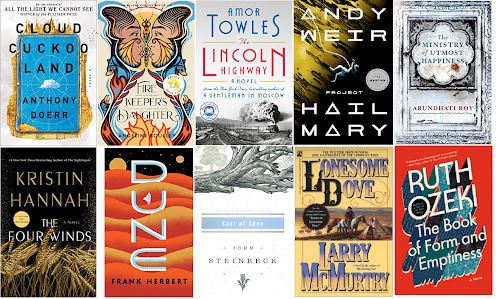
Top Ten Tuesday: Best big books (over 450 pages long) I've read in the past few years 

At the beginning of this month I read an article about February being the perfect month to read a short book or two. I decided that was a great plan. My problem, however, was I was in the middle of several big books, really big books. So as February winds down, today I am honoring big books instead of short books on this off-the-board TTT post.


1. Cloud Cuckoo Land by Anthony Doerr 
626 pages
 
2. The Firekeeper's Daughter by Angeline Boulley
498 pages 
 
3. The Lincoln Highway by Amor Towles
576 pages
 
4.  Project Hail Mary by Andy Weir
476 pages

464 pages

6. The Four Winds by Kristin Hannah
464 pages

7. Dune by Frank Herbert
890 pages

8. East of Eden by John Steinbeck
601 pages

9. Lonesome Dove by Larry McMurtry
960 pages

10. The Book of Form and Emptiness by Ruth Ozeki
548 pages (my current read, 57% complete)

What big books have you read recently that you think are worth the effort?

-Anne

Review: SUPERMAN SMASHES THE KLAN


Superman Smashes the Klan
by Gene Luen Yang and Gurihiru is an award-winning graphic novel about our favorite super hero. But this story is based on a real Superman genesis story.

Back in 1946, when Superman was just a few years into his worldwide introduction, there was a wildly popular 16-part radio series called, "The Adventures of Superman." In the series Superman took down a gang of robed, hooded, white supremacists. The story begins with a Chinese-American family moving into Metropolis when the Clan of the Fiery Cross (a fictional stand-in for the Ku Klux Klan) burns a wooden cross on the family's lawn. Superman comes to the rescue.

Gene Luen Yang, the author and graphic artist himself, is Taiwanese-American and was very excited when he learned about this early Superman radio program and the story's plot. Everyone has heard of the ways that the Ku Klux Klan terrorized African-Americans but few people are aware that a branch of the Klan started up in California in 1865 to thwart Chinese immigration and to terrorize Chinese already living in the state. In 1882 the Chinese Exclusion Act was passed, effectively ending all legal Chinese immigration. Finally in 1941 when Japan attacked Pearl Harbor did US citizens recognize that the Chinese were our allies against Japan. 

Superman was introduced to the world in 1939. During WWII he often faced off against Nazi villains like Der Teufel, and the Scarlet Widow. After the war, he continued his fight against hatred and bigotry, especially that directed at immigrants. This graphic novel, and the radio show it was fashioned after, shows us why. Superman is an immigrant himself, after all.

Why did I call this novel one of Superman's genesis stories? Well, here he is learning about his powers, often denying that he even has powers. He is also finally ready to learn about his past and where he came from. Since I am not a big DC comic person, I found this aspect of the book very genuine and touching: Superman didn't start off wearing a tight spandex suit, flying here and there, He started off walking fast and leaping up on telephone wires to get places fast. He got his idea for a costume from the strong man at the circus and the letter S on his chest didn't stand for "superman" but was a symbol of strength from his own planet.

In 2020, Superman Smashes the Klan won the Harvey Award for outstanding achievement in the comic book industry. In 2021 it won the 2021 YA Graphic Novel Cybils Award.


Even if you don't consider yourself a comic book or a super hero type of person, I still recommend that you take a look at Superman Smashes the Klan. It is a very NOW story with Nazism making a resurgence in 2022. Read it then spread the word so others will, too.

-Anne

Sunday, February 27, 2022

Sunday Salon -- End of February

Pictures from my week: Bingley at my sister's house where he stayed while we were in California; George helping Carly pack her books; view from the window of Carly's apartment on our last night; bottle brush tree flowers in SF; Russian Orthodox Church in SF; Heated hummingbird feeder, a birthday gift from my sister; Fred making himself at home in our house; Jamie snacking on yogurt with doo-dads; Ian and I preparing to blow out my birthday candles.

Birthday week:
This week we celebrated my birthday, first in San Francisco between packing boxes and then again here at home with my family. I feel the love.

Jamie messing around with my swim cap after the birthday party.

Weather:
It has been an odd month weather-wise: We had glorious, warm days great for long dog-walks and attacking the roses which needed to be pruned down ASAP. Then the temperatures plummeted and we were back to freezing temperatures at night and barely above freezing during the day. One morning we woke to one inch of snow covering the yard and flower beds. It still hasn't melted on the shady side of the house. Fortunately the heated hummingbird feeder arrived in time to save the birds from chilling morning food.

California: Last weekend Don and I drove down to San Francisco to help facilitate our daughter's move back to our hometown. We drove the whole way down in one go, thirteen hours, helped her pack for two days, then headed home with her cats in tow, fourteen hours. Carly and her cats are living with us now until her furniture arrives in the next few weeks. We are so happy that she is home and will be close by.

Empire State Building in NYC lit up in colors in support of Ukraine. Getty Images, Gary Hershorn.

Ukraine:
Of course our hearts are broken about the Russian invasion of Ukraine. Everything I've read, which I hope isn't just wishful thinking, is that this unprovoked attack on a sovereign country will probably be the undoing of Putin. Let's hope so. I highly recommend that you watch this video by Sen. Chris Murphy. It is only 3 minutes long and it really helped me feel a bit better about the whole sordid situation:

Supreme Court pick: President Biden on Friday announced his historic pick of federal judge Ketanji Brown Jackson to serve on the Supreme Court, following through on a campaign pledge to nominate the first Black woman to the nation’s highest court in its 223-year history. Yay!

 Books read since my last Sunday Salon on Feb. 6th.:
  • The Firekeeper's Daughter by Angeline Boulley. The 2022 Printz Award winner for best YA novel of the year.  Print.
  • Call Us What We Carry: Poems by Amanda Gorman. The poet who spoke at Biden's Inauguration. This is her first collection of poetry. Most of the poems are about the pandemic racism, and other historic points. Print.
  • Under a White Sky: The Nature of the Future by Elizabeth Kolbert. Another nonfiction book about climate change and our life on earth. Audio.  
  • The Silent Patient by Alex Michaelides. We listened to this mystery on our trip down to California, finishing it just miles out of SF. This is a book club selection. I imagine the gals will like it. Audio.
  • Murder on the Orient Express by Agatha Christie. This is the book we listened to on the homeward bound trip. It is unbelievable even to me but I've never read it before, nor have I seen any of the movies from it. So I fun with the mystery. Audio.
  • Superman Smashed the Klan by Gene Luen Yang and Gurihiri. A graphic novel that captures a moment when Superman was making his introduction to the world and coming into his own power battling the Ku Klux Klan. This won the 2021 Cybils HS Graphic Novel award. Print.
  • A Spindle Splintered by Alix Harrow. A modern retelling of the Sleeping Beauty fairy tale. It makes me smile to think of it. Print.

Currently reading:

  • Measuring Up by Lilly LaMotte. The 2022 Cybils winner for MG Graphic Novels, about a young Taiwanese girl whose family has moved to the US. She wants to help raise money to bring her grandma over for a visit. She does it by entering a cooking contest. Print. 24%.
  • The City of Mists: Stories by Carlos Ruiz Zafon. A short story collection published after the author's death in 2020. Print.  46 %
  • A Psalm for the Wild-Built by Becky Chambers. A novella about a future time when robots and humans do not co-habitat and yet... Print. 63%
  • The Book of Form and Emptiness by Ruth Ozeki. An odd book partially narrated by a book itself. A long book at 548 pages. Audio. 47%

On the lighter side or food for thought: 


-Anne

Friday, February 25, 2022

Review: CALL US WHAT WE CARRY: Poems


I sat enthralled as I watched the whole Biden Inauguration on January 20, 2021. Every moment was a revelation, a joy, a weight lifted from my shoulders, a time of great happiness. But no moment was more poignant or wistful than when Amanda Gorman the National Youth Poet Laureate and youngest poet to ever participate an inauguration, stepped up and recited "The Hill We Climb." Gorman stole the show that day. Afterwards she confessed she completed the poem the day after watching the January 6th insurrection attempt on the Capitol. Reread the poem (here) and it takes on a whole new meaning knowing this:

We've seen a force that would shatter our nation rather than share it,
Would destroy our country if it meant delaying democracy.
And this effort very nearly succeeded.
But while democracy can be periodically delayed,
It can never be permanently defeated. /
Days after the inauguration, I ran to the library to check out whatever books I could by Amanda Gorman and discovered that she wasn't published yet. I placed a hold on the small book of her inauguration poem, The Hill We Climb, which was being rushed into publication, and for her upcoming collection, this book, Call Us What We Carry: Poems, which would be published late in 2021. I finally got my turn with the poetry almost a year to the day from inauguration day.

The book jacket says that this book is a message in a bottle, a letter, and it does not let up. "It captures a shipwrecked moment in time and transforms it into a lyric of hope and healing." Using a variety of poetic styles, including a powerful section of erasure poems, it explores history, language, identity and our collective grief during a global pandemic. In a time period when some parents are concerned that their children not learn anything negative about our history, Gorman holds up a mirror and asks us to look within. We may not always like what we see or learn, but it is real and it is important for us to know and to remember.

Call Us What We Carry is possibly the most difficult poetry collection I've ever read. Not difficult in terms of language but difficult in terms of content. Not only is the collection full of poems about what it was like living through the pandemic but about slavery, and race relations, and being "other." 

The first section is titled Requiem. In the poem "At First" Gorman writes about our collective experiences with the pandemic: "March shuddered into a year. / Sloshing with millions of lonely, / An overcrowded solitude."  I laughed at the turn of phrase in the poem, "There's No Power Like Home": "We were sick of home. / Home sick. / That mask around our ear / Hung itself into the year. / Once we stepped into our home, / We found ourselves gasping, tearing it off like a bandage." Didn't you feel sick and tired of being stuck at home, yet when you went out, didn't you hate the way it felt wearing a mask? I have certainly flung off my mask the second I've returned to my car or home. Clearly in years to come people will read the poems in this collection if they are curious how we coped with our new, restricted lives.
 
The next section, What a Piece of Wreck is Man, many of the poems relate to shipping, boats, water, drowning. "In the Deep" our pandemic experiences were likened to being on a ship bucking at sea. "For a year our television / Was a lighthouse, blinking / Only in warning & never in warmth. / ... / Grief made ropes of our arms. / This whole time, what we craved most / Was only all that we have ever loved." My husband and I had each other and we included our daughter and her family in our bubble. So I never felt that desperate feeling that comes from no human contact. But I know many who did experience that deep loneliness.

Portions of Call Us What We Carry reads very much like a history lesson. In the poem "Vale of the Shadow of Death or Extra! Extra! Read All About It" Gorman uses primary documents to report, in poetic form, about the Spanish flu, The Chinese Exclusion Act, and other documents that blame that deadly flu on Blacks and Asian people. Sound familiar? In the section titled Atonement, she uses erasure poems using primary documents, letters, and diary entries to make poignant points about people who have been ignored throughout our history. Gorman says she wants these erasure poems to create an extension instead of an extract. "Hereby the pen looks to enhance, evoke, explore, expose the bodies, the truth, the voices that have always existed but have been exiled from history & the imagination. In this case, we erase to find." These poems were very powerful but were quite difficult to read and to digest.

I suspect I will need to reread this volume of poems several times to really gain a fuller appreciation for all the poems. My favorite poem, after the inaugural one I referenced above, was the "Call Us What We Carry" which was used as the title for the book. In it we are reminded that there is joy in the world and we should discard those things from our life like rage, wreckage, hubris, hate, ghosts, greed, wrath, and wars. "...Rejoice for / What we have left / Behind will not free us. / But what we have left / Is all we need. / We are enough / ...We walk into tomorrow. / Carrying nothing. / But the world."

-Anne