"Outside a dog a book is man's best friend, inside a dog it is too dark to read!" -Groucho Marx========="The person, be it gentleman or lady, who has not pleasure in a good novel, must be intolerably stupid." -Jane Austen========="I don’t believe in the kind of magic in my books. But I do believe something very magical can happen when you read a good book."-JK Rowling========"I spend a lot of time reading." -Bill Gates=========“Ahhh. Bed, book, kitten, sandwich. All one needed in life, really.” -Jacqueline Kelly=========
Showing posts with label Book reviews 2018. Show all posts

Wednesday, November 28, 2018

Cybils: Nonfiction reviews

Last night the doorbell rang at 8:30. It was a delivery person dropping off another nominated book for the Cybils Award. The book of late night doorbelling fame was donated to me by the publisher. It and the other ten I've received from publishers await an honest and thoughtful review. I wish I had time for the thorough review these books deserve, but with the deadline looming, short and succinct will have to win the day.

Extreme Survivors: Animals That Time Forgot 
By Kimberley Ridley, published by Tilbury House, part of "How Nature Works" series, November 17, 2017.
Target audience: Grades 5-8.
48 pages, includes a glossary, a timeline of Earth's history, up-close and personal facts about the highlighted animals. Includes color photographs of every animal discussed.

During Earth's whole history most life-forms have either gone extinct or have been altered to adjust to different living conditions. Most but not all. This book showcases extreme survivors---life-forms which exist in pretty much the same as they have for millions of years--- goblin sharks, tuatara, tadpole shrimp, lungfish, horseshoe crabs, velvet worms, tardigrade, chambered nautilus, comb jelly, and sponges.

The tuatara is the closest living animal to dinosaurs of old, existing only in one location in New Zealand, it looks like a iguana but it hunts at night and has such a slow metabolism it can live for 150 years. Lungfish have primitive lungs and have to come up for air about once an hour but can exist outside water for two years by burrowing under the mud and going into estivation, which is the fish form of hibernation. Horseshoe crabs have been able to survive, while other life forms haven't, because they have the ability to form blood clots around invading bacteria, stopping the spread of infection in their bodies. Goblin sharks are horrifying to look at and they are huge (10ft.) but it is unlikely we will ever run into one since they lurk around the ocean at 800 ft. The weirdest of all the extreme survivors, at least in my estimation, is the tardigrade. It's other name is Zombie Bear. It is a microscopic creature which lives on moss. It can survive for decades, losing up to 99% of it's water, but once it rehydrates it can repair it's own DNA. I have so much moss in my backyard, could I also have tardigarades?

This is a perfect book for the kid who likes to read about weird things and enjoys looking at pictures as they read. I recommend that middle school/junior high librarians get a hold of this book and display n top of the shelf or in a prominent place. I bet it will be checked out almost immediately.

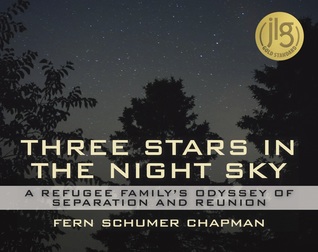
Three Stars in the Night Sky: a Refugee Family's Odyssey of Separation and Reunion
By Fern Schumer Chapman, published by Gussie Rose Press, June 6, 2018.
Target audience: Grades 5-8.
46 pages, includes photo credits of color and b/w photos.

At age 12 Gerta Katz was sent by her Jewish parents from Nazi Germany to the USA as an unaccompanied minor. She was sponsored by a Jewish woman in Seattle. She made friends with one girl who was also an unaccompanied minor but she her destination was not Seattle and they lost touch. Gerta lived in a boarding house, lonely and bereft, waiting for news from her family left behind in Germany.  After many months she finally heard from an older brother that the family had gotten out of the country safely and were now settled on a commune in the Dominican Republic. The dictator of that country, Trujillo, had just recently killed hundreds of black Haitians. In an effort to appear as a good guy to the international community, he granted visas to thousands of Jews hoping to flee Germany. These refugees were given some land, where they lived in a sort of commune. Trujillo hoped that the white Germans would marry DR people so that the children would be lighter skinned.

Gerta was relieved that her family was safe, but miles still separated them. First they couldn't reunited because of the war, next they were kept apart because of immigration policies on DR. Not until 1959 did the family finally reunite, twenty years after Gerta first left Germany.

So much has been written about WWII and the Holocaust it seems impossible that one could learn something new about it, but that is not the case. Everyone's story is unique and Three Stars in the Night Sky tells a new story...that of the unaccompanied minor to the USA and immigration from Nazi Germany to the Dominican Republic. Both were unknown aspects to me. The book is very short and does not give many details about either of the experiences, but it does give a human face to the disaster that happened to so many during the war. The book is full of family photographs, making it more personal. The book was chosen as a Junior Library Guild 2018 selection. It would be a nice resource for schools looking to increase their collection of personal WWII/Holocaust stories.


The Wondrous Workings of Planet Earth: Understanding Our World and Its Ecosystems
By Rachel Ignotofsky, published by Ten Speed Press, September 18, 2018.
128 pages, includes quick steps for protecting the planet, source notes, bibliography, an index, and an illustrated glossary.
Target audience: Grades 7 and up.
"Beautifully combining art and science, The Wondrous Workings of Planet Earth is an illustrated tour of the planet that reveals ecosystems large and small, from reefs, deserts, and rainforests to ponds, backyard gardens, and even a drop of water. Through exquisite drawings, maps, and infographics, New York Times best-selling author Rachel Ignotofsky makes earth science accessible and entertaining, explaining how our planet works, from its diverse ecosystems and their inhabitants, to the levels of ecology, the importance of biodiversity, the carbon cycle, weather cycles, and more. Perfect for nature-loving readers ages 10 and up, this is an utterly charming and educational guide to the world we live in" (Goodreads). 
A close-up detail on one of the illustrations.
I love the illustrations in this book. I was enraptured by them and spent long minutes examining each page. The text that accompanies each section is rather dense and often printed white on black pages, which I find hard to read.  The essence of the book is so good, however I cannot figure out the target audience. Teen readers seem unlikely to spend as much time as I did with each page to discover its treasures and adults may be put off by the marketing toward young adults. I especially appreciate the back few pages about climate change, global warming causes, how we can help protect our planet, and the illustrated glossary. In the note about the author we learn that Ms. Ignotofsky believes that illustration is a powerful tool that can make learning exciting. I agree. I want to explore this book more when time allows once Cybils judging is complete.


Back From the Brink: Saving Animals From Extinction
By Nancy F. Castaldo, published by Houghton Mifflin Harcourt, April 24, 2018.
168 pages, includes a call to action suggested activities, what to read and watch to learn more, source notes, a glossary, a bibliography, and an index. Includes lots of color photographs.
Target audience: Grades 5-8.

Back from the Brink examines seven different species which have been brought back from the brink of extinction by conservation efforts: whooping cranes, wolves, bald eagles, giant Galapagos tortoises, California condors, American alligators, and American bison. for each species Castaldo examines the causes that led to the near-extinction and the actions that have helped bring the species back from the brink. 

The book strikes such a hopeful tone by the time I finished reading it I was ready to shout hooray. Young readers will feel the same way, I am sure, and will want to involve themselves in many of the activities listed in the Call to Action chapter. We are reminded that though these animals are doing better, there is still much to be done to ensure that they are safe from extinction. I am a big fan of this book and I hope it finds its way onto all middle school/junior high library shelves and that it is widely read. The book reminded me of a video I saw several years ago about the benefits to Yellowstone National Park after the reintroduction of gray wolves in 1995. Take a look. It is very inspiring.

I am having a grand time reading so many nonfiction books. I hope my reviews encourage you to pick up a nonfiction book, even one you think you aren't interested in, just to learn something new today.

Monday, November 26, 2018

Nonfiction review: Very, Very, Very Dreadful

Before I get started on this review I'd like to encourage you to stop and think about the title for a minute. Have you ever seen any sentence with three verys in it? Before one even gets started reading the book they know one thing for sure... whatever the topic, it is the most dreadful thing you've ever heard about. Be prepared. The dreadful thing was the 1918 influenza. There has never been a more dreadful disease in all of human history and you barely know anything about it, right?

Well, Albert Marrin decided it was time that we learn something about the 1918 flu by writing Very, Very, Very Dreadful: The Influenza Pandemic of 1918, and in the process he also teaches us about other pandemics in world history and what set up the circumstances for the most dreadful of them all in 1918. He also warned us that it could happen again. In fact, scientists are certain that another pandemic will strike some time in the future. Will we survive it or not?

Back in early 1918 World War I was raging when American troops at Camp Riley started coming down with flu symptoms. The disease spread quickly but fortunately the symptoms were mild and most of the soldiers survived. When the number of new cases started to diminish, doctors thought the worst of the flu season was over, but they were wrong. The disease had just jumped from stage one to stage two. The mutated form was much, much, much deadlier. As it turns out "no war, no natural disaster, no famine has ever claimed as many lives. In 18 months, over 500 million people contracted the flu---one third of the world population at the time---and between 50-100 million people died" (Book blurb). The disease infected people from every corner of the globe, including Pacific islanders and those living in the Arctic region.

No one was safe from the disease, though some people were more susceptible to dying from it and oddly it is not who you might suspect. The normal influenza usually kills people with weak immune systems like children and the elderly. The 1918 version, sometimes called the Spanish Flu, actually was more likely to kill healthy young adults with strong immune systems. In fact, it was probably the strong immune response that did them in. For this reason, more soldiers died from influenza than from WWI all together.

By the summer of 1919, the second wave was over and the third wave began with the disease receding into a more normal flu pattern. Coincidentally by this time, the war was over and soldiers were no longer living in cramped spaces and unhealthy conditions associated with the war effort. Even though the disease killed around 5% of the world's population it stopped making the news, downplaying it's lethal implications.  "Historian Alfred Crosby confirmed this. While glancing at the Readers' Guide to Periodical Literature for the period from 1919 to 1921, he made a startling discovery: thirteen inches of column space were dedicated to baseball stories, but only eight inches to stories about influenza" (138). Textbooks often don't mention the epidemic at all or give it very little attention. It is as if society was so sick of the disease they just wanted to forget it ever happened.

Marrin addresses this societal forgetfulness in the last few chapters of the book where he discusses what science has discovered about the H1N1 virus since that time and makes some predictions of possible or potential epidemics to come. The scariest is the bird flu, which if it makes the jump from bird to human transmission to human to human transmission, could wipe out over 60% of the population. It doesn't take a very active imagination to figure out what would happen to societies if that were to happen...total chaos.

My husband and I listened to the audio version on a trip we took over the holiday weekend. We were both fascinated and horrified by what we learned. We both remarked how effective it is to receive historical information when it is delivered on a theme. So often history is taught in a chronological manner...often highlighting wars and the circumstances leading up to them while skipping over other societal events that were impacting millions of people. From this book we not only learned about the Spanish Flu pandemic, but about other pandemics throughout history. We learned some of the details of WWI and the deplorable conditions soldiers were forced to live in throughout. The author even touched on Women's rights, since suffragists were busy at work attempting to secure the right for women to vote during the same time period. I highly recommend this book for all history buffs and every high school or public library should have it in their collection. At my old school, I'd be getting this book into the hands of the Medical Careers teacher urging her to recommend that her students read it. We can no longer ignore the lessons we should have learned from the most dreadful disease know to humankind---The 1918 influenza pandemic.


Friday, November 16, 2018

Fun and worthy YA/MG nonfiction books

Since I am attempting to read 89 nominated nonfiction HS/JH books before the end of December I don't really have the time to give each one I like a full review. but I wanted my readers to be aware of these books and to look for them at your library or a bookstore near you.


(Don't) Call Me Crazy: 33 Voices Start the Conversation About Mental Health
Edited by Kelly Jensen, Published by Algonquin
Target audience: teens and young adults; appropriate and of interest for adults.
228 pages, includes resources list and contributor bios.

There is a plethora of "these types" of books published this year. Honestly if you are a young adult author and haven't been asked to submit an essay for one of them one will wonder if you are popular with your peers. (Just kidding.) That said, this book distinguished itself from the others by the quality of the writing. Though I didn't read every single essay, I read about one third, and each was spectacular. The best, I thought, was the first "Defying Definition" by Shaun David Hutchinson. He reminds/tells the reader that he refuses to be defined by depression. His concluding sentence sums up the essay nicely, "Define words, not people. Define 'depression,' but don't define others by it. Because we are people and we defy definition" (7). Some of the other essays were about the authors' struggles with mental health issues I didn't even know had names, like compulsive hair-pulling (trichotillomania) and being aware of and disturbed by noises made by other people, like chewing sounds (misophonia.) Even if a mental health issue isn't conquerable, it is comforting to know that others struggle with the same thing---that you aren't alone.

Among the many essays on depression, suicidal-ideation, OCD, drug/alcohol addiction there were also essays on related topics like the top movies and fictional characters related to mental illness. One character, Vicky Cruz from The Memory of Light by Francisco X. Stork, is very memorable. She wakes up in the "after" of her failed suicide attempt. As the story unfolds we learn that there is no magic pill to make a person better but with hard work and understand one can come to a point of being relieved that they are alive.

The book also had submissions from graphic authors/illustrators. My favorite is called "Tearing Feelings Apart" where the artists helps the readers imagine what would happen if all the words that make up your sad feelings are so far apart that they are inhabiting another planet or universe where they are happy. Very creative.

When the Cybils judging event is over for 2018, I want to revisit this book and read the other 20 essays that I missed first time around. It is that good. Now I will close with a meta-meditation I learned from the book: "May I be well. May I be safe. May I be happy. May I be healthy. May I live with ease." Now I do it again but this time insert the name of someone I care for; someone I am struggling with; the country, etc. (57)


They Lost Their Heads: What Happened to Washington's Teeth, Einstein's Brain, and Other Famous Body Parts
By Carlyn Beccia, Published by Bloomsbury
Target Audience: upper elementary, middle school or junior high students
182 pages, including an index, selected bibliography, source notes and a table of contents. 

Ho ho. What fun. Everything about this book is fun, or funny, or gross, or just plain interesting. As you can tell from the title that it has a lot to do with body parts, and in a lot of cases we are talking about dead body parts. I am pretty sure that people from past centuries weren't as grossed out by the idea of dead body parts as I am because so many of them stored skulls, brains, legs, warts, and even eyeballs instead of burying with the dead owner of said body part. Don't they stink?

Here are a few highlights that you might not know. When Pedro 1 ascended to the throne of Portugal tried to hold a coronation for his dead wife so she could be queen. He dug up her skeleton, dressed it up, and made his subjects kiss her hand. // A few pieces of Beethoven's hair were saved by a young boy. It survived in a wooden locket. The locket made several journies to keep it safe from the Nazis when finally in 1994 someone bought the locket and hair at auction and had it analyzed. to everyone's surprise Beethoven had been poisoned. Lead poisoning to be precise. // Some counterfeiter's hatched a plan to steal Lincoln's body after he was entombed in a fancy sarcophagus. Shockingly body-snatching wasn't illegal at the time. // Some people thought that death was contagious. After a mother and two daughters died roughly in the same period, everyone was worried that the son would catch the death, too. So they dug up the three females to see which one was killing him. One, Mercy Brown, was not as decayed as the other two, so they thought she was killing her brother. (They never used the word "vampire.") // Albert Einstein wanted to be cremated after he died. And he was...except for some of his body parts. His brain has actually been dissected to examined many times to see if anyone can figure out why he was so smart.

The book is filled with fun and entertaining illustrations to coincide with the factoids and short accounts of what happened to the famous people and their body parts. I think this would be a perfect book for a young teen or preteen boy. It is a quick read with lots of gross facts, the kinds they can tell their friends about. I loved the book and though I meant to read only a portion of it to make my judgment for the contest, I couldn't keep myself from reading the whole thing.


Capsized!: The Forgotten Story of the SS Eastland Disaster
By Patricia Sutton, Published by Chicago Review Press
Target audience: middle school students
176 pages, including reference sources.

Well, I'd say the title is only partially correct. I'd rename it: Capsized! An Untold Story of the SS Eastland Huge Disaster. I'm pretty old and I've never heard of the sinking of the SS Eastland and it was a huge disaster.

On July 24, 1915, the SS Eastland, filled to capacity with 2,500 passengers and crew, capsized in the Chicago River while still moored to the pier. Happy picnic-goers headed for an employee outing across Lake Michigan suddenly found themselves in a struggle for their lives. Trapped belowdecks, crushed by the crowds attempting to escape the rising waters, or hurled into the river from the upper deck of the ship, roughly one-third of the passengers, mostly women and children, perished that day. The Eastland disaster took more passenger lives than the Titanic and stands today as the greatest loss of life on the Great Lakes. Capsized! details the events leading up to the fateful day and provides a nail-biting, minute-by-minute account of the ship's capsizing. (Book blurb)
The book is very readable. I read it in just an hour or two. The circumstances of the day were remarkably detailed, not lost to history. From the time that the ship started loading its passengers until it rolled over, trapping and drowning over 800 people, was only a half hour. It is a incredible and disturbing story. One that shouldn't be forgotten.

At the end of the book, the author raises some critical-thinking questions for young readers to ponder. She asks, "Why do you think that this disaster got so little historical attention compared to the Titanic, even though more people died in this disaster?" Good question. One that would be worthy of a good class discussion. I recommend this book for middle school students who have to read a book about American history. It will thrill them and impress their teacher.

Three good books. Ask for them at your library!


Monday, November 12, 2018

Nonfiction Review: We Say #NeverAgain

We Say #NeverAgain: Reporting by the Parkland Student Journalists is an important book for today's students and anyone interested in how to resist in a positive way. The editors of the book are Melissa Falkowski and Eric Garner, the MSD journalism and broadcasting teachers. Aside from an essay or two as introduction to this book project written by the teachers, all the other essays in the book are from student contributors.

On February 14, 2017 the unthinkable happened at Marjorie Stoneman Douglas (MSD) High School in Parkland, Florida. A shooter, familiar with the school, came into the building and killed seventeen students and staff and wounding many, many more. Within days of the tragedy, students had decided to do something to put an end to gun violence and started a movement called #NeverAgain. Many of the most impactful voices for this movement came from the school's journalism and broadcasting programs. These students have credited their teachers and the training they received at school for allowing them to think critically and communicate clearly---enabling them to launch a movement that has inspired a nation (Book blurb).

The book is divided into three parts: 1. Activism, 2. MSD Strong, 3. What Comes Next. It is not designed to give a play-by-play of the day's shooting and the aftermath. In fact, nothing was said in the whole book about the shooter, including his name. That was an intentional decision by the students. They did not want to give the shooter any attention, which he desired.

Part 1: Activism---from the Parkland March and Rally, the bus full of students lobbying the Florida Legislature in Tallahassee, to the Washington, D.C. March for Our Lives, student's essays touched on what it was like to be suddenly thrust into national limelight.

Many of the students talked about how their role as a student journalist at MSDHS helped them to deal with their grief and trauma because even as the tragedy was unfolding they recognized they would need to report on it, so they put on their journalist hat and took the victim hat off. Either way, all the students wished that the tragedy had never happened, even with all the national attention they received for their activism. Dalaney Tarr's opening sentence of her essay, "Pushed Into the Spotlight", echoed what many others reported. "To me, the worst thing anyone can say to hurt us is that we're 'just doing this for fame'...Every day, I long for the life I once lived" (21).

The students also had to deal with their disillusionment with politicians and certain media representatives. When the students met with their Florida senators Nelson and Rubio, they learned very quickly that constituent concerns may not top their priorities, as Ryan Deitsch, in his essay "Holding Politicians to Account", discovered.
"We researched the candidates and learned that Marco Rubio had taken over $600,000 from the NRA. I couldn't wait to ask him a question during our town hall: Why do we as children or young adults have to march on Washington, DC to save our lives? That is when I learned what political dancing was...when a politician is asked a question and he/she doesn't answer but hijacks the interview to get out their own agenda. This happened on stage right in front of me, and I was powerless to stop it" ( p. 77).
Many of the students showed wisdom beyond their years and expressed themselves very eloquently as exampled by Richard Doan in "Shining a Light on Gun Violence". He says, "I believe that this nation needs not a heated political argument, but a respectful discussion about guns and mental health. Each side must be willing to listen to the opinions of the other side" (87).

Many of the essays were about the experience of planning, putting on, and participating in The March For Our Lives. Some were speakers while others worked behind the scenes to coordinate the program while others were journalists in the field. One such person was Josh Riemer ("Photographing Revolution") a MSD photographer at the March. He talked not only about his craft but how being involved made him feel hope for the future:
"For the first time in a long time, I felt that we as a people, young and old, were making a difference. I felt that finally, after all these years, the gears of democracy and bureaucracy were grinding, and the world change for the better...Photos are how I express myself. These photos are my contribution to the revolution. A new day is coming, and until then, we're not going to stop documenting change, and we are certainly not going to stop to marching" (111).
 Suzanna Barna ("Bird's-Eye View") talked about how awful events were leading up to the march and how much anxiety she had leading up to the day until the "moment I realized that no matter what happened during the march lineup, the real hope lay with the crowds below me, full of individuals and groups from all over the country---not just Florida---who had decided that they'd had enough of gun violence and were ready to speak up" (118).

This sentiment was reiterated over and over by these student journalists. Nikhita Nookala ("Backstage at the March") was hopeful for the legacy of her school. "Not the shooting, not the blood in the hallways, but the march. The voices. The memories. Is this the legacy of my alma mater? I can only hope." (122)

Part 2: MSD Strong---Stories from the home front. Heroes on the day of the shooting. Celebrating the lives of the seventeen students who lost their lives to the shooter. Figuring out how to live in the face of deep grief and the new reality.

Seemingly small acts which are viewed as heroic when looked through the lens of the day. Teachers who kept doors open to catch as many students as possible. Students performing first aid. Students helping teachers who were clearly suffering and upset. One boy's act of shutting the classroom door saved the lives of nearly everyone in the room.

Carly Novell in her well-written essay "Balancing Guilt with Opportunities", talks about the opportunities she has had as a journalist juxtaposed to the horror of the event.
"When we were given the opportunity to write the book, I struggled with the idea---like every opportunity I have been given in the aftermath of my school's shooting---because seventeen people had to die for us to have this platform. It feels unfair that seventeen voices were taken away for ours to be amplified" (161).
Part 3: What Comes Next?---After the days following the event and the march when the media goes home and pays attention to other issues plaguing our country. What are these students left with? What will they do with their newly-found activism?

David Hogg, a student activist who received so much critism by conservatives, talks about the effect of social media in "Leveraging Social Media". He understands, better than many adults, how to use social media to effect change. He also was surprisingly thoughtful toward those who attacked him personally for his activism.
"And let me add a word of compassion to the people online who have said some shockingly hateful things to me and my friends. That hate didn't occur spontaneously on the day we decided to speak out in favor of sanity in our gun policies. That hate comes from a place of deep unhappiness, and even trauma...Hate loves company. And hate always goes in search of somebody to blame. That is the downside of social media---groups can organize like never before for positive change, but mobs can also form to do bad things. in any case, a human response to someone who shows you hatred can disarm the hate, and might even lead to actual understanding" (218).
David Hogg and several of his classmates embarked upon a tour across America to take their message of #NeverAgain and have seen firsthand how divided our country is. He has seen how our politicians and leaders exploit these differences rather than trying to work for positive change. Into this world, the students are moving, trying to make the world safer due to sane gun laws. ("Road to Change" 237).

The last essay of the book, "Independent Student-Run Newsrooms"  was written by the journalism teacher, Melissa Falkowski. She urges all high schools to support a vibrant, student-led journalism program. This article should be required reading for teachers, administrators, and school board members who constantly want to squash student efforts to write and produce news as they see it. Besides, shes says, "student newsrooms are the ultimate exercise in project-based learning" (244). That sentence alone should motivate school boards and administrators to give journalism more room in their schools!

I became aware of We Say #NeverAgain because it was a nominated book for the Cybils Award this year. (Are you paying attention MSD journalism and broadcasting students? Your book has been nominated for an award!) Though I was often aware that I was reading essays written by students, taken as a whole the book is very good. I am a fan of recognizing works which reflect what is happening in our country and in the news. No event of 2017 captured more of the country's heart and soul as the events at MSDHS on February 14, 2017 and the subsequent March for Our Lives and the #NeverAgain movement. For this reason, I will be recommending that this book move on to round two of the judging. Be mindful that I am one of many but I will do my best to make my voice be heard. Thank you for this book. It is an important piece of information for students of today. I have several friends who teach journalism and I will certainly recommend that they read it and share the contents with their students. Librarians, make sure you have at least one copy in your library and then suggest that your student journalists read it.


Friday, November 9, 2018

Friday Quotes and Nonfiction review: Votes for Women

Book Beginnings on Friday is hosted by Rose City ReaderShare the opening quote from the book.
Th
e Friday 56 is hosted at Freda's VoiceFind a quote from page 56.

This is the book I'm reading right now---


Title: Votes for Women: American Suffragists and the Battle for the Ballot by Winifred Conkling

Book Beginning: (Preface)---
Everyone expected Harry T. Burn to vote against the Nineteenth Amendment, which gave women the right to vote. The twenty-four-year-old first-term member of the Tennessee House of Representatives was from Niota, Tennessee, a conservative area in the mountains. It was August 1920. Burn was running for reelection in the fall, and most of his constituents were opposed to female suffrage. If he wanted to win, surely, they thought, he would vote against the bill. But Burn hadn't made up his mind.
Friday 56:
It was at the meeting there that Anthony organized a new group, the Woman's State Temperance Society. Anthony wrote hundreds of letters of invitation to prospective members, and almost single-handedly raised the money, hired the hall, and organized the speakers for the group's first meeting. One of the people she contacted was her new friend Elizabeth Cady Stanton, whom she recruited to serve as president and to write a speech for Anthony to present. "I will gladly do all in my power to aid you," Stanton responded. 
Review: Starting with Elizabeth Cady Stanton, whose father wished aloud that she was a boy, Votes for Women takes a deep dive into the lives of the suffragists and their struggles to eventually see to the passage of the 19th amendment to the US Constitution, securing the right for women to vote.
     It was a long struggle. When Stanton held the first meeting on women's rights in 1848 in Seneca Falls, New York, no one knew it would take 72 years to secure voting rights for women. Only one woman, Charlotte Woodward Pierce, who attended that first meeting was even alive in 1920 and she was too old and sick to vote. Along the way so many women dedicated their lives to the women's rights concept, which not only asked for the right to vote but also the right to own property, to attend college, to keep their own wages---not just hand them over to their husbands, and if they divorced, to keep their children.
     The path of suffrage was not a straight one. Most of the early advocates met because of their activities related to abolition or temperance. The Friday 56 quote talks about Susan B. Anthony's early work on temperance. She formed a women's temperance branch because she was not allowed to speak at the general meeting, even though she had so good ideas, because she was a woman. Just when things seemed to be going in the right direction, the Civil War broke out and the leaders of the suffrage movement decided to leave it alone as the country focused on more pressing needs. After the war, the woman were ready to pick up the cause again but now the issue of voting for black men came up and legislators didn't want the women to sink the men. Oddly, though Stanton and Anthony were good friends with Frederick Douglass, their talk about the vote for black men sounded very racist. It is such a common thing for factions to fall apart when one feels that the other is stepping on their toes.
     By the late 1800s other women had to step up to the leadership as the initial members were aging though Anthony continued to lobby Congress right up to her death in 1906. By the time that Alice Paul got involved with the legislative branch of the Women's Suffrage Organization in 1913, women were tired of waiting for their turn. Alice decided that they needed to be more active and more militant like their sisters in Great Britain. She organized marches and the Silent Sentinels---women holding banners in front of the White House with messages for the President . (Look at the cover photo, the Silent Sentinels stand in the background.) As these silent protests went on, the police started arresting the women. Several of the women, Paul included, were sent to a prison with such deplorable conditions that they went on a hunger strike. Paul asked to treated like a murderer on death row who had sanitary living conditions and good food to eat. After several weeks of this the President relented. He didn't want to have the death of any suffragists on his hands.
     This time when war came started (WWI), the women did not relent and eventually both the US House and the Senate passed the 19th Amendment in 1919. Now it was time for the states to act. It took another year for the ratification process to take place. It was hard work finding the states willing to sign on. They needed 35 states to ratify. When the vote passed the Tennessee Senate, the 35th state, the women needed the Tennessee House to vote yes, but their prospects didn't look good. On the first try the vote was a tie. Harry T. Burn had voted no (from the Book Beginnings quote.) But on the final vote, he switched his vote to a yes. What people didn't know at the time, his mother had written urging him to vote yes. The 19th amendment was finally ratified in 1920. Women could finally vote.
     Sometimes book reviews make books sound so boring, one would be crazy to want to read it. That is the case with this review. I know the book sounds boring but it is actually quite fascinating. I thought I knew a lot about the suffrage movement and about the key advocates, but I really had no idea. I learned so much and am in awe of the courageous women who fought for my right to vote. I highly recommend this book to you.
     In addition to the wonderful narrative nonfiction writing, author Winifred Conkling (with her suffragist-sounding name) has put together a very credible book to use for research. There is a timeline of events and individuals. There is a an exhaustive bibliography and helpful source notes. This book should be purchased for every high school and public library.


'
   

Friday, November 2, 2018

Friday Quotes and Short Review: 1968

Book Beginnings on Friday is hosted by Rose City ReaderShare the opening quote from the book.
Th
e Friday 56 is hosted at Freda's VoiceFind a quote from page 56.

This is the book I'm reading right now---


Title: 1968: Today's Authors Explore a Year of Rebellion, Revolution, and Change edited by Marc Aronson and Susan Campbell Bartoletti

Book Beginning, from first contribution in the form of a prose poem by Elizabeth Partridge---


Friday 56, from the essay "The Wrong Side of History" by Laban Carrick Hill


Review: I was a kid in 1968, just eleven years old. And my family didn't live in the States at the time. We lived in Africa where my dad was a missionary for three years, 1966-69. I, like Laban Hill, hadn't heard of Martin Luther King, Jr. but I remember the day he died very clearly because my parents were so distraught. In fact, it was his death that made me start paying attention, at least a little bit, to the politics at home in the USA. By 1969 when we were slated to come home, I was terrified. What would I be going home to? Fights in the streets? Assassinations here and there? Demonstrations and anger over Vietnam everywhere? I decided as a twelve-year-old kid that I'd rather stay in Africa and deal with the bugs than go home to the political mess that awaited us. But I was overruled and we returned home during the summer of 1969. We were in Norway, on our return trip, when Neil Armstrong walked on the moon. My, my the world HAD changed a lot while we were "gone".

Now, with the perspective of age, I can really see what a pivotal year 1968 was.
[The year] grew more intense with each day. As thousands of Vietnamese and Americans were killed in war, students across four continents took over colleges and city streets. Assassins murdered Dr. King and Robert F. Kennedy. Demonstrators turned out in Prague and Chicago, and in Mexico City, young people and Olympic athletes protested. In those intense months, generations battled and the world wobbled on the edge of some vast change that was exhilarating one day and terrifying the next. (Book blurb)
The book is comprised of  fourteen essays and a long prose poem interspersed throughout the book by authors who usually write for young adults. Each essay is personal in nature in that the author remembers living through some event in 1968 and so was able to personalize on some level that which they researched and wrote about. All of the essays were not about what was happening in the USA in 1968 because it wasn't just a year of turmoil in one country but in many places around the globe. France, Czechoslovakia, China, and Mexico also experienced tumult in 1968. In fact the essays about these events were some of my favorites because I learned something as I read them. And because the essays were at least a bit personal in nature, one received information from a unique point of view, as the Friday 56 quote shows. Laban Carrick Hill talks about what it like living in a family of racists who were glad when Martin Luther King, Jr. was killed. Now that is not a point of view one often reads about in the history books. His immediate family, however, did come around to see the error of their views, so we was able to talk about that evolution, too.  

A few of my favorite essays weren't even about the Vietnam war or the Civil Rights movement, but about life in the late 1960s. Paul Fleischman remembers 1968 in his essay "Biker's Ed" as the year he took his first long bicycle trek with a friend leaving Santa Monica heading north to San Francisco or Vancouver, BC, points north. The trip ended when his friend's sleeping bag was stolen in Santa Barbara. He saw that event, not the stabbing of a concert-goer at a Rolling Stone concert by a Hell's Angel, as the beginning of the end of the 1960s culture. David Lubar's essay "Running with Sharp Schticks", about the comedy of the 1960s, is must reading if anyone wants to understand how much the world has changed since that time. And "Running Into History" by Jim Murphy reminded me about the 1968 Summer Olympics and how three brave men, two Americans and one Australian, attempted to make a statement about the unfair treatment of blacks in the world. All three were punished or ostracized for their efforts. Remind you of something today with the NFL?

In fact, this book is a nice reminder for us today. When one is embroiled in a world on the precipice of big change, one where everything is very unsettled, it is good to look back on another year where everything seemed to hang in the balance. We lived through 1968, we shall survive 2018, too.

The book is not only expertly written, it is also nicely sourced. It has notes about each of the authors who contributed to the project, source notes, and a limited bibliography for further research. Do I think that teenagers of today will flock to this book? Unlikely. But I hope that every library, both public and school, will make sure to have it available for those readers and researchers who are curious about what it was like in 1968, a truly pivotal year in world history.

Thursday, November 1, 2018

Nonfiction Review: Resist: 35 Profiles of Ordinary People Who Rose Up Against Tyranny and Injustice

It is a theme this year in YA/MG publishing of nonfiction to compile collections of essays/authors on topics related to resistance, hope, persistence, and mental illness or the books highlight particular people who have stood up and stood out to make a difference in this world. I know this is a theme because I have already read five of the books so far this year and I have another seven on my Cybils reading list. In my mind twelve out of 89 books makes up a theme.

At any rate, Resist by Veronica Chambers is an easy to read book targeted at younger teens or tweens highlighting the lives of 35 people who stood up and did something for the betterment of mankind or to draw attention to something that needed to be corrected. I suppose that the goal is for a teen reader to pick this book and decide that if these 35 people could do XYZ, they, too, should have the courage to do the same. Each section covers a very brief biography of the person and their accomplishment as viewed through the lens of the trials they had to endure along the way. At end of each section there is a bolded resist lesson. For example, the chapter on the Lalai Lama ends with, Resist Lesson---The People who want to do good are the real majority. Troublemakers make up just a handful of all the people in the world.

The book begins with an inspiring forward introduction by Senator Cory Booker. He tells the story of a young lawyer, Arthur Lessman, who was inspired to help the civil rights movement but couldn't afford to go down to the south to march and protest. Instead he stayed home in New Jersey and volunteered his services to assist the Fair Housing Council. Years later, because of his services, Booker's family was able to buy a home in an area which up to that point had not been open to black families. Because of Lessman, Booker was able to grow up in his beloved neighborhood which would not have happened without the Fair Housing Council's help.

I zoomed through this book, out of interest and because of it's easy to read format. It took me less than an hour to read. Many of the highlighted persons I was familiar with their stories, so I didn't need to linger long to get the point of what they did to make the world a better place. Younger readers may not be as familiar with many of the included persons. It started with Joan of Arc, Galileo, and Susan B. Anthony and included many names one expected to see---Martin Luther King, Gandhi, Oskar Schindler. And finished up with individuals who are still living like Rev. Dr. William Barber, the founders of Black Lives Matter, ending with a note from the activists from Marjorie Stoneman Douglas High School about gun safety. I liked that the book had a historical and a current feel about it.

One hero, who I'd never heard about was Chinune Sugihara. He taught us that sometimes you break the rules to do what is right. He was a Japanese man living in Lithuania at the consulate at the time WWII broke out. When he learned about the atrocities concerning the Jews, he started writing visas for Jews who wanted out of the country. Even when Japan recalled him, he kept writing as many as her could, as fast as he could until he ran out of paper. He was later punished by his government for what he did but he learned later that his actions saved 6,000 Jews from the Nazis!

Inspiring stuff.

I liked the book, though I often felt that the five or six pages dedicated to each of the thirty-five people was far too few to really explain everything they did and stood for, but I had to think back to the target audience... young teens not cynical adults!

Look for this one at your nearby library. If they don't have it in their collection, encouraging them to get it.

You may only be one person, but you have the power to change the world.


Wednesday, October 24, 2018

Review: Hope Nation edited by Rose Brock

Hope Nation: YA Authors Share Personal Moment on Inspiration is one of those cool collections of essays and, in this case, one short story. Hidden within its cover is a personal message of hope for everyone who is struggling with something. Ha! How is that generalizing? The book blurb describes the book this way,
Hope is a decision... but it is a hard one to make---or even recognize---in the face of oppression, belittlement, alienation, and defeat. We all experience moments when we struggle to understand the state of the world, when we feel powerless and---in some cases---even hopeless. But in trying times, words have power. Some of today's most popular YA authors come together in this revealing, personal collection of essays, each a flame that offers light in the darkness. Together, just like us people, these hard-earned words of wisdom become even stronger when united.
Hope is the uniting theme of the collection of essays but each deals with different topics: reacting to the current political climate; disfigurement; self-esteem; LGBTQ issues; rejection; abuse; racism; and finding one's voice are all included. As with most collections of this type the writing isn't completely consistent. How could it be? And my interest or need to hear words of hope of the various topics varied. But overall the whole was very good and I didn't find myself feeling impatient to move on or be done with the book, as has happened before when I "got" to the purpose and message and didn't need to be beat over the head with it.

My two favorites from the collection happened to be the first two. The first was a short story written by David Levithan, an author I am fairly familiar with. He attended the Women's March in January after the inauguration of Donald Trump. He, like I, was hurting but found hope and peace in the process of marching with others. His short story was written after he had time to reflect on the day's events after the march. There was a lot to love in the story but here is one of my favorite lines:
"We strangers are all smiling at one another. We are so much louder together than we are on our own. I knew I was here to protest; I knew I was here to unite. But what I didn't know was that I was here to remember why I am so in love with this world" (28).
My second favorite essay was written by Libba Bray, another favorite author. If you haven't read anything by her most of her books are very funny or contain a lot of humor mixed in with the poignant bits. What I didn't know about her was she was in a serious, nearly life-threatening, disfiguring accident right out of high school. She had a really hard time with her recovery and learning to love herself again. Writing/journeling saved her. What a powerful message to teens struggling with self-acceptance. The last line, repeated three times, "You are not alone" (58).

Some other gems were found dispersed throughout the other essays. Jeff Zentner says he is hopeful about the future because of "book people." He goes on to describe that Book People have empathy brought about by reading about other people, people different than self. He goes on to encourage Book People to stand up for the rights of others when they see discrimination happening. James Dashner tells teens, "If life is rotten, then go and find those people who will accept you and love you and join your quest to change the world. I promise you they are out there" (268). Both of these authors are speaking directly to bookish students. These students often feel like misfits in their high schools. But here they are reminding these teens that there are like-minded folks who will understand them and LIKE them. Once again very hopeful words.

All together twenty-four authors have messages of hope to share with the readers of this book. It is a very good collection and I hope it finds its way into the hands of the readers who need it.


Monday, October 22, 2018

The Faithful Spy: A True Story: Dietrich Bonhoeffer and the Plot to Kill Hitler


Some of you may not be aware that my father is a Methodist minister. I am not only a Christian, but one of those dreaded "preacher's kids" you've heard so much about. I tell you this as a sort of confession because I thought I knew about Dietrich Bonhoeffer because of my upbringing but I really had no idea what he did until I read this book, The Faithful Spy: A True Story: Dietrich Bonhoeffer and the Plot to Kill Hitler by John Hendrix. As I was growing up I would hear about Bonhoeffer in sentences similar to those I'd hear about Martin Luther, or John Wesley, or Calvin Knox. I just figured he was just another theologian who had insightful things to say about a life in Christ. Later I came to understand that he also was a published author and that his books were very deep and theological. I attempted to read his The Cost of Discipleship once but gave up quite quickly. I thought it was his theology that got him in trouble with the Nazis. I had no idea he was killed by them, just weeks before the end of the war, because he was a spy conspiring with others to assassinate Hitler!

So The Faithful Spy: A True Story: Dietrich Bonhoeffer and the Plot to Kill Hitler cleared up my misconceptions of the famous German theologian and it delivered the information in a remarkable way---through a graphic (illustrated) biography written and illustrated by John Hendrix. however, unlike most graphic novels, this book is quite heavy in its text to illustration quotient. The illustrations were usually to make a point about what the text said, not to replace the text. And most speech wasn't delivered in text bubbles. I say this because it was decided that this book should be judged for a potential Cybils award in the JH/SH nonfiction category, not the graphic novel category.

This page is more illustrated than most. Before Bonhoeffer became involved as a double agent spy, he tried to sway the German people to beware of Hitler and his special brand of hatred. His broadcast was cut off mid-program, probably by the Nazis. The bottom right corner shows Hitler delivering his hate-filled speeches, getting people all fired up with anger through his rhetoric and delivery method.

On this page, more typical for the book, one big illustration makes two points about Hitler (He is an Omnipresent dictator and he liked to think of himself as a wolf, even encouraging others to call him Herr Wolf.)


On this page we find Dietrich and other conspirators waiting for news that the plane Hitler was on blew up from the bomb they placed on it. It didn't. Plot #1 was a dud.

So what is new about this book compared to others about Dietrich Bonhoeffer except that it was illustrated? Well, for one thing it is marketed to children and teens, not adults. As I read it I kept thinking that older teens or adults would get more out of it (or actually read it) compared to younger teens or children since it is so text-rich and full of complex issues. Elizabeth Bird, reviewing the book for School Library Journal, has this to say about that argument:
No doubt you will hear people argue about its age range. They will say that the book should never have been marketed to children and that due to the complexity of the ideas inside, to say nothing of the presence of Hitler himself, this should be purchased only for young adult collections. But to say that denies that children and middle-schoolers are capable of reading, comprehending, and processing moral complexity. Let’s put it another way. Few historical works for children will proffer the idea that all German Christians during WWII weren’t dyed-in-the-wool Nazis. In an era when nationalism is on the rise in countries across the globe, it is a great good to teach kids about a time when blind and displaced loyalty to a country led to unspeakable evil. Hendrix doesn’t have to spell out the parallels to the times in which we live. Have faith in the kids. They’re going to be able to get there on their own. The author is just laying the facts out before them. He trusts their intelligence. We, the adults, would be wise to do the same.
 We should trust kids to "get it": to read and enjoy the book on one level, and to understand the meaning for today's children on another level. In the author's notes, Hendix said he wanted to do this book because he is afraid we have not all been permanently vaccinated against tyrants. He wonders, "how a majestic nation can willingly become a puppet for evil... and how quickly a good and noble people can become infatuated with hated." This is not just an issue for Germany of the past. Hendrix, a Christian himself, challenges his readers, no matter how young, to consider that sometimes our faith forces us to stand up in the face of this evil and speak out, or maybe even act out in opposition. Dietrich Bonhoeffer did this and it cost him his life. What is his legacy? It is an "unswerving belief in sacrificing for the good of  'the other', which is exactly the opposite of the Nazi ideology" (169). 

I highly recommend this book even though Hendrix admits that he is an artist, not a historical researcher. It was a joy to read.

I read a print copy of The Faithful Spy from my public library.