This month the Shepherd of the Hill Book Club will be discussing The Heart is a Muscle the Size of a Fist by Sunil Yapa. Though I am the club kit-selector, I tried to talk the ladies out of reading this book, thinking perhaps it contained a bit too much profanity for a Christian women's group. But the members overruled me. The reason I selected the book kit in the first place was because we live near Seattle and most of us remember the World Trade Organization (WTO) Protests in 1999. In fact, my husband, a Washington Army National Guard officer, was called up with his unit to help quell the riot. The hostess for this month's meeting has invited my husband, Don, to come as a guest speaker to shed additional light on what we read in the book. In preparation for book club, Don listened to the audiobook after I was finished with it. This blog post is a discussion between Don and me about its merits.
Me: I was always proud of you and the National Guard for your participation in quieting the WTO riot. But after I read even a small portion of this book I was aghast at what I learned about the police brutality. How accurately do you think that Yapa covered that aspect of the riot?
Don: First, we have to remember this is a work of fiction that is set within an actual, historic event. Some protesters were subjected to rough treatment, pepper spray, and tear gas as the police attempted to regain control of the streets. I think Yapa uses the many graphic descriptions of police violence to raise questions about the human cost of law and order on both sides, and which interests are served by law enforcement. I don't think Seattle PD was prepared for the scale and number of disparate protests. They had advance dialogue and ongoing negotiations with organizers of the several permitted marches and non-violent protests. But at ground level, when police officers were confronted with direct action and vandalism intended to shut down the WTO meetings, the political pressure to clear the path from hotels to the convention center translated to meeting force with force and some violent consequences.
Me: Were you aware of the reasons so many people showed up in Seattle to protest the World Trade Organization conference while you were on duty? I really had no idea how serious the issues were. In fact, I thought the discussion between the delegate from Sri Lanka and the bus full of arrested protesters was very enlightening. The one issue I had never heard of before was how one big conglomerate would sell infertile seeds to poor farmers, so that they would have to buy new seed every year, insuring that they remain poor and dependent on the company for their livelihood.
Don: I had followed news of anti-globalization protests at other cities that hosted previous world economic summits in the decade prior. In Seattle, many groups saw an opportunity to highlight various negative aspects of our increasingly global economy. As a supporter of organized labor and worker's rights, as well as my concern for the environment, my politics align with some of those concerns. I remember laughing with friends later that it would have been really strange if we'd seen each other across the lines during the WTO protests.
Me: I was also struck by the seeming organization among the chaos of the riot. How did 50,000 protesters communicate with each other so that amid the chaos they were so effective in thwarting the police attempt to shut them down? Why was the protest in Seattle so much more successful than those held in other cities?
Don: While it's true that up to 50,000 people were involved in protests during WTO, a much smaller number engaged in rioting and vandalism. I think the book focused on one group of direct action organizers to represent the entirety of the protest against the meetings. In reality, you also had large labor union marches and rallies, environmental action groups, religious groups, and others including anarchists who were able to exploit the situation. Movements of large numbers of protesters were planned and coordinated, and leaders used cell phones and walkie-talkies to communicate. I'm not sure how much cross-group collaboration was going on, but the sheer numbers of people in a reasonably concentrated area contributed to the "success" of disrupting the WTO meeting.
Me: As we discussed the book, you kept pointing out some of the inaccuracies. What were some of these?
Don: Again, we have to remember this book is fiction so strict factual accuracy can't be expected. The author's standard disclaimer "any resemblance to any real person, living or dead, is completely coincidental" is included in fiction works for a reason. Very importantly, no Seattle police officer fired live rounds and killed a protester. I struggled most with the seemingly compressed timeline from my recollection of events. For example, President Clinton's arrival and speech to the WTO was the day after the worst of the demonstrations that had cancelled the opening ceremony. Here's a link to a timeline compiled by the city's WTO Accountability Review Committee that lays out the days before and after the events described in the book, which apparently focus on Tuesday, November 30th.
Anne: What did you think of the different characters in the book? Michel Schaub, reviewing the book for NPR, thought that Victor, the police chief's wayward son, was the most fleshed out of all the characters and thought the others "essentially stand-ins for ideals and emotions, or convenient foils for other characters. The two cops are tough but caring, and cruel but damaged, respectively, and the two main protesters are idealists whose thoughts and dialogue read like the bumper stickers on a VW in 1960s Berkeley" (NPR). Do you agree with this characterization?
Don: Perhaps we get a lot more introspection from Victor because he is still trying to figure out where he belongs in the world living with the grief of his mother's death and severed relationships with a father he never knew and step-father police chief. Victor is looking for purpose, acceptance, and love, as well as trying to make a few bucks selling weed, when he falls in with the direct action crowd -- King and John Henry, the preacher, two disaffected people committed to a cause or the thrill of the fight. The two police officers are interesting contrasts: Jules, two-time immigrant from Guatemala and Los Angeles; and Park, refugee from Oklahoma City bearing scars visible and unseen from the right-wing bombing of the Murrah Federal Building. Along with the step-father police chief, their commitment to maintaining order worn like their gas masks and riot shields to hide conflicted feelings and desires.
Anne: I wouldn't say that I liked the book. I actually thought it tried to do too much having several stories running underneath the WTO story, like King's Mexican experience, Victor's issues with his father, the police chief, and the back stories on the highlighted police officers. It was hard to keep track of all the details while trying to pay attention to the main event. What are your thoughts on this?
Don: I tried not to hear these as separate story lines, but as different flawed individuals trying to navigate the external conflict during the WTO (police vs. protesters; rich countries vs. poor; etc.) while they each dealt with even more profound conflicts within their own much smaller worlds.
Anne: What I did appreciate, however, is how the book served as a conversation starter for us. I realized that you and I have never really discussed your participation in the WTO riot past a superficial level. Good literature seems to cause people to go beyond the book and this one did for us.
Don: For your blog readers who don't know, I served as a Judge Advocate officer or military lawyer during the last 28 years of my Army career. In 1999, my rank was Major and I was detailed to serve as legal adviser for the WTO call up of a two battalion task force (about 1000 soldiers). I was called at my civilian office in the middle of the afternoon on Tuesday, Nov. 30, and after picking up my gear and some personal belongings, reported in about 8:00 that evening. We rolled into Seattle before dawn on Wednesday, Dec. 1 to put a perimeter of troops around the hotels and convention center, which was maintained around the clock for the next four days. I provided counsel to the task force commander and his staff, conducted briefings and training on the Rules for Use of Force, and did liaison work with legal counsel for Seattle Police and federal agencies, and the state attorney general's office. I made lasting professional associations with other National Guard soldiers during this intense week, who I would serve with for the next 18 years.
Anne: Thank you, Don, for putting so much time and effort on writing out your answers. Though not a favorite book, I think it will generate a good book club discussion especially if you come as guest speaker! And, as you know, I am very proud of your service to our country and state as an officer in the National Guard.
SOTH Book Club April 2019.
Saturday, April 6, 2019
Friday, April 5, 2019
Review and quotes: THE WALK
Book Beginnings on Friday is hosted by Rose City Reader. Share the opening quote from the book.
The Friday 56 is hosted at Freda's Voice. Find a quote from page 56.
Review, of sorts, to follow.

This is the book I'm highlighting right now---
Title: The Walk by Richard Paul Evans
Book Beginnings:
Review: At first I thought the book was a little light-weight, a kind of dressed up romance novel. You know, man meets girl, man gets girl, man loses girl, man finds self type of book. It reads fast and is a book club selection, so I had no doubt I would finish it, but that didn't mean I was going to enjoy it. That is until about page 200 when it suddenly became clear to me that there were "angels" located along the route ready to offer assistance and thoughtful words of encouragement. Suddenly I was interested to see how far Alan would get on his trip and what he would learn along the way. What he did learn wasn't what I expected and it was profound and life-changing.
I'm actually pretty excited to discuss the book in my club and to share some of my inspirations from it. I'm also really glad that this book came along when it did, as our club has been reading pretty heavy stuff lately, the kind of books that drag you down, not lift you up. The Walk is just the opposite of that and I am sure that our club will appreciate that.
After visiting Richard Paul Evans' webpage, I learned that The Walk is the first book in a series of five books about the physical and spiritual journal of Alan Christoffersen. I'm pretty happy to learn that this book is part of a series because Alan never even makes it out of Washington State by the end of this book. Richard Paul Evans was extremely popular in my library with teens because of his Michael Vey series. The first book I read by him, and it may be his most popular, is called The Christmas Box.
I listened to the audio version of The Walk expertly read by the author. I was shocked to learn that the narrator wasn't the actor John Cusack. They sound a lot alike. Ha!
Evans, Richard Paul. The Walk. Simon and Schuster Audio, 2010. Audible Audiobook available from my library.

SOTH Book Club May 2019
The Friday 56 is hosted at Freda's Voice. Find a quote from page 56.
Review, of sorts, to follow.

This is the book I'm highlighting right now---
Title: The Walk by Richard Paul Evans
Book Beginnings:
Prologue: My name is Alan Christoffersen. You don't know me. 'Just another book in the library.' my father would say. 'Unopened and unread.' You have no idea how far I've come or what I've lost. More important, you have no idea what I've found.Friday 56:
As a boy I heard this story in church. A man was patching a pitched roof of a tall building when he began sliding off. As he neared the edge of the roof he prayed, 'Save me, Lord, and I'll go to church every Sunday, I'll give up drinking, I'll best man this city has ever known.' As he finished his prayer, a nail snagged his overalls and saved him. The man looked up to the sky and shouted, 'Never mind, God, I took care of it myself.' How true of us.---Alan Christoffersen's diarySummary: Everything in Alan Christoffersen's life is gone---his wife, his job, his friends, his money, his home. After a suicide attempt is thwarted, he decides to walk across the country, the furtherest point he can get from where he lives in Washington State. That point in Key West, Florida. He starts out on his walk with very little planning. He just wants to get away from where he is and all the painful memories he wants to leave behind. Among the few things he does take a long with him is a blank journal. He hopes to record his thoughts and feelings as he crosses the country. The quote from page 56 is an example of a journal entry. This book is about his walk, who he meets, and what he learns along the way.
Review: At first I thought the book was a little light-weight, a kind of dressed up romance novel. You know, man meets girl, man gets girl, man loses girl, man finds self type of book. It reads fast and is a book club selection, so I had no doubt I would finish it, but that didn't mean I was going to enjoy it. That is until about page 200 when it suddenly became clear to me that there were "angels" located along the route ready to offer assistance and thoughtful words of encouragement. Suddenly I was interested to see how far Alan would get on his trip and what he would learn along the way. What he did learn wasn't what I expected and it was profound and life-changing.
I'm actually pretty excited to discuss the book in my club and to share some of my inspirations from it. I'm also really glad that this book came along when it did, as our club has been reading pretty heavy stuff lately, the kind of books that drag you down, not lift you up. The Walk is just the opposite of that and I am sure that our club will appreciate that.
After visiting Richard Paul Evans' webpage, I learned that The Walk is the first book in a series of five books about the physical and spiritual journal of Alan Christoffersen. I'm pretty happy to learn that this book is part of a series because Alan never even makes it out of Washington State by the end of this book. Richard Paul Evans was extremely popular in my library with teens because of his Michael Vey series. The first book I read by him, and it may be his most popular, is called The Christmas Box.
I listened to the audio version of The Walk expertly read by the author. I was shocked to learn that the narrator wasn't the actor John Cusack. They sound a lot alike. Ha!
Evans, Richard Paul. The Walk. Simon and Schuster Audio, 2010. Audible Audiobook available from my library.

SOTH Book Club May 2019
Thursday, April 4, 2019
April is National Poetry Month
Today I will read
poems by Rupi Kaur. THE
SUN AND HER FLOWERS
I may look at SHOUT
Laurie Halse Anderson's
new memoir in verse
Open TEN WINDOWS:
to see if poems really
do transform the world
Wednesday, April 3, 2019
Review: Gilead
Thirteen years ago (I looked it up) a dear friend suggested to our book club that we read Gilead by Marilynne Robinson. She cited as her rationale for the choice that it was her favorite, or one of her favorite books. I got the book and made a stab at reading it but doubt that I got much more than thirty of so pages into it before abandoning it. The book was just so slow, lacked plot, was written in journal style so it had no quotation marks to indicate dialogue (a pet peeve.) I recall nothing of the book club discussion.
Several years ago I decided, after reading two fantastic books that ended up winning the Pulitzer Prize for literature, that I would go back and read several previous winners. When I perused the list I noted that Gilead had won the prize in 2005. I added it to my list of Pulitzers' to read, since I must have missed something the first time around. (Here is my personal Pulitzer Challenge list.) Later I found a copy of it at a used bookstore and I purchased it in hopes that proximity would spur me to action.
Last month I started a reading challenge to read 'My Own Books' and Gilead was selected as one of the first ten books I hoped to read for the challenge. It has taken me thirteen years but I can finally say--- I have read it and, surprisingly, love it, too. Before starting, I found this fantastic review written by Lee Siegel for New York Magazine. Without this review I don't think I would have understood the book or been as open to its message. I urge you to read it now or after you finish reading the drivel I write here.
Siegel begins his review with a paraphrase of a T.S. Eliot quote stating that a person can not fully understand Dante's Inferno unless they are a believing Catholic. This prepares us that Gilead will likely be a book best understood by believing Christians. The protagonist of the novel is John Ames. He is an aging Congregational minister who has been given a poor health report. He decides to write down his thoughts and prayers for his young son who is six years old, since it is unlikely he will be around to see the boy grow to manhood. In this diary/journal Ames hops around from remembrances of his youth, the history of his family which include stories of a grandfather who fought in the Civil War and was active in what is now called the Bloody Kansas battles, and moral advice he hopes his son will heed.
Robinson is unapologetic for her own faith and beliefs and readers will find in Gilead a book that reads like a meditation or a handbook on Christian thought. For an unbeliever the book will likely be plodding and plotless, for a believer, a solace and a reminder how one can grapple with their own life of faith. If there is a plot to be had it runs along two veins. The first, how will his young wife and child cope once he is gone. He loves them both so much and wishes he had many. many more years to be with them. At one point in the text he writes to his son, "I imagine your child self finding me in heaven and jumping into my arms, and there is great joy in that thought." The afterlife is never in question in Gilead.
The second plot vein runs to his conflict with his best friend's son who was named after him, John Ames Boughton, Jack for short. Jack, now a man, has come home because his father's health is also failing. His presence brings up all kinds of feelings of disgust in John Ames, the pastor, for things that Jack did long ago. When Jack seeks his namesake out for advice and confession, the elder is forced to confront old prejudices and find a way to forgiveness. This process is so redemptive, perhaps it saves both men.
Gilead spoke to my heart on many levels. How, as a Christian, can I work out my human frailties in a way that honors God and others? What kind of legacy am I leaving my daughters and grandchildren?
Because I want to remember them, I've included a few of my favorite quotes, which will also give you examples of Robinson's exemplary writing skills.
With the reading of Gilead I have finished my third book for the 'My Own Books' challenge and another Pulitzer Prize winner to cross off my list. The book will be donated to my church's library.
Do I recommend you read Gilead? I'll let this review speak for itself.
Several years ago I decided, after reading two fantastic books that ended up winning the Pulitzer Prize for literature, that I would go back and read several previous winners. When I perused the list I noted that Gilead had won the prize in 2005. I added it to my list of Pulitzers' to read, since I must have missed something the first time around. (Here is my personal Pulitzer Challenge list.) Later I found a copy of it at a used bookstore and I purchased it in hopes that proximity would spur me to action.
Last month I started a reading challenge to read 'My Own Books' and Gilead was selected as one of the first ten books I hoped to read for the challenge. It has taken me thirteen years but I can finally say--- I have read it and, surprisingly, love it, too. Before starting, I found this fantastic review written by Lee Siegel for New York Magazine. Without this review I don't think I would have understood the book or been as open to its message. I urge you to read it now or after you finish reading the drivel I write here.
Siegel begins his review with a paraphrase of a T.S. Eliot quote stating that a person can not fully understand Dante's Inferno unless they are a believing Catholic. This prepares us that Gilead will likely be a book best understood by believing Christians. The protagonist of the novel is John Ames. He is an aging Congregational minister who has been given a poor health report. He decides to write down his thoughts and prayers for his young son who is six years old, since it is unlikely he will be around to see the boy grow to manhood. In this diary/journal Ames hops around from remembrances of his youth, the history of his family which include stories of a grandfather who fought in the Civil War and was active in what is now called the Bloody Kansas battles, and moral advice he hopes his son will heed.
Robinson is unapologetic for her own faith and beliefs and readers will find in Gilead a book that reads like a meditation or a handbook on Christian thought. For an unbeliever the book will likely be plodding and plotless, for a believer, a solace and a reminder how one can grapple with their own life of faith. If there is a plot to be had it runs along two veins. The first, how will his young wife and child cope once he is gone. He loves them both so much and wishes he had many. many more years to be with them. At one point in the text he writes to his son, "I imagine your child self finding me in heaven and jumping into my arms, and there is great joy in that thought." The afterlife is never in question in Gilead.
The second plot vein runs to his conflict with his best friend's son who was named after him, John Ames Boughton, Jack for short. Jack, now a man, has come home because his father's health is also failing. His presence brings up all kinds of feelings of disgust in John Ames, the pastor, for things that Jack did long ago. When Jack seeks his namesake out for advice and confession, the elder is forced to confront old prejudices and find a way to forgiveness. This process is so redemptive, perhaps it saves both men.
Gilead spoke to my heart on many levels. How, as a Christian, can I work out my human frailties in a way that honors God and others? What kind of legacy am I leaving my daughters and grandchildren?
Because I want to remember them, I've included a few of my favorite quotes, which will also give you examples of Robinson's exemplary writing skills.
The twinkling of an eye. That is the most wonderful expression. I've thought from time to time it was the best thing in life that little incandescent you see in people then the charm of a time strokes them or the humor of it. "The light of the eyes rejoiceth the heart." That's a fact (53).The book is full of little thoughts like this one about the twinkling of an eye. Ames wanted his son to know him at a personal level which includes things that cause him joy. Do I do the same thing for my daughters and let them in on things in which I delight?
As you read this, I hope you will understand that when I speak of the long night that preceded these days of my happiness, I do not remember grief so much as I do peace and comfort---grief, but never without comfort, loneliness, but never without peace (71).Surely this is what is means to lean on Christ. We will experience grief and loneliness, but there will always be comfort and peace. Ah, such a hopeful claim.
Calvin says somewhere that each of us is an actor on a stage and God in the audience. That metaphor has always interested me, because it makes us artists of our behavior, and the reaction God to us might be thought of as aesthetic rather than morally judgmental in the ordinary sense (124).This metaphor also interests me and gives me pause to think and reflect on my life and my actions.
I fell to thinking about a passage in the Institutes where it says the image of the Lord is in anyone is much more than reason enough to love him, and that the Lord stands waiting to take our enemies' sins upon Himself. So it is a rejection of the reality of grace to hold our enemy at fault (189).Forgiveness is hard, but it helps to think of the other in light of God's love, not our own.
Augustine says the Lord loves each of us as an only child, and that has to be true. "He will wipe the tears from all faces." It takes nothing from the loveliness of the verse to say that is exactly what will be required (245-6).Here, also, is a mystery of God. How can he love us all and give us exactly what we need? Who knows? But knowing is not required to be comforted by these words.
With the reading of Gilead I have finished my third book for the 'My Own Books' challenge and another Pulitzer Prize winner to cross off my list. The book will be donated to my church's library.
Do I recommend you read Gilead? I'll let this review speak for itself.
Monday, April 1, 2019
April Fools' Day---a remembrance for my siblings
Today is April 1st also known as April Fools' Day. When I was teaching the day could not go by without someone pulling a joke on me or vice versa. One of my last years as a secondary educator, the students arrived at the school early and blocked all the stairways with balloons. It was a fantastic joke, to my way of thinking. Since no one has pulled any jokes on me today and there is no one here for me to fool, I have spent the day thinking back on past April Fools' jokes. As my brain has meandered down memory lane of course I had to recall the best April Fools' Day ever.
The year was 1972 or '73. Our mom worked part-time and would usually get home around 5:15 PM. Dad usually didn't come home until right before dinner at 6:00 PM. With this in mind my siblings and I decided to completely booby-trap the house before they got home. We all raced home from school in order to execute our plan. Nothing we did was malicious or harmful, everything was relatively simple and easy to undo.
When Mom got home, she saw a note on the front door "Use the back door, please." She dutifully walked to the back on the house to enter by the sliding glass door. We greeted her by yelling, "April Fools." She laughed at herself that she was so easily fooled. She moved to the hallway closet to hang up her coat. As she opened the door, all the hats on the top shelf slid off on top of her. My brother had brilliantly booby-trapped it with a long string and some paper. The result was a mess of hats and scarfs on Mom and the floor. Once again Mom laughed as we hollered "April Fools!"
After changing out of her work clothes, Mom entered the kitchen to prepare dinner. First stop was the sink to wash her hands. But as she turned on the water she got sprayed in the face because we had taped the spray nozzle open with black electrical tape. Unbelievably Mom didn't get angry as she toweled off and we once again yelled "April Fools". As she started dinner preparations it was discovered that we had switched the silverware drawer with the junk drawer. How many times she was fooled by this prank I don't know, but she didn't immediately switch them back so it was an on-going prank, as was the spray nozzle on the sink. I'm sure she got wet at least three times before pulling off the tape. Heck, we probably pranked ourselves, too, since the kids had to set the table for dinner at our house.
Dad was home by now and you guessed it. He came in the back door. Dinner was unremarkable, at least as far as I remember, unless someone tried to salt their meat. We had switched the salt for sugar in the shaker and sugar for salt in the sugar bowl. I don't recall anyone confusing those that day, but no one switched them back that night, so the prank probably went on for days with sweet meat and salty breakfast cereal as the result.
That night we all watched TV together in the living room. A little after nine, Mom left to get ready for bed. As she left the room she gave us a general goodnight message saying she was so glad that April Fools' Day was over. A few minutes later we heard laughter from her bedroom.
We had short-sheeted her bed.
Happy April Fools' Day!
Sunday Salon---Wonder
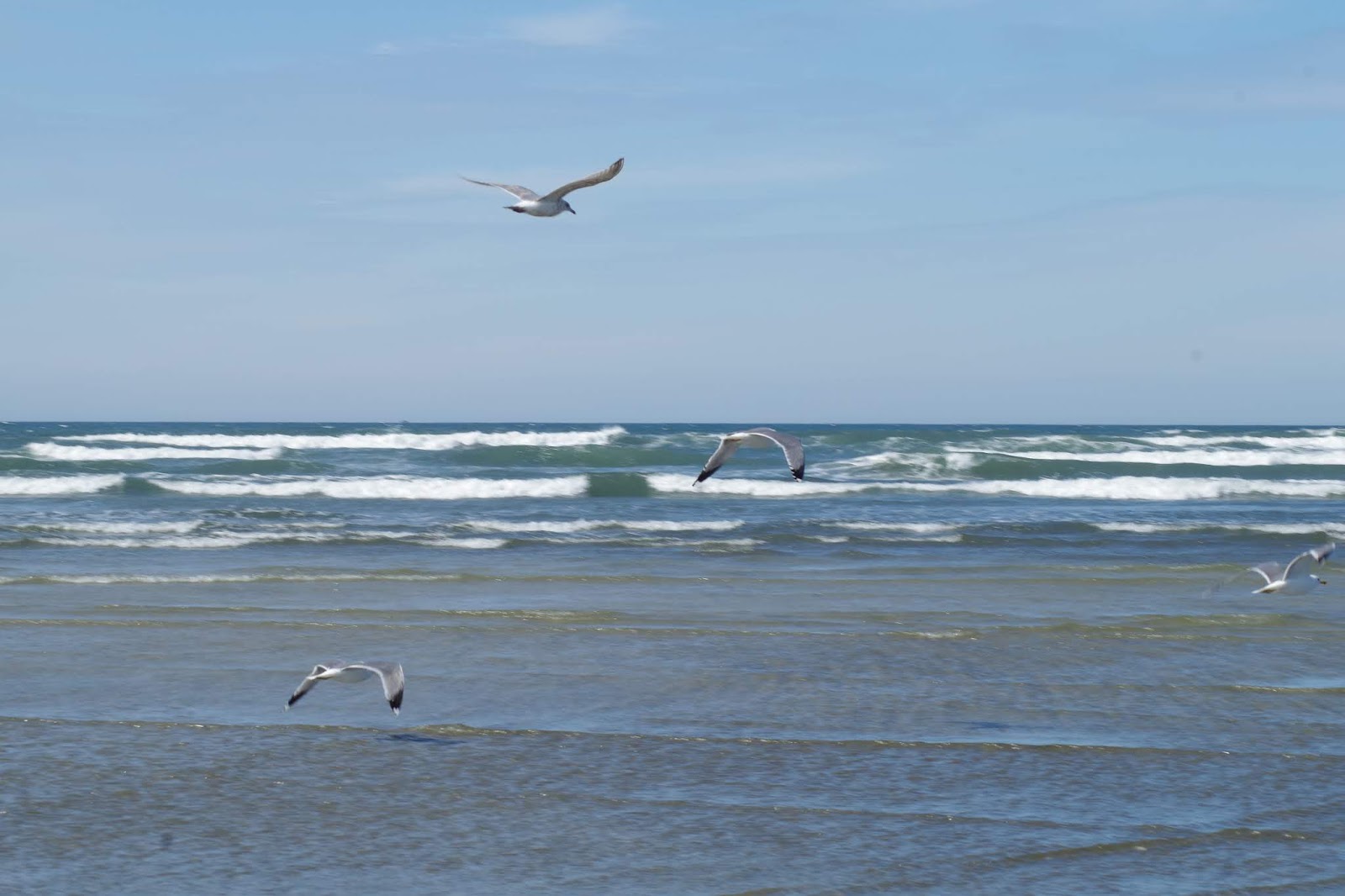
Yesterday, Sunday, we skipped church and headed to the Washington Coast for a day of sun and sand. It was a day full of wonder, which is my theme for the Lenten season. So without much ado, here is the day in photos.
| I manned the dog, and Don manned the camera. The temperature was in the 60s and there was very little wind. We even used a little sunscreen to avoid burning. |
| The dog, Bingley, loved everything about the beach and got progressively wetter and sandier the longer we walked. Here he is relatively clean. |
| I love this photo of the dog and his reflection. Notice how much dirtier he is in this shot. |
| While I wrangled the dog, Don focused on the birds, the surf, and the sky. |
| Don kept teasing me about my hair. It wasn't bothering me. |
(By the way Google, Carrie Underwood did not write this song. She may have performed it but it was written by a Swede, Carl Boberg, in 1885.)
Friday, March 29, 2019
BECOMING by Michelle Obama---Some random thoughts and insights
Last Sunday night I had the distinct pleasure to attend a Michelle Obama book event at the Tacoma Dome. The event had been scheduled long before and then rescheduled due to snow in February. My husband, sister Kathy, mom, daughter Rita, and friend Margaret attended with me. We made it into a celebration, dining before the event on pizza and chatting with people we stood near in line. My mom, who can make friends with anyone, struck up a conversation with three gals standing in front of us. All were hugging Michelle Obama's book to their chests, hoping to get a chance to have her sign them at some point in the evening. My husband ran into a co-worker and her husband, who is a public school librarian. My sister, daughter, friend, and I are all teachers, so we started chatting with him while my husband spoke to his colleague. There was an air of enthusiasm and anticipation in the air. Even the long line to get through security did little to dampen our moods.
When Michelle and her host for the evening, Jimmy Kimmel, stepped out on stage thirty minutes late (due to the aforementioned security lines, no doubt) we all cheered and wept for joy. To be in the same room with this woman felt like privilege and honor. I wanted to take notes so I could remember everything, but I held myself in check. That would be such a teacherish thing to do. Anyway, here are a few of my thoughts and insights from the evening and her book, sans notes---
---A reviewer of the book BECOMING, Afua Hirch for the Guardian, said there is an irresistible light in Michelle Obama. I would agree. Even from our vantage point far from the stage, her light shone throughout the room. It is almost unbelievable how warm, kind, and funny she is.
---In her book, Michelle Obama describes an almost idyllic life growing up on the South Side of Chicago. As she started campaigning for her husband she came to realize that her most valuable tool was to relate her story with the people she met along the way that seemed like her family. There was a moment during the campaign, which she described in the book, where she was sitting in someone's living room. She looked around at the doilies on the tables. The doilies reminded her of her great-aunt and it was at this point that she realized we are all the same, really. It changed the way she campaigned.
---Ta-Nahesi Coates, the author of Between the World and Me, a book of advice from a black father to his black son, attended one of Michelle's events and wrote that he “almost mistook her for white”, comparing her to “an old stevedore hungering for the long-lost neighborhood of yore... In all my years of watching black public figures, I’d never heard one recall such an idyllic youth.” (Guardian) Michelle has embraced her story and in the process may help us to embrace our own.
---For all her remembrances of an idyllic youth, there was one event which Michelle did recount when her older brother was riding a new bicycle and was pulled over by the police. He did nothing wrong but he got pulled over because a black kid couldn't possibly have a new bike. Craig talked the officer into taking him home to ask his mother, which he did. Later their mom insisted that she and Craig go to the police station to demand an apology from the officer, who gave them one.
---Jimmy Kimmel was funny but I think Michelle was funnier. She poked fun at Barack the most. At one point Kimmel asked her how her husband's memoir was coming along and she joked that she got a lot of the good stories since hers came out first. From the book I remember a lot of comments about Barack's tardiness and blowing through deadlines.
---She didn't talk much about this at the event last Sunday, but the book made it clear that Michelle needs and wants to have a purpose. When she became the First Lady of the United States (FLOTUS) she could have melted into the background, finding times to make her husband look good and fading back, but that wasn't for her. Since no one was telling her what to make as her projects, she decided to pick things that were important to her---Military families and health issues related to poor food choices and lack of exercise of youth and children. She accomplished remarkable participation and changes by leading by example and finding ways for companies and organizations to piggy-back on her themes. For example, the NFL Play 60 encouraging kids to go outside and play for an hour every day came about because of a collaboration with Michelle. She continues with project aimed at making the world a better place. One project which is going worldwide is called 'Let Girls Learn.' Now that is a project I can get behind.
---As the evening event was coming to a close, all six people in my party were struck with a feeling of nostalgia. We had the wonderful Obamas and now we have the awful Trumps. As Michelle talked about her last day in the White House she said she just broke down and cried. Jimmy Kimmel quipped, "So did I." So did I. I'm remembering that awful Wednesday in November when we all got up to a new America. All I could do was cry, too. In fact, for several weeks I couldn't even watch anything on TV except old Jane Austen movies. I didn't want to face the reality of an America in the grips of the most selfish man alive, after being in a country run by the most selfless president and his wife, Barack and Michelle Obama.
---I listened to BECOMING on audiobook. Michelle Obama is the narrator. It was such a special experience hearing the stories of growing up, falling in love, raising children, and becoming FLOTUS in her own voice. I recommend it.
---One odd, dissonant note prior to the Sunday event...we were greeted, before we entered the dome, by people standing on the street corners holding signs telling us we were going to go to hell. (If we, what, went to the Michelle Obama event?) It was so odd, and of course, judgmental, so opposite of what the evening was about---acceptance, love, and making a difference.
---I recommend that you read the book, or better yet, listen to it, AND, if you get a chance, attend one of Michelle Obama's book events. I understand she has extended her tour. Perhaps she is coming to a stadium near you. Honestly, a stadium. Can you imagine a book generating such passion that the events have to be held in huge venues? Just this week sales of her book topped 10 million (books, e-books, audiobooks combined) and is on its way to be the most popular memoir of all times. Don't be the last person to read it.
---Lastly, let's all stop and think for a minute why the book was titled BECOMING. I'm going to chew on that one for a while but I am guessing that Michelle would hope that we are "becoming" our true selves, too.
RHS Book Club selection May 2019
When Michelle and her host for the evening, Jimmy Kimmel, stepped out on stage thirty minutes late (due to the aforementioned security lines, no doubt) we all cheered and wept for joy. To be in the same room with this woman felt like privilege and honor. I wanted to take notes so I could remember everything, but I held myself in check. That would be such a teacherish thing to do. Anyway, here are a few of my thoughts and insights from the evening and her book, sans notes---
---A reviewer of the book BECOMING, Afua Hirch for the Guardian, said there is an irresistible light in Michelle Obama. I would agree. Even from our vantage point far from the stage, her light shone throughout the room. It is almost unbelievable how warm, kind, and funny she is.
---In her book, Michelle Obama describes an almost idyllic life growing up on the South Side of Chicago. As she started campaigning for her husband she came to realize that her most valuable tool was to relate her story with the people she met along the way that seemed like her family. There was a moment during the campaign, which she described in the book, where she was sitting in someone's living room. She looked around at the doilies on the tables. The doilies reminded her of her great-aunt and it was at this point that she realized we are all the same, really. It changed the way she campaigned.
---Ta-Nahesi Coates, the author of Between the World and Me, a book of advice from a black father to his black son, attended one of Michelle's events and wrote that he “almost mistook her for white”, comparing her to “an old stevedore hungering for the long-lost neighborhood of yore... In all my years of watching black public figures, I’d never heard one recall such an idyllic youth.” (Guardian) Michelle has embraced her story and in the process may help us to embrace our own.
---For all her remembrances of an idyllic youth, there was one event which Michelle did recount when her older brother was riding a new bicycle and was pulled over by the police. He did nothing wrong but he got pulled over because a black kid couldn't possibly have a new bike. Craig talked the officer into taking him home to ask his mother, which he did. Later their mom insisted that she and Craig go to the police station to demand an apology from the officer, who gave them one.
---Jimmy Kimmel was funny but I think Michelle was funnier. She poked fun at Barack the most. At one point Kimmel asked her how her husband's memoir was coming along and she joked that she got a lot of the good stories since hers came out first. From the book I remember a lot of comments about Barack's tardiness and blowing through deadlines.
---She didn't talk much about this at the event last Sunday, but the book made it clear that Michelle needs and wants to have a purpose. When she became the First Lady of the United States (FLOTUS) she could have melted into the background, finding times to make her husband look good and fading back, but that wasn't for her. Since no one was telling her what to make as her projects, she decided to pick things that were important to her---Military families and health issues related to poor food choices and lack of exercise of youth and children. She accomplished remarkable participation and changes by leading by example and finding ways for companies and organizations to piggy-back on her themes. For example, the NFL Play 60 encouraging kids to go outside and play for an hour every day came about because of a collaboration with Michelle. She continues with project aimed at making the world a better place. One project which is going worldwide is called 'Let Girls Learn.' Now that is a project I can get behind.
---As the evening event was coming to a close, all six people in my party were struck with a feeling of nostalgia. We had the wonderful Obamas and now we have the awful Trumps. As Michelle talked about her last day in the White House she said she just broke down and cried. Jimmy Kimmel quipped, "So did I." So did I. I'm remembering that awful Wednesday in November when we all got up to a new America. All I could do was cry, too. In fact, for several weeks I couldn't even watch anything on TV except old Jane Austen movies. I didn't want to face the reality of an America in the grips of the most selfish man alive, after being in a country run by the most selfless president and his wife, Barack and Michelle Obama.
---I listened to BECOMING on audiobook. Michelle Obama is the narrator. It was such a special experience hearing the stories of growing up, falling in love, raising children, and becoming FLOTUS in her own voice. I recommend it.
---One odd, dissonant note prior to the Sunday event...we were greeted, before we entered the dome, by people standing on the street corners holding signs telling us we were going to go to hell. (If we, what, went to the Michelle Obama event?) It was so odd, and of course, judgmental, so opposite of what the evening was about---acceptance, love, and making a difference.
---I recommend that you read the book, or better yet, listen to it, AND, if you get a chance, attend one of Michelle Obama's book events. I understand she has extended her tour. Perhaps she is coming to a stadium near you. Honestly, a stadium. Can you imagine a book generating such passion that the events have to be held in huge venues? Just this week sales of her book topped 10 million (books, e-books, audiobooks combined) and is on its way to be the most popular memoir of all times. Don't be the last person to read it.
---Lastly, let's all stop and think for a minute why the book was titled BECOMING. I'm going to chew on that one for a while but I am guessing that Michelle would hope that we are "becoming" our true selves, too.
![]() |
| Waiting for the event to start. Margaret, me, Mom, Kathy, Rita (Don not in photo) |
Thursday, March 28, 2019
Review and quotes: The Magic Strings of Frankie Presto
Book Beginnings on Friday is hosted by Rose City Reader. Share the opening quote from the book.
The Friday 56 is hosted at Freda's Voice. Find a quote from page 56.
Review, of sorts, to follow.
This is the book I'm highlighting right now---
Title: The Magic Strings of Frankie Presto by Mitch Albom
Book Beginning:
Review: I was quite taken by this book and was enchanted by the narrator: Music. Several reviewers said they didn't like the shtick that Albom used by making everything about music which included musical terms to describe the action. But I loved it. For example, he said that every love story follows the four parts of a symphony: Allegro, Adagio, Minuet/Scherzo, and Rondo. Thankfully the narrator explains each term, not leaving musical intelligence to the reader. My favorite parts of the story were supplied by the musical interludes---interviews with actual musicians about their interactions with Frankie Presto. At the end of the book, Albom explained that he contacted each of the real musicians and asked them if they would allow some event in their real life to have Frankie Presto inserted into their history. It was so clever. Apparently Albom is quite musical himself and has played in many bands during his life.
My sister gave me this book for my birthday even though she hasn't read it because she (and I) are Mitch Albom fans. His books are very readable and often deal with spiritual themes. I gave the book 4 stars on my Goodreads review because it seemed a bit too long, though I really shouldn't be picky since it only took a few days to complete. It is the second book I finished for the "My Own Books' reading challenge. Part of that challenge involves deciding what to do with the book after finishing it. I will share the book with my sister and my cousin-once-removed. The book deserves wide distribution.
Source: Albom, Mitch. The Magic Strings of Frankie Presto. HarperCollins, 2015. Print.
The Friday 56 is hosted at Freda's Voice. Find a quote from page 56.
Review, of sorts, to follow.
This is the book I'm highlighting right now---
Title: The Magic Strings of Frankie Presto by Mitch Albom
Book Beginning:
"I have come to claim my prize. He is there, inside the coffin. In truth, he is mine already. But a good musician holds respectfully until the final notes are played."Friday 56:
"'You will call me El Masestro,' he said."Summary: Frankie Presto is the greatest guitarist to ever live. This is his story, as told by MUSIC itself. It is also the story of a boy who is born in the lowliest of circumstances, raised by someone other than his parents, and taught to play the guitar by a blind drunkard he called El Maestro. When he is sent away from Spain at the age of nine, all he has to call his own is a guitar and a set a strings. As it turns out the strings seem to have magical qualities, each saving or changing a life before turning brilliant blue. Frankie just wants to make music and to reunite with the girl of his dreams, Aurora. But fame gets in the way of both. When he finally can't stand himself anymore, he disappears for years, finally re-emerging for one last spectacular concert before his death.
Review: I was quite taken by this book and was enchanted by the narrator: Music. Several reviewers said they didn't like the shtick that Albom used by making everything about music which included musical terms to describe the action. But I loved it. For example, he said that every love story follows the four parts of a symphony: Allegro, Adagio, Minuet/Scherzo, and Rondo. Thankfully the narrator explains each term, not leaving musical intelligence to the reader. My favorite parts of the story were supplied by the musical interludes---interviews with actual musicians about their interactions with Frankie Presto. At the end of the book, Albom explained that he contacted each of the real musicians and asked them if they would allow some event in their real life to have Frankie Presto inserted into their history. It was so clever. Apparently Albom is quite musical himself and has played in many bands during his life.
My sister gave me this book for my birthday even though she hasn't read it because she (and I) are Mitch Albom fans. His books are very readable and often deal with spiritual themes. I gave the book 4 stars on my Goodreads review because it seemed a bit too long, though I really shouldn't be picky since it only took a few days to complete. It is the second book I finished for the "My Own Books' reading challenge. Part of that challenge involves deciding what to do with the book after finishing it. I will share the book with my sister and my cousin-once-removed. The book deserves wide distribution.
Source: Albom, Mitch. The Magic Strings of Frankie Presto. HarperCollins, 2015. Print.
Wednesday, March 27, 2019
Winter Hours: Prose, Prose Poems, and Poems by Mary Oliver
A few months ago I saw a blog post about Mary Oliver's Winter Hours: Prose, Prose Poems, and Poems. I thought, mistakenly, that it was something new. Something published posthumously by my favorite poet. I quickly started searching for it and found a copy available for checkout from my public library. It wasn't something new, published in 1999 Winter Hours: Prose, Prose Poems, and Poems had been around for years I'd just missed it. Old or new, it was still Mary Oliver's writing and relished the moments I had reading through it. Several of the essays were very familiar. I'm sure I've read them before, probably in a compilation collection published after this one, but I am not sure.
In the forward, Mary Oliver says that everything in this collection is autobiographical, written out of "meditation and memory" and she thinks of her prose not so much as essays but more like prose poems (hence the subtitle.) I would correct her, though, because the chapters on the poets Poe, Whitman, Hopkins, and Frost are certainly not autobiographical. Here, she says are her thoughts on poets written for a class she was teaching. But she says, "Consider what is written rather as parts of a conversation, or a long and slowly arriving letter--- somewhat disorderly, natural in expression, and happily unfinished." So we shall.
As in all the other books and collections I've read by Mary Oliver this one is full of nature, but in this book one is very aware of the author herself. The first essay is titled "Building a house" where she describes building a small (very small) house in her backyard from scavenged materials. She compares herself as the opposite of a young carpenter she knows who is very good at building things but likes to spend his lunch hour quietly writing poetry. His poetry isn't very good, but he enjoys writing it. Oliver recognizes that her building skills aren't very good, but sometimes a person just needs to do something physical, from start to finish. This is when she decided to build the little house. And though it was rarely used for its purpose, as a writing shed, she is tremendously satisfied with the product of her labors.
In her essay "The Swan", Mary Oliver talks about the "rules" she set out for herself when she began her writing career. Each poem must "have a genuine body, it must have sincere energy, and it must have a spiritual purpose." If the poem lacked any of these elements she would discard it. Later she added other "rules" or "admonitions and consents." She wanted every poem to "rest in intensity" and to be full of "pictures of the world." She also wanted her poems to "carry a thread from perceptually felt to the intellectual world." She wanted readers to recognize that her professional life was was full of "intelligence, patience, passion, and whimsy." This essay, more than any of the others, gave me insights as to why I like Mary Oliver poems above all others.
Part two of the collection were the essays on the four poets: Poe, Hopkins, Frost, and Whitman. I marveled at her thoughts and insights on these remarkable men and their works. I found the essay on Frost to be the most profound, where I really gained new knowledge. She points out that in almost all of Frost's lyrical poems something is wrong. The metaphoric language names something disquieting, yet the meter and rhyme tells us everything is just fine. She says the general reader of his poem finds them easy to read and enjoyable yet she finds them heavy-hearted. After he became famous for his writings, his poems changed to reflect more cheerfulness, as if he thought that is what the public wanted so he would give it to them. This essay, and the other three on the poets, would become part of my professional library were I an English teacher who had to teach about poetry. All four of the essays are very insightful.
In part three, Oliver has three meditations she calls "Sand Dabs". I had to look up the term. A sand dab is a small type of flounder, or a small, well put-together fish. It is a clever title for meditations which are all one or two lines long. Here are few that provoked insights in me:
During this Lenten season I am charged to be wonderstruck, to be open and aware for God and all his wonders. Mary Oliver is always a good place to start when looking for an opening.
She asks, "Who knows what is beyond the known?" and "If you think that any day the secret of light might come, would you not keep the house of your mind ready?"
I'll let you ponder those last two questions as my closing.
Source: Oliver, Mary. Winter Hours: Prose, Prose Poems, and Poems. Houghton, Mifflin Company, 1999. Print.
In the forward, Mary Oliver says that everything in this collection is autobiographical, written out of "meditation and memory" and she thinks of her prose not so much as essays but more like prose poems (hence the subtitle.) I would correct her, though, because the chapters on the poets Poe, Whitman, Hopkins, and Frost are certainly not autobiographical. Here, she says are her thoughts on poets written for a class she was teaching. But she says, "Consider what is written rather as parts of a conversation, or a long and slowly arriving letter--- somewhat disorderly, natural in expression, and happily unfinished." So we shall.
As in all the other books and collections I've read by Mary Oliver this one is full of nature, but in this book one is very aware of the author herself. The first essay is titled "Building a house" where she describes building a small (very small) house in her backyard from scavenged materials. She compares herself as the opposite of a young carpenter she knows who is very good at building things but likes to spend his lunch hour quietly writing poetry. His poetry isn't very good, but he enjoys writing it. Oliver recognizes that her building skills aren't very good, but sometimes a person just needs to do something physical, from start to finish. This is when she decided to build the little house. And though it was rarely used for its purpose, as a writing shed, she is tremendously satisfied with the product of her labors.
In her essay "The Swan", Mary Oliver talks about the "rules" she set out for herself when she began her writing career. Each poem must "have a genuine body, it must have sincere energy, and it must have a spiritual purpose." If the poem lacked any of these elements she would discard it. Later she added other "rules" or "admonitions and consents." She wanted every poem to "rest in intensity" and to be full of "pictures of the world." She also wanted her poems to "carry a thread from perceptually felt to the intellectual world." She wanted readers to recognize that her professional life was was full of "intelligence, patience, passion, and whimsy." This essay, more than any of the others, gave me insights as to why I like Mary Oliver poems above all others.
Part two of the collection were the essays on the four poets: Poe, Hopkins, Frost, and Whitman. I marveled at her thoughts and insights on these remarkable men and their works. I found the essay on Frost to be the most profound, where I really gained new knowledge. She points out that in almost all of Frost's lyrical poems something is wrong. The metaphoric language names something disquieting, yet the meter and rhyme tells us everything is just fine. She says the general reader of his poem finds them easy to read and enjoyable yet she finds them heavy-hearted. After he became famous for his writings, his poems changed to reflect more cheerfulness, as if he thought that is what the public wanted so he would give it to them. This essay, and the other three on the poets, would become part of my professional library were I an English teacher who had to teach about poetry. All four of the essays are very insightful.
In part three, Oliver has three meditations she calls "Sand Dabs". I had to look up the term. A sand dab is a small type of flounder, or a small, well put-together fish. It is a clever title for meditations which are all one or two lines long. Here are few that provoked insights in me:
You can have the other words---chance, luck, coincidence, serendipity. I'll take grace. I don't know what it is exactly, but I'll take it.
I am a performing artist; I perform admiration. Come with me, I want my poems to say. And do the same.
Every day I think of Schubert and the mystery of his six hundred songs.As is always the case, Mary Oliver helps me stop and wonder. I know from her own words in this collection, that she does this on purpose. At the end of part four she talks about wonder...about finding an unfindable bird and the moment he disappears another bird, hundreds of miles from his home, appears. It is hard to top such a moment but she does. Once, she says, she came upon two angels keeping guard beside a car."Light streamed from them, and a splash of flames lay quietly under their feet. What is one to do with such moments, such memories, but cherish them?"
During this Lenten season I am charged to be wonderstruck, to be open and aware for God and all his wonders. Mary Oliver is always a good place to start when looking for an opening.
She asks, "Who knows what is beyond the known?" and "If you think that any day the secret of light might come, would you not keep the house of your mind ready?"
I'll let you ponder those last two questions as my closing.
Source: Oliver, Mary. Winter Hours: Prose, Prose Poems, and Poems. Houghton, Mifflin Company, 1999. Print.
Monday, March 25, 2019
TTT: Some of my favorite audiobooks
Top Ten Tuesday: Some of my favorite audiobooks
(that I've listened to recently)---
I love, love, love this narration. Whitener brings the New Orleans accent to the book. This is a fun, quirky, hilarious read. Perfect as an audiobook. Listen to a clip here:
2. Lincoln in the Bardo by George Saunders, read by a cast of 166, including Nick Offerman and David Sedaris.
This book won the best audiobook of 2018 for good reason because of this amazing cast. The audiobook is much better than the book, I understand from my book club friends. Those of us who listened, loved it, those who read it, didn't. Read more about the audiobook here.
3. There There by Tommy Orange, read by Alma Cuervo, Kyla Garcia, Darrell Dennis, Shaun Taylor-Corbett.
This is a hard story about a hard topic but the audiobook is so, so good. And the reader feels like they are at the Big Oakland Powwow with the others on that fateful day. For a sample clip, click here:
4. The Soul of America: the Battle for Our Better Angels by Jon Meacham, read by the author and Frank Sanders.
For folks who are disturbed by what is happening in America politics today, this book is a salve for the soul. Jon Meacham is an excellent narrator for his own historical writing and Frank Sanders is so inspiring to listen to. If you like reading history, I recommend this book in this format. Listen to a clip here.
5. Becoming by Michelle Obama, read by the author.
I just saw Michelle last night at a big event here in Tacoma. It is so wonderful listening to stories about her life in her own voice. Listen to a sample.
6. Hitchhiker's Guide to the Galaxy by Douglas Adams, read by Stephen Fry
This is possibly the funniest book ever written and Stephen Fry is master of creating unique and memorable voices, making it even funnier. This is not-to-be-missed in this format. Sample here.
7. The Raven Cycle series by Maggie Stiefvater, read by Will Patton
I love every book I've heard read by Will Patton. He has a very unique and interesting voice and his narration makes this series, which is wonderful by itself, simply superb. Give the audio a try here.
8. Children of Blood and Bone by Tomi Adeyemi, read by Buhni Turbin
This is an example of a book that works well for people who has trouble sounding out words from other languages, like me. This is set in Nigeria and utilizes lots of terms from the language. The audiobook works well to make the story richer for hearing the language as it is supposed to sound. Listen to a clip.
9. Less by Andrew Sean Greer, read by Robert Petkoff
As I mentioned before, sometimes the audio version of a book makes it more accessible, or humorous, or aids in understanding. Other times it offers the chance for two listeners to share an experience. This book, a Pulitzer prize winner, is very funny and the humor is enhanced by the listening experience. Any book by Alexander McCall Smith is also funnier in the audio format, I think. Listen to a clip of Less here.
10. His Dark Material series by Philip Pullman, read by Philip Pullman and a complete cast
Okay. I confess. I listened to this series many years ago but it really made an impression. My whole family and I were mesmerized from start to finish. We were together for a long car trip and we sat in rapt attention for hours, barely daring to say a word. It was a magical listening experience. Another series which was also magical to listen to was The Harry Potter series. The family listened to one of the books on a long trip. It took hours of listening but we all loved it. Clip of the Golden Compass. A Clip from Harry Potter and the Goblet of Fire narrated by Jim Dale, who won awards for his work on the series.

Subscribe to:
Posts (Atom)