"Outside a dog a book is man's best friend, inside a dog it is too dark to read!" -Groucho Marx========="The person, be it gentleman or lady, who has not pleasure in a good novel, must be intolerably stupid." -Jane Austen========="I don’t believe in the kind of magic in my books. But I do believe something very magical can happen when you read a good book."-JK Rowling========"I spend a lot of time reading." -Bill Gates=========“Ahhh. Bed, book, kitten, sandwich. All one needed in life, really.” -Jacqueline Kelly=========

Sunday, January 9, 2011

New edition to bowdlerize Huckleberry Finn

bowdlerize, v. 
to expurgate (a written work) by removing or modifying passages considered vulgar or objectionable.

Publisher's Weekly has decided that they will publish a sanitized version of The Adventures of Huckleberry Finn substituting "slave" for the "N-" word and also removing another inflammatory word, "Injun" for a more sanitized word.  Here is the rationale for why PW decided to bowdlerize this classic work of fiction:
Mark Twain's Adventures of Huckleberry Finn is a classic by most any measure—T.S. Eliot called it a masterpiece, and Ernest Hemingway pronounced it the source of "all modern American literature." Yet, for decades, it has been disappearing from grade school curricula across the country, relegated to optional reading lists, or banned outright, appearing again and again on lists of the nation's most challenged books, and all for its repeated use of a single, singularly offensive word: "nigger."

Twain himself defined a "classic" as "a book which people praise and don't read." Rather than see Twain's most important work succumb to that fate, Twain scholar Alan Gribben and NewSouth Books plan to release a version of Huckleberry Finn, in a single volume with The Adventures of Tom Sawyer...Marc Shultz for PW
To be fair, the article does go on to say that they are doing this so that schools and students will have an option, not because they want to completely do away with the original text penned by Twain.

Adam Kirsch writing for the New York Times asks us to recognize the time period, the audience, and culture of the day.  Should every work of fiction that offends someone be sanitized?
“Huckleberry Finn” was intended, of course, as an attack on racism. In its most famous scene, Huck hides the runaway slave Jim from a party of slave-hunters, and then feels guilty for having done so. “I knowed very well I had done wrong,” he says, though the reader, and Twain, know he has done right. It’s a searching demonstration of the way conscience is not just innate but also learned, and how confusing it can be to do right in a society dedicated to wrong ...
Yet all those racial epithets are a reminder that, when Twain wrote it, the audience he had in mind — the America for which he wrote — was segregated. He did not worry about constantly writing “nigger,” because he was writing about blacks, not for them. And for many readers, encountering classic literature means sometimes finding yourself excluded, or insulted, in this way. For blacks reading Twain, certainly, but also for Jews reading Shakespeare or Dickens, and for women reading, say, Plato (among countless others).-Adam Kirsch, NYT, 1/7/11
A good teacher should and will help students understand the value and purpose of the text and examine what was going on historically so that it makes sense.  Without using the language of the day, the story loses much of its impact.  An English teacher is teaching Huck Finn at my high school right now.  She decided it was important to start with a text other than Huck Finn and had students read parts of The Narrative of the Life of Frederick Douglass as an introduction to the topic of slavery and injustices.  Following that contextual introduction, the students jumped into Twain's masterful story.  Should we in education only teach things that are comfortable and non-offensive to everyone?

Syndicated columnist Leonard Pitts of the Miami Herald recently wrote that censoring Huck Finn is "wrong, wrong, wrong."  He understands why Publisher's Weekly is planning the new version of Huck Finn but believes "the fix is profoundly wrong."
In the first place, any work of art represents a series of conscious choices on the part of the artist – what color to paint, what note to play, what word to use – in that artist’s attempt to share what is in his or her soul. The audience is free to accept or reject those choices; it is emphatically not free to substitute its own.

In the second place, it is never a good idea to sugarcoat the past. The past is what it is, immutable and nonnegotiable. Even a cursory glance at the historical record will show that Twain’s use of the reprehensible word was an accurate reflection of that era.

So it would be more useful to have any new edition offer students context and challenge them to ask hard questions: Why did Twain choose that word? 
Finally, and in the third place, it is troubling to think the state of reading comprehension in this country has become this wretched,...that not only can our children not divine the nuances of a masterpiece, but that we will now protect them from having to even try.-Leonard Pitts
Pitts goes on to say that Huckleberry Finn is a funny story about a "runaway boy who comes to locate the humanity in a runaway black man and, in the process, vindicates his own." We, like Huck, have a lot to learn about others and about ourselves.  Erasing unpleasant aspects of our past, deprives others from learning in the future. 

Ray Bradbury reacted strongly when he learned that well-meaning editors were bowdlerizing his stories in an attempt to sanitize them for compilation volumes readily available in schools today.  He said the words he chose at the time were the words that he wanted and no one had the right to change or remove those words merely because they were offensive. "I will not go gently onto a shelf, degutted, to become a non-book."(Author's notes, Fahrenheit 451).

The Adventures of Huckleberry Finn is one of the best books ever written.  Why change a single word?

I think this whole kerfuffle would greatly amuse Mark Twain. Here's what he said when people tried to ban or censor his work in his day: "..I am tearfully afraid this noise is doing much harm. It has started a number of hitherto spotless people to reading Huck Finn, out of a natural human curiosity to learn what this is all about---people who had not heard of him before; people who will go to wreck and ruin now."-NY Times, 9/6/1902

Hopefully many people will dust off their old copies of Huck Finn and read it (or re-read) to see what this new fuss is all about.

Saturday, January 8, 2011

The Lover's Dictionary by David Levithan

I just closed this book and decided I'd best blog about it right away before the magic fades.

The Lover's Dictionary by David Levithan is a remarkable and unique book and it makes me want to grab a dictionary and try to write the rest of the blog in the same style as the book.

remarkable, adj.
     I am reading along thinking this book is so clever.  Every page starts with a different word from the dictionary, in alphabetical order, and tells the story by defining the word in context to the developing relationship. It really is quite extraordinary and notably refreshing. I sure hope this book gets the attention it deserves.

unique, n., adj.
     I have never read a book like it before.  It is the sole example of a tale written as if by a dictionary, to my knowledge.

urge, v.
     Does this earnest recommendation press you into action and make you want to jump up, run to the libray or bookstore, and take a look at this book?  I sure hope so.  I do recommend that you grab a dictionary before you sit down with it as there may be a few words you'll need to look up--I did!

example, n.
     Though I am having fun trying to emulate his work, take a look at a few samples of Mr. Levithan's own words:
corrode, v.
I spent all this time building a relationship. Then one night I left the window open, and it started to rust. -p.64
ineffable, adj.
These words will ultimately end up being the barest of reflections, devoid of the sensations words cannot convey. Trying to write about love is ultimately like trying to have a dictionary represent life.  No matter how many words there are, there will never be enough. -p. 120
lover, n.
Oh, how I have hated this word...I have never wanted a lover.  In order to have a lover, I must go back to the root of the word. For I have never wanted a lover, but I have always wanted to love, and be loved. - p. 137
Here is what David Levithan says about the book on his website: 
The Lover’s Dictionary, my first book about post-teenagers, has now hit stores. As with many of my novels, it started as a story for Valentine’s Day – it was February 1st, and I knew I only had two weeks to write something, so I opened up a book of “words to know” and decided to take random words and apply them to a relationship. The result? The story of two people who have been together for a little over two years, told entirely in dictionary form. All the ups, all the downs, and all the in-between. --David Levithan

savor, v. with object
     I gave myself over to the enjoyment of this book.  I heartily recommend it to mature readers and hope they'll enjoy every minute of it, too.

Friday, January 7, 2011

Friday Blogger Hop

Book Blogger Hop

The Book Blogger Hop is a weekly event hosted by Jennifer at Crazy for Books and runs from Friday to Sunday. The Hop is a fantastic way to get your blog noticed, and visit some other blogs that you didn't know about before. Head over and sign up and see what you can find!

Each week a different question will be added to the hop in order for conversations to occur, and for your followers to get to know you better. Here we go!

"What book influenced or changed your life?
How did it influence/change you?
My older sister Kathy was reading a book and she told me I had to read it:  Cold Sassy Tree by Olive Ann Burns. It was the best fiction book I had read in years, maybe ever. Up to that point I was either not reading or I was reading "junk".  This book catapulted me into the wonderful world of great literature and I've never looked back.

2011 Mock Printz Award Update


And the 2011 MOCK PRINTZ AWARDS go to....
After school today I met with 20 high school students for the GKHS 2nd Annual Mock Printz Workshop. After two hours of a stimulating debate, the group selected the following as their award and honor books:

Mock Printz Award Winner:
#1 The Cardturner by Louis Sachar
      After much spirited discussion, this wonderful novel emerged as a group favorite for several reasons--most of the students admired Sachar's writing and how it got us interested in bridge, a game we had no interest in before we read the book; they felt that the main character, Alton, showed growth as a character; and they enjoyed the original whale symbol that indicates it is OK to skip some of the more detailed information about bridge without missing out on the story.

Mock Honor Books
#2 Finnikin of the Rock by Melina Marchetta
     After our first ballot Finnikin and Cardturner were tied.  Several students spoke passionately of how much they like the originality of this imaginative fantasy novel.  Others felt that the novel got off to such a slow start that it shouldn't be our top book. Either way they all agreed it was our top Honor book and certainly worthy of praise.

#3 Half Brother by Kenneth Oppel
     The talk about this book centered around how this book informed us about animal rights/experimentation and how much we cared about the main characters, especially Zan, as the story progressed.


#4 (Tie) The Last Summer of the Death Warriors by Francisco X. Stork
     Growth and development of characters, wonderful writing, and plenty of literary allusions. Some kids chuckled when they learned that the story is loosely based on Don Quixote, a book few teenagers have read but all have heard about.


#4 (Tie) Nothing by Janne Teller
     Several students chafed at our inclusion of this disturbing story on our list but many others felt that the writing was so good especially how Teller evoked such strong emotions in us, even if the emotion was revulsion.


Three other books received a lot of attention but ultimately didn't rise to the top:
a. The Sky is Everywhere by Jandy Nelson- students REALLY liked this book but felt it wouldn't be selected because it is predominantly a "girl" book.
b. Ship Breaker by Paolo Bacigalupi- students liked this book and were impressed that this was the National Book Award winner but weren't as impressed with the symbolism within the story as I was.
c.  Incarceron by Catherine Fisher-came to our attention late so only three kids had a chance to read it but one gal, Rebecca, is convinced that this book will be the winner.  She says she's never read a better, more exciting book.

Now we wait.  
The actual Printz Award will be announced Monday, January 10th.    Stay tuned.
    

Thursday, January 6, 2011

Books I Should Have Read in School Challenge

Much Madness is Divinest Sense
Books I Should Have Read in School...But Didn't Challenge

Last year I participated in, enjoyed, and completed the YA Decades Challenge where I was challenged to read one YA book from each decade 1930 (or before) to present.  As a relatively new librarian I took it as an opportunity to catch up on reading some of those books that I should have read, but hadn't, while I was in school.  When I went to the hosting site for that challenge in late December I didn't see any evidence that that challenge was being offered again this year.  Drats!  But now I discovered this book challenge and think it will fit my needs nicely.  Here are the rules and requirements for this challenge which is hosted over at Much Madness is Divinest Sense:
  • The challenge runs from January 1, 2011 to December 31, 2011.
  • You need not decide which books you will read at this time, and you may commit to any level with which you feel comfortable.
  • You can determine whether a book meets the criteria for the challenge. If you think you should have read it in school and didn’t, then it qualifies. In fact, you can even define school however you like—elementary school, middle school, high school, college, grad school—the list goes on and could vary based on the educational system with which you’re most familiar.
Challenge levels:
  • Literature Professor: Read 12 books you feel you should have read in school.
  • Graduate Student: Read 6 books you feel you should have read in school.
  • College Graduate: Read 4 books you feel you should have read in school.
  • High School Graduate: Read 2 books you feel you should have read in school.
I will aim for the graduate level, 6 books.

These are a few books I'm considering, but please don't hold me to them in case other books pop into my head (I'm almost ashamed to admit I haven't read these):
Beloved by Toni Morrison
Brave New World by Aldoux Huxley
Lord of the Flies by William Golding
The Bell Jar by Sylvia Plath
Ragtime by E.L. Doctorow
Frankenstein by Mary Shelley
East of Eden by John Steinbeck

Here goes....

Do you have any suggestions for me?  If you were going to do this challenge what are the titles of a few books you should have read in school but didn't?

Wednesday, January 5, 2011

Yummy: the Last Days of Southside Shorty by G. Neri

This graphic biography, Yummy: the Last Days of a Southside Shorty, is getting quite a bit of attention in the literary world this year so I thought that I would read and review it. Unlike most graphic novels that I've read, this book has a very disturbing theme: juvenile crime, gangs, and murder. Though an easy book to physically read with it's black and white illustrations, it was a difficult book to mentally read. There are no easy answers when it comes to gang and juvenile crimes. Kids raised in poverty or without proper parental supervision may find acceptance and a sense of "family" with other gang members. But the gangs may ask of them to commit crimes, even murders as a kind of sick initiation.  Should young children, in Yummy's case-- eleven years old, be treated like adults when they commit such heinous crimes?  And how can a person be rehabilitated if they have never been "habilitated" in the first place? The book doesn't offer any easy answers, it mainly just points to the problem and challenges the reader to do things differently.

G. Neri, the author, said about the situation and about Yummy specifically:
When Yummy's story first broke, I was teaching in South Central Los Angeles...I remember following Yummy's story day by day. A couple of students heard about it and we argued whether he was a victim or a bully. When Yummy was found dead and all the facts came out, I wasn't sure who the bad guy was. There were no winners in this story, only losers...So, was Yummy a cold-blooded killer or a victim? The answer is not black-and-white. Yummy was both a bully and a victim--he deserves both our anger and our understanding. Other answers, however, may be clearer. Like the preacher at Yummy's funeral said: make up your mind that you will not let your life end like Yummy's.-Author's note at end of book
Though Yummy: the Last Days of a Southside Shorty is about a disturbing topic, I still recommend it if for no other reason than it calls us out of our complacency.  Here is a link to a sample of a few pages of Yummy by Geri Neri which shows the wonderful graphic designs.  Check it out!

(Yea for me.  This is the first book from yesterday's list of Books I Resolve to Read in 2011 that I have completed...just 9 more!)

Monday, January 3, 2011

Top Ten Books I Resolve to Finish in 2011

Broke and Bookish
I decided that to spend the early part of 2011 finishing up those books that I started sometime in 2010 and that, for a variety of reasons, never had a chance to finish. Here is that list in no particular order.

1.  Yummy: the Last Days of Southside Shorty by G. Neri
I read most of this graphic biography before I went on Winter Break and I just want to finish it up and return it the school that I borrowed it from.
(Completed 1/5/11)
2.  Please Ignore Vera Dietz by A.S. King
I've actually only read three chapters of this book but it was a big enough tease that I really want to finish it which will require that I purchase it or borrow it from the public library.
(Completed 1/17/11)


3.  As Easy as Falling Off the Edge of the Earth by Lynne Rae Perkins
I heard this book was not only good but funny.  A students asked me to recommend a funny book so I allowed him to check out the copy I was reading even though I wasn't finished reading yet. He returned it ages ago, now I just need to get back to it.


4.  The Weed that Strings the Hangman's Noose: a Flavia de Luce Mystery by Alan Bradley
I checked this web version of an audio-book out of the public library and was supposed to be able to copy to my iPod, which I couldn't. I had to sit at my computer to listen to it which was completely irritating. I like to listen to books while I'm driving not working at a computer. I will have to just check out the print version, which is a bummer because I adore the reader for the audio version: Jayne Entwistle.

5.  Chasing Fireflies by Charles Martin
A favorite among other book club members I really do want to know how this book ends I just need to dedicate some reading time to it. I'm nearly halfway finished so that shouldn't be a problem.

6.  Dewey: the Small-town Library Cat Who Touched the World by Vicky Myron
I abandoned this book without giving it much of a go because I didn't think it was particularly well-written.  Then I overheard someone telling another person how delightful, and well-written this book was and I thought to myself, "Come on, give it a fair try." So back on the list it goes.


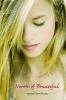
7.  North of Beautiful by Justina Chen Headley
I was several chapters into this compelling YA story before I had to relinquish it to a student who was looking for it.  My turn should come up again soon.


8.  The Burn Journals by Brent Runyon
I was watching a movie promo about this boy who set himself on fire.  I remembered that I had read the first few chapters of such a book but never took the time to complete it. Now I want to find out what all the fuss is about.

9.  The Luxe by Anna Godbersen
Sometimes I abandon books for good cause.  Was this such a book?  I can't remember.  I will need to pick up where I left off to figure out why I didn't feel compelled to complete this book, which is the first book of a popular series.


10.  I can't remember the name or the author.  Hmmmm.  But I really liked the book and I wanted to finish reading it....Ever have one of those moments? 3/6/11...An update: I remember the book:  Enna Burning by Shannon Hale.

What's on your TBR (To Be Read) pile that you'd like to finish in 2011?

Saturday, January 1, 2011

My Head is Full of Books can now receive messages from my new Droid!

Friday, December 31, 2010

Dash and Lily's Book of Dares by Cohn and Levithan

“I’ve left some clues for you. If you want them, turn the page. If you don’t, put the book back on the shelf, please.” So begins the latest whirlwind romance from the New York Times bestselling authors of Nick & Norah’s Infinite Playlist, Rachel Cohn and David Levithan. Lily has left a red notebook full of challenges on a favorite bookstore shelf, waiting for just the right guy to come along and accept its dares. But is Dash that right guy? Or are Dash and Lily only destined to trade dares, dreams, and desires in the notebook they pass back and forth at locations across New York?-from Goodreads
Dash and Lily's Book of Dares is a sweet and thoughtful story of two teens who find themselves alone at Christmas, both ripe for adventure and romance. The chapters alternate between Dash and Lily.  My favorite parts of the story were the things that both of the teens wrote in the red moleskin journal about their thoughts and dreams.  Both are lovers of the written word, as am I, and they articulate their thoughts well.  Parts of the story seem too easy/silly/far-fetched/unrealistic but I did appreciate that the kids each recognized that a romance started this way may not flourish and, at the same time, had family and other friends that needed tending. 

I think that this book will resonate with other teens and I hope that they will want to read it at other times of the year than just during the holidays. I know I will be recommending it to my library patrons the minute I get back from break.

Thursday, December 30, 2010

Booking Through Thursday

BTT2
Questions of the day:
What’s the best book you read this year? Worst? Favorite?

Best book I read this year: The Adventures of Huckleberry Finn by Mark Twain.  (Can you believe I have never read this book, The Great American Novel, before?)

Worst book I read: The Human Stain by Philip Roth. (Perhaps it is because of all the critical acclaim it received but it was a very difficult book to read and I was very disappointed. I did finish it, however.  There were other books that I abandoned mid-book.  I guess one of those really should be the worst.)

Favorite book of the year:  Tales of the Madman Underground by John Barnes.  (I love, love, love this book and it seems like no one else has read it.)

What are your answers to the above questions?