"Outside a dog a book is man's best friend, inside a dog it is too dark to read!" -Groucho Marx========="The person, be it gentleman or lady, who has not pleasure in a good novel, must be intolerably stupid." -Jane Austen========="I don’t believe in the kind of magic in my books. But I do believe something very magical can happen when you read a good book."-JK Rowling========"I spend a lot of time reading." -Bill Gates=========“Ahhh. Bed, book, kitten, sandwich. All one needed in life, really.” -Jacqueline Kelly=========

Wednesday, July 21, 2021

My Goodreads Project

Goodreads vs AnneReads!

Cue the eyerolls!


 I am starting another inane project. I'm calling it my Goodreads Project.

In 1997 I started keeping a book of annotated list of books I was reading in little blank book. I filled at least three of them over the years.

In 2009, around the time I started blogging, I found Goodreads (after a short stopover at Library Thing) and slowly stopped using the paper/print version of cataloging in preference to the ease of Goodreads.

Over the years I have honed my Goodreads account to be a very useful tool in not only keeping track of titles I've read, but also categories -- audiobooks, book club selections, reviewed books, nonfiction, etc. -- allowing me to do all kinds of 'sorts' when I am making lists.

Using my little books isn't as easy to use to help find titles/dates/my timely thoughts.

So...

Today I am launching into my Goodreads Project where I will transcribe the titles/dates/thoughts on books I read between 1997 to 2009 into the Goodreads database.

 Just another chore that no one cares about but me. But here I go anyway... (This one should take me awhile.) 

Update: It took me two days but I finally updated my records for 2009! One year done. And what a fabulous year of reading. I enjoyed the walk down memory lane thinking about these books and remembering what was happening in my life during that year.

Update #2: I have now completed 2008. It is odd to think that I read some of these books over twelve years ago but they are still fresh in my mind. By 2008 I was almost reading YA exclusively unless for book club and my passions for classics. 

Update #3: I've almost completed entering reviews for books read in 2007. It was a stellar year for reading memorable books. I was still reading mostly adult fiction with obvious attempts to catch up on reading classics, books assigned to classes to read. I've also started adding links to my reviews to all my newer blogposts thinking if I ever want to find a review using a link on Goodreads would be way faster than trying to find it on blogger. I recognize that this project, like just about everything I do in the blogging world, is mainly for me so I should make it as user friendly for myself as possible.

-Anne

Tuesday, July 20, 2021

Are these the 'Best of the Best' Pulitzer Prize novels?


This week I've been reevaluating my Pulitzer Prize Challenge, thinking perhaps I should abandon it and just make an attempt to read the current winner each year and not worry about going back and attempting to read past winners. With this idea running through my head it occurred to me that perhaps I should check out which books are considered the best and make an attempt at reading those and leaving the others.

What I discovered after doing a little research here, here, here, here, here, here, and here, these eighteen Pulitzer Prize winning novels were mentioned the most (at least three of the seven lists) as the best of the lot. (Note: only two lists were compiled in 2020 all the rest before that date, thus few recent winners were even mentioned, obviously.) I've now read all the eighteen books on this 'Best of the Best Pulitzer' list I've created and have decided to continue reading as many of the past winners as I can.

The 'Best of the Best' Pulitzer Prize Winners for Fiction


1. To Kill a Mockingbird by Harper Lee (1961, six lists)

I read TKAM for the very first time in 2003. I loved it instantly and wondered what took me so long to get to it. I listened to the audiobook narrated by Roses Pritchard. Her voice, with a sweet southern accent, is now the voice of Scout to me. My review, of sorts.

First line: "When he was nearly thirteen years old, my brother Jem got his arm badly broken at the elbow."


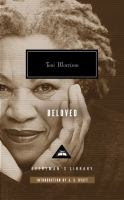
2. Beloved by Toni Morrison (1988, six lists)

I read Beloved in 2010 and I wished I'd been part of a college lit class so to discuss all the symbolism. It blew me away but I found that I needed/wanted help to understand it. After I'd book-talk this for my students many were attracted to the idea of its ghost story but sadly I'm not positive any of them actually ever finished it. My review.

First line: "124 was spiteful."


3. The Color Purple by Alice Walker (1983, six lists)

As a high school librarian I made an attempt to read most of the books that were recommended for students to read before they graduated. This one, read in 2009, didn't make as big of an impact on me as the play we saw in New York City starring Cynthia Erivo in 2018.

First line: "You better not tell nobody but God."


4. The Interpreter Of Maladies: Stories by Jhumpa Lahiri (2000, six lists)

One of the reviewers on Book Riot picked The Interpreter of Maladies as her favorite Pulitzer over TKAM because she's read this short story collection over and over and it always speaks to her. I found all the stories very memorable. (My review)

First line: "The  notice informed them that it was a temporary matter: for five days their electricity would be cut off for one hour, beginning at eight p.m."


5. Grapes of Wrath by John Steinbeck (1940, six lists) 

I wasn't able to tell from the seven lists if this is anyone's favorite Pulitzer, or if it is just one book that it is agreed everyone should read. As often happens with me, the hardest part of reading this classic book was starting. What I appreciated so much was how Steinbeck was writing about such big events in US history in real time. Profound. (My review)

First line: "To the red country and part of the gray country of Oklahoma, the last rains came gently, and they did not cut the scarred earth."


6. Shipping News by E. Annie Proulx (1994, five lists)

I was surprised to see this book on five of the lists because I thought I was the only one who loved it. It is so quirky and odd. I read it in 1997 the first time and several times since. Looking back through my blog I see I never reviewed it. But I did mention it many times on my 'lists of favorites' over the years.

First line: "Here is an account of a few years in the life of Quoyle, born in Brooklyn and raised in a shuffle of upstate towns."


7. The Confederacy of Dunces by John Kennedy Toole (1981, five lists)

TCOD is one of the funniest books I've ever read experienced. Hilarious! Actually, I recommend listening to the audiobook to get the full impact of the story set in New Orleans. Ignatius J. Reilly is possibly the most memorable character in literature. (My review from 2013)

First line: "A green hunting cap squeezed the top of the fleshy balloon of a head."


8. All the Light We Cannot See by Anthony Doerr (2015, four lists)

I not only love this book but I've done a lot with it: two book clubs meetings, an evening event with the author and I wrote two reviews of it. Check out both of them here and here.

First line: (Leaflets) "At dusk they pour from the sky."

9. The Amazing Adventures of Kavalier and Clay by Michael Chabon (2001, four lists)

Why does TAAOKAC deserves a spot on the 'best of the best' list? One reviewer said she was dazzled by it. "It wasn't just its technical perfection—physical description, character development, perspective, time shifts, dialogue, metaphor—and [Chabon] deployed them gracefully, without apparent effort, with inflections of 1940s New York and the language of comic books." (My review.)

First line: "In later years, holding forth to an interviewer or to an audience of aging fans at a comic book convention, Sam Clay liked to declare, apropos of his and Joe Kavalier's greatest creation, that back when he was a boy, sealed and hog-tied inside the airtight vessel known as Brooklyn, New York, he had been haunted by dreams of Harry Houdini."


10. The Age of Innocence by Edith Wharton (1921, four lists)

Edith Wharton was the first female to win a Pulitzer for a novel, and only the third overall. It has stood the test of time with its story of unfulfilled/scandalous love. I read this masterpiece in 2016 as part of the Classics Club Spin challenge. (My review.)

First line: On a January evening of the early seventies, Christine Nilsson was singing in Faust at the Academy of Music in New York.


11. Middlesex by Jeffrey Eugenides (2003, four lists)

Such a complex book about many seemingly unrelated topics: life as a transgender individual, the Armenian genocide, and the Detroit riots of 1968. I listened to the audiobook in 2007 and it has improved in my memory since that time to almost epic proportions.

 First line: "I was born twice: first as a baby girl, on a remarkably smogless Detroit day in January of 1960; and then again, as a teenage boy in an emergency room near Petosky, Michigan, in August of 1974."


12. The Road by Cormac McCarthy (2007, four lists)

After my husband has read this his description of unrelenting dread and the nearly hopeless struggle of a father and son who survived an worldwide apocalypse was a bit off-putting, making me not so eager to start it. But I was profoundly touched by the love each had for the other. In the end love is all we will have. (My review.)

First line: "When he woke in the night and the cold of the night he'd reach and touch the child sleeping beside him."


13. The Angle of Repose by Wallace Stegner (1972, three lists)

I am a Wallace Stegner fan and have enjoyed everything I've read by him. I read TAOR in 1995 and confess that my memory of it is a bit hazy though I do recall being swept up in the story and the setting.

First line: "Now I believe they will leave me alone."

14. The Brief Wondrous Life of Oscar Wao by Junot Diaz (2008, three lists)

This book fairly blew me away. First, who is the narrator? I couldn't figure it out until well into the book. Then all the mysticism or fuku connected to Dominican Republic and some history of the island. Oscar is a marvelous, quirky character. I'd be remiss not to mention the footnotes. Be sure to read them. All of them. (My review)

First line: "Our hero was not one of those Dominican cats everybody's going on about -- he wasn't no home-run hitter or fly bachatero, not a playboy with a million hots in his jock."


15. The Old Man and the Sea by Ernest Hemingway (1953, three lists)

I was in junior high in 1971 or '72 when I read TOMATS so I have only the vaguest of memories of it. I do recall thinking it was a pretty good story after all the torture of reading it for class was done. That said I am not a big fan of Hemingway's sparse style of writing so I doubt I'll reread this one to see what I think of it as an adult.

First line: "He was an old man who fished alone in a skiff in the Gulf Stream and he had gone eighty-four days now without taking a fish."


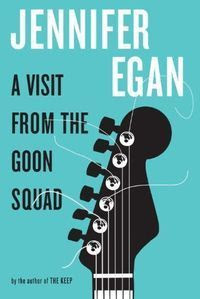
16. A Visit From the Goon Squad by Jennifer Egan (2011, three lists)

The BookRiot reviewer said, "I loved her book, a funky retro-current account of the music industry meets the e-age and the excellently funny chaos that ensues from there." I listened to the audiobook so I think I missed what made this book so unique in terms of format. (My review)

First line:  "It began the usual way, in the bathroom of the Lassimo Hotel."

17. The Hours by Michael Cunningham (1999, three lists)

The Bookriot reviewer said hands down The Hours is the best Pulitzer. "Cunningham writes beautifully, and he does a wonderful job of getting in the heads of three very complex women: Virginia Woolf herself; Laura Brown, a 1950s housewife; and a Clarissa Dalloway-esque character, Clarissa Vaughn." As I read the book, I kept picturing the movie. (My review.)

First line: (Prologue) "She hurries from the house, wearing a coat too warm for the weather."


18. Lonesome Dove by Larry McMurtry (1986, three lists)

Having just read Lonesome Dove last year, this wonderful book is very fresh in my mind. Just about every line is quotable and I can picture all of the action in my head. At 800+ pages in length I 'lived' in the old West for weeks while I read it and I didn't want to leave when I was finished. So I gave it to my husband and had the fun of reliving the book through him. (My review.)

First line: "When Augustus came out on the porch the blue pigs were eating a rattlesnake -- not a very big one."

Now I recognize that this list is sorely out-of-date already. The most recent book to make it onto the list is All the Light We Cannot See from 2015. We've had six years of awards since that date and surely one or more of the most recent books should have at least been in contention for this 'best of the best'  list. I also realize that the lists I drew from were actually just lists of opinions. As my husband and I were discussing my final eighteen titles, he remarked that there are probably very few people alive who have read all 90+ Pulitzer Prize fiction winners, and unless a person had read them all they shouldn't be making a 'best of the best' list. Good point. And that would be me. I've only read 40 and that number includes a few of the finalists. What if one of the best books is just one we haven't read yet? One of the reviewers in the Book Riot article said she'd only read six Pulitzer winners. That is a fairly small field to pick from. So my research is flawed. Very flawed. But as I look over this list and compare it to the whole Pulitzer list, I bet I'm not very far off. Accept this project for what it is -- me trying to decide which of all the Pulitzer winners should I make an attempt to read before I close out my personal Pulitzer Challenge.

Update, July 4, 2023 --- I've completed reading all of the books on this list and linked my reviews.

What is your favorite Pulitzer Prize winning novel?

What books from the master list are conspicuously missing? See full list here.

Sources used to create this list:

Decades represented:

1920s-1; 1930s-0; 1940s-1; 1950s-1; 1960s-1; 1970s-1; 1980s-4; 1990s-2; 2000s-5; 2010s-2

-Anne

Monday, July 19, 2021

TTT: Books I've Read in a Single Sitting


Top Ten Tuesday: Books I've actually read in a single sitting

To be honest, I rarely read books in one sitting unless they are Children's books (no fair) or graphic novels. So I decided to share the graphic novels I remember reading start to finish.


1. The Prince and the Dressmaker by Jen Wang


2. Speak: The Graphic Novel by Laurie Halse Anderson 


3. The Faithful Spy: Dietrich Bonhoeffer and the Plot to Kill Hitler by John Hendrix


4. Laura Dean Keeps Breaking Up With Me by Mariko Tamaki


5. New Kid by Jerry Craft


6. Cicada by Shaun Tan


7. Dancing at the Pity Party by Tyler Feder


8. The Boy, the Mole, the Fox, and the Horse by Charlie Mackesy


9. March, Book 3 by John Lewis


10. The Spill Zone, #1 by Scott Westerfeld

-Anne

Sunday, July 18, 2021

Sunday Salon---July 2021

The joy of summer. Ian and his cousin, Wayde, running through the blueberry field.

Weather: Sunny and warm; perfect summer weather.

Rita and her boys during today's worship service outside. Can you see Jamie peeking over the side of the wagon?

In-person church: Finally. Finally. We gathered today for the first time for in-person worship service since the COVID-19 lockdown last March. When our state ended restrictions the end of June, we weren't nimble enough to start having in-person services quite yet. Today we worshiped outside, without masks. We even sang. Oh how lovely to worship together again.

More summer fun. Don and Ian preparing for a topless drive.

Grocery shopping and dining out:
Today I went grocery shopping without wearing a mask. I almost felt naked. In the last two weeks we've eaten out two times. Nothing fancy-- burgers and pizza -- but we were out in public without a fear of our fellow diners.

Jamie playing peek-a-boo with his auntie.


Carly home: Our youngest daughter flew home  from San Fran this week to attend a friend's wedding. Ah, we miss having her around all the time. She did miss her boys (cats) but I know she was delighted to spend time with her nephews again.


New (old) me: I've had it with grey roots and constantly dying my hair brown to make people think I'm younger than I am. This week I took the first step toward going natural. What do you think? Not sure if you can tell from the photo but the grey highlights are on purpose.

All things bookish:

  • Books completed since my last Sunday Salon (click on titles to open reviews):
    • The Ministry of Utmost Happiness by Arundhati Roy---a complicated story but I felt like I was on a trip to India. I ended up really enjoying the experience. (Print and audio.)
    • This Tender Land by William Kent Krueger---set in the 1930s, it is a remake of the Odyssey story with Great Depression themes. Clever. (E-book and audio.)
    • Christmas Day in the Morning by Pearl S. Buck---I requested this children's book from the library last November. Not sure what took them so long but I decided to read it in July for fear I'd have to wait another seven months to get it. (Print.)
  • Currently reading
    •  The Cold Millions by Jess Walter. A book club selection. Set in the early 1900s. Audio. 5% complete.
    • The Tattooist of Auschwitz by Heather Morris. Based on the experiences of a real person, a Jewish man, who was forced to tattoo prisoners arriving in Auschwitz. Another book club selection. Print. 5% complete.
    • Stitches: A Handbook On Hope, Healing, and Repair by Anne Lamott. I've had this book on my night stand for over a year. Print. 22% complete.
  • Classics Club Spin: It is time for another classics club spin book. I made a very generic list this time around with a lot of "something by [different author]". The spin landed on Willa Cather. So I hope to read Death Comes for the Archbishop. We'll see if I can find a copy of it somewhere.
  • Upcoming book clubs this week:
    • Tuesday, SOTH Club; my house; I'm the hostess and the discussion leader for The Ministry of Utmost Happiness. I predict few members will have completed the book. Should be a challenging discussion.
    • Wednesday, RHS gals club; my house; I'm the discussion leader for this meeting, too, where we will discuss This Tender Land. I think the gals will like, not love, the book but we will have a decent discussion.

Vaccine hesitant? Think about the value of vaccines in the quality of our lives. Think about the elimination of smallpox and polio. Think about all those childhood illnesses that no longer are a threat to children: rubella, measles, diphtheria, mumps. Think about others who are immuno-suppressed and can't get the vaccine. Help protect them. Think of this as a 'all-for-one and one-for-all' project. Scared? Ask a friend to go with you and hold your hand. We are counting on you. All of us are in this together. Just do it! On a related note, we just learned that our neighbor has been in the hospital since April with COVID. Since April! It sounds like he is finally on the mend but no one, absolutely no one, wants to be in the hospital for three months for any reason, least of all COVID related complications.


Squirrel nest down: On Wednesday we looked out to see a huge blob of leaves under a tree in our yard. It seemed odd since it isn't autumn and it wasn't windy. On closer inspection we realized that we were looking at a squirrel nest. A friend told us that squirrels knock their nests out of trees when they are finished with them. So don't worry, our furry friends did it on purpose.

A few items to tickle your funny-bone:

This is so clever. I keep looking at it and can't get over how clever these photos are.

Ha. Ha. Anyone who walks a dog knows this one is actually true.

Do you think those folks who keep insisting on flying the Confederate flag will understand this?


And cat owners will agree that this is a likely outcome if their cat were in the operating room.


Ouch.

-Anne


Friday, July 16, 2021

Review and quotes: THIS TENDER LAND


Title
: This Tender Land by William Kent Krueger

Book Beginnings quote:

(Prologue) In the beginning, after he labored over the heavens and the earth, the light and the dark, the land and sea and all living things that dwell therein, after he created man and woman and before he rested, I believe God gave us one final gift. Lest we forget the divine source of all that beauty, he gave us stories.

Friday56 quote

I'd lost my mother and my father. I'd been beaten, degraded, thrown into isolation, but until that moment, I'd never lost hope that someday things would be better.

Summary: Part Homer's Odyssey, part Twain's Adventures of Huckleberry Finn, and part Steinbeck's Grapes of Wrath, the narrator of This Tender Land is Odie who, like his namesake Odysseus (Latin for Ulysses), is a story-teller and a musician. He tells the tale of four vagabonds in 1932 in the midst of the Great Depression -- himself; his older brother Albert; Mose, a teenage Sioux student who is mute; and Emmy, a young girl, recently orphaned -- who set off down the Mississippi River in a canoe in an attempt to escape from the horrors of the Lincoln Indian Boarding School. They are pursued by the director of the school and his wife. Along the way they are briefly captured and detained by an unpredictable farmer who seems intent on enslaving them. After escaping their captors the four children fall in with Sister Eve and her tent revival troop escaping again in the nick of time. Next they end up spending time near an encampment of displaced families known as a Hooverville. The children's goal is to find a home. Will they find it on Ithaca Street in St. Louis with Aunt Julia?

Review: A friend, who is a retired English teacher, recommended this book to me in a note saying, "This was my favorite book read in 2020." Not being a literature major myself, I missed a lot of the literary references until they clunked me on the head near the end of the book. Now I wish I could reread it with an eye for all of them. The author wanted to write an American saga similar to Huck Finn but accomplished much more by tucking in so much information about what life was like in the despicable Indian Boarding Schools, the desperation of so many people living in Hoovervilles during the Depression, life along the Mississippi River and its tributaries, and even the old-timey tent revivals. And the whole time, like Ulysses (Odysseus) of old, looking for a way home. It really is a masterpiece and I understand why my friend enjoyed it so much. I'm sure my book club will find a lot to discuss as we digest This Tender Land together next week during out meeting.

Odie was a storyteller. In the epilogue he tells us about the importance of this story, which I think is a perfect way to close a book:

(Epilogue) "As I told you in the beginning, this is all ancient history. There are not many left who remember these things. But I believe if you tell a story, it's like sending out a nightingale into the air with hopes that is song will never be forgotten...In every good tale there is a seed of truth, and from that seed a lovely story grows. Some of what I've told you is true and some...well, let's just call it the bloom on the rosebush."

In an interview with the author, William Ken Krueger said he set out to write a companion book to another of his stand-alone novels, Ordinary Grace. In that book, as in this one, the main character is a young boy who has a wounded spirit that needs healing. Though the process of reading stories, Krueger tells us, we too can be healed from our wounds as we see the characters surviving and thriving despite their own. This is what I love about books. The title, This Tender Land, refers to the sacredness of nature and our connection to it. As Odie and his little band of vagabonds explore the river their eyes are open to its sacredness. If this doesn't make you want to read the story, I don't know what will.

Book Beginnings on Friday is hosted by Rose City ReaderShare the opening quote from current book.
Th
e Friday56 is hosted at Freda's VoiceFind a quote from page 56 to share. 

Visit these two websites to participate. Click on links to read quotes from books other people are reading. It is a great way to make blog friends and to get suggestions for new reading material.   
   

Challenges:

  • Big Book Summer Challenge: 5th book, 465 pages
  • 20-Book Summer Challenge: 12th book
  • 2021 Audiobook Challenge: 22nd audiobook


-Anne

Wednesday, July 14, 2021

Rethinking my reading challenges


Just a few thoughts today on reading challenges.

First, I have figured out a long time ago that reading challenges stress me out. I set myself up for the stress by joining the challenge, tell myself it is no big deal, then I feel the stress any way.

For me the best types of challenges are ones that are short termed like the Big Book Summer Challenge, Jane Austen in July, the Spooky October Books challenge or the Nonfiction November Challenge. These challenges have such short limits, one to three months, which helps me check my expectations. Usually I'll sign up to read one or two books for each and I'm good. But, and this is big but, if these challenges can add up. There's that stress again.

In an effort to "catch up" on books 'I should have read in the past', I often create my own personal challenges with long lists of books that nobody is talking about anymore. My personal Pulitzer Project is a case in point. I decided to read past winners of this award. I selected the books to place onto the list from the master list of winners. Of those books, I've read 40 (good) but still have 11 (bad) to go and I just can't seem to find the interest to read them. But, I ask myself, who cares? No one. 

Another bug-a-boo comes from confronting the changes in my life. As a teen librarian I read predominately YA titles and always tried to read as many YA book award winners each year as I could. Now that I am retired, I no longer need to know about current books to make recommendations to students.  Do I need to hang onto my personal Printz Award challenge? Probably not, but am I really ready to let go? It will feel like I am also letting go of friends at the same time, those people and bloggers I've met because we have YA books in common. 

Lastly, there is the Classics Club list. Originally I created a list of 50 classic book titles I wanted to read. Then I was supposed to work away on the list, finishing the list within 5 years. My problem was I was busier adding books to the list than reading them. Every time I'd come across some list of books everyone should read I would add to my list.  Over the years I've added and subtracted from the list with many of the original titles disappearing and other books taking their place. Currently there are over 96 titles on the list with over 40 left to read. I don't seem to be making much progress. Plus the last several books I've read off the list---So Big and Wide Sargasso Sea, specifically---I disliked. Hmm. Time to ditch the project altogether?

My plan going forward:

1. Stop the Printz Award Challenge. Read the winners if I want to but don't commit to reading them all. Time is up on me having to stay current on all things YA.

2. I just reviewed the Pulitzer Prize Challenge and crossed three books off my list, leaving only 8 titles left to go. That still sounds like a lot so I am going to review each one and may cross off a few more. Going forward perhaps what I will do is consolidate my "Award" challenges into one but I'm not sure that would really change anything.

3. I did the same thing for the Classics Club Challenge, culling the list down to 29 left to go. That sounds like so many books, but I really do want to read some of these old tomes and 29 is better than 40+. I also commit to NOT adding any more books to the list without first removing another one. Ha!

-Anne

Monday, July 12, 2021

TTT: Book Titles That Are Questions.

 Top Ten Tuesday: Book Titles That Are Questions

In May we created lists of books that are complete sentences. There are a few duplicates from that list.

The other books on the list all seem to be children's books.


-Anne

Audiobook review: THE MINISTRY OF UTMOST HAPPINESS


The Ministry of Utmost Happiness
is Arundhati Roy's second novel, published twenty years apart. The God of Small Things, her first, is one of those novels I think of quite often, not because I can recall much about the plot but because of its beautiful prose. A year or so after reading it I was asked to share my favorite novels with a group of high school students. I selected The God of Small Things, among other books, and read aloud a passage thinking it was especially well-written. The students sat their with their mouths set into question marks, asking "Why would you think we'd be interested in a book because of that passage?" I learned my lesson, at least as far as high-schoolers were concerned, to keep my love of the prose to myself. Stick to the plot, Anne, stick to the plot.

First, I should say that listening to the audiobook of The Ministry of Utmost Happiness is probably the perfect way to consume the book. Roy narrates her own novel in a beautiful, melodious Indian accent. The reviewer for Publisher's Weekly said her narration was too slow, too concerned with pronouncing the various words in Hindi, Punjabi, Kashmiri or whatever language she was reading, to make her narration enjoyable for the listener. I solved that problem (if it was one) by bumping up the narration speed on my phone to 1.25. I thought the narration was perfect. With Roy's words and tone the listener can hear her love and passion for India and her fear of what is happening in the New India of recent years. When the story became complicated or when I lost the thread, I would just listen to the narration and absorb it. It made me feel like I had actually traveled to India myself. I experienced every smell, reveled in the colors and the sounds, tasted every morsel of food. I may not have understood everything that was happening in the plot but I WAS in India!

The story runs along two specific branches which find themselves attached to the same tree later in the book. First there is the story of Anjum, a transgender woman, who ends up living in a graveyard after the death of friend and her own survival from torture during the uprising of Gujaret in 2002. Living in a graveyard when one thinks of themself as dead already makes sense but Anjum doesn't die, she ends up collecting a whole community of other societal misfits and other victims of the New India. I'm sure a literature teacher somewhere is asking her students the symbolism behind why these people all ended up living in a graveyard. And while we are at it, what does Anjum's divided soul tell us about what is happening in India today?

The second story line deals with the repression of independence and the subsequent violence in Kashmir, a northerly state bordered by Pakistan and China. Fighting and unrest has been occurring in this region since partition in 1947 but there have been several bloody and deadly battles over the years, and at other times the unrest is caused by the cruelty, arrests, and torture by the Indian security forces on whomever they choose and for seemingly no provocation. The reviewer for the L.A. Times said that The Ministry of Utmost Happiness was the best protest novel he'd read in years. I would agree. I knew things weren't wonderful in Kashmir, but I had no idea how bad things really are for the citizens of this area. Tilo, a beautiful yet haunted architect, and the three men who love her all carry the story forward, telling their parts in separate, yet related chapters. Once again I imagine some teacher probing the symbolism here. Why so many lovers? How does this relate to India?

Everything is a muddle and in the middle of the muddle there are babies and children. Their stories, too, exemplify the New India and where the two branches merge. "Happily... Roy weaves the stories of Tilo and Anjum together in the novel’s musical and beautifully orchestrated conclusion — an ending that manages to extract hope from the copious tragedies these people have witnessed, a glimpse of the future in lives so burdened by the past" (NYT).

The prose, let's not forget the beautiful and often silly prose.


I do want to warn you, the book is not an easy read. Roy weaves the story together but often I found myself wondering what was happening and when the action was taking place. She often tells us some fact and chapters later goes back and fills in the details. This circular-type of writing is very off-putting for many readers. When I found myself confused I just had to remind myself that I would eventually figure things out and then I'd sit back and enjoy my trip to India, relishing all the sights and sounds.

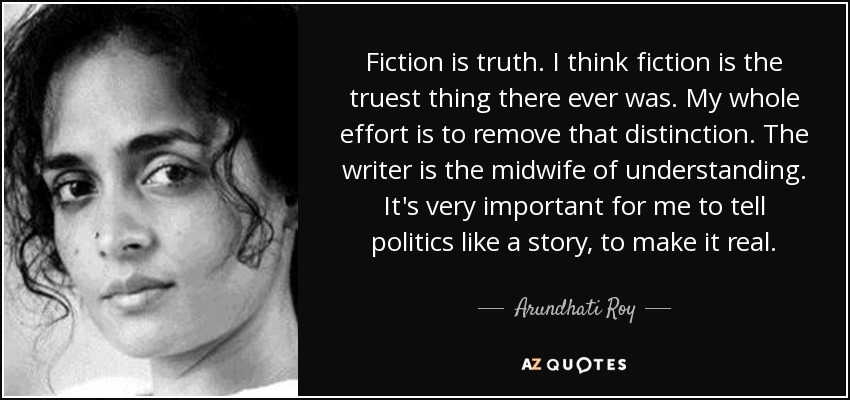
To understand the book better it helps to do a little research on Arundhati Roy. Her first book, The God of Small Things, seemed to come out of no where and when it won the Booker Prize in 1997 everyone talked about how pretty Roy was and how innocent. 

Roy appeared to want no part of any of this. She chopped off her hair after the Booker win, telling The New York Times she didn’t want to be known “as some pretty woman who wrote a book,” and donated her prize money to the Narmada Bachao Andolan, a group protesting the construction of a series of dams that threatened to displace millions of villagers. She turned her attention from fiction to people’s movements all over India—Kashmiris resisting the Indian military’s occupation, tribal communities fighting to protect their ancestral lands. She decried India’s nuclear testing (a source of much national pride at the time) and became an outspoken critic of America’s war in Afghanistan. She was praised for her commitment and derided for her naïveté, and faced charges of obscenity and sedition (later dropped). She was invited to model khakis for Gap (she declined) and to march through the forests of central India with Maoist insurgents (she accepted). And now, after 20 years, she has finally returned to fiction with a new novel, The Ministry of Utmost Happiness (The Atlantic).

All of her passions mentioned in The Atlantic review are included in the book: displaced villagers, Indian occupation of Kashmir, Afghanistan, and Maoist insurgents. Between her first and her second novels Roy was busy writing nonfiction articles and books on these topics but she is a firm believer in the power of fiction to tell us the truth in a format we can understand.


Critics of The Ministry of Utmost Happiness are quick to say that the novel is too full of her causes and not organized in a way that they, literary snobs, would have organized it. One critic even mentioned that she writes without any (or very little) editing, like that is a bad thing. I say, hooray for Roy and her ability to educate and activate her readers.

The Ministry of Utmost Happiness is this month's book club selection and I am in charge of the discussion. These discussion questions seem to get at the heart of the text, so I will use them to guide me. One question really jumped out at me and I hope to really delve into it. Honestly, this question seems to encapsulate the whole point of the book.

15. Discuss the lines of poetry that Tilo writes the end of the book, "How / to / tell / a / shattered / story? / By / slowly / becoming / everybody.  /No. / By slowly becoming everything" (page 442). How do the main characters—Tilo, Musa, Naga, and Anjum—embody the idea of telling a story through the assimilation of its many fragments?


In addition to this being a book club selection, it also qualifies for three other reading challenges. It was a long book, 467 pages, so it qualifies for The Big Book Summer Challenge and it is the eleventh book I've read for the 20-Book Summer challenge. It will also be added to the Audiobook challenge where I've committed to listening to 25 books this year. It is my 21st audiobook of 2021.

-Anne