"Outside a dog a book is man's best friend, inside a dog it is too dark to read!" -Groucho Marx========="The person, be it gentleman or lady, who has not pleasure in a good novel, must be intolerably stupid." -Jane Austen========="I don’t believe in the kind of magic in my books. But I do believe something very magical can happen when you read a good book."-JK Rowling========"I spend a lot of time reading." -Bill Gates=========“Ahhh. Bed, book, kitten, sandwich. All one needed in life, really.” -Jacqueline Kelly=========
Showing posts with label Editorials and etc.. Show all posts

Friday, August 15, 2025

Encouragement for my daughter: TEACHING WITH FIRE


This week I reread the 2003 poetry collection, Teaching with Fire: Poetry that Sustains the Courage to Teach. It is actually the second time I've reread it. The first time I read it was in 2007. I was a new high school librarian. I'd been a teacher for 25 years but now I was in a new role within the school -- librarian. I read Teaching with Fire looking for inspiring poems I could share with teachers to encourage them for those hard days. I found a lot in it to not only encourage others, but also myself.

The second time I read through the collection was in 2016. At that time I was wondering if I should retire or not. My role as librarian had changed quite a lot in ten years and I was questioning if my time had come to call it quits. I don't actually remember if any poems spoke to me about retirement or not, but once again I found professional encouragement in many of the poems and in the short essays teachers wrote about why this or that poem spoke to them as teachers.

Now in 2025, a retired teacher librarian, I reread Teaching with With Fire, again. (Clearly I like it a lot.) This time I selected it to fulfill a StoryGraph challenge to read books from all 58 of the subject genres. This book fulfilled the "education" genre so I picked it because I didn't want to read a book about teaching methodology. From the very first page in the 'Authors' Notes' by the editors: Sam Intrator and Megan Scribner, I kept thinking about my daughter, Rita, and how many of the poems said things I wanted to say to her about her teaching career. All this was made more urgent when a week ago she called us to ask our opinion on a placement move. Last school year she had moved from a position in the middle school, where she taught math for eight or nine years, to the elementary level teaching 4th grade. She was all excited about another school year with 4th graders when the school district HR director contacted her last week asking if she would consider a move back to the middle school. With her seniority, it was Rita's call, but if she didn't do it, the next person down the line would be forced to make the move. Rita was very conflicted but ultimately decided to switch back to the middle school. 

She had already spent some time getting her elementary classroom set up and now she has to start over in another building and classroom this late in the summer. When I reread Marge Piercy's "To be of use" I felt so proud of my daughter's willingness to work hard for the greater cause:
"The people I love the best
jump into work head first
without daillying in the shallows...

"I love people who harness themselves, like an ox to a heavy cart,
who pull like a water buffalo, with massive patience,
who strain in the mud and the muck to move things forward,
who do what has to be done, again and again" (5).
In the excellent poem/prayer by Marian Wright Edelman, "I Care and I'm Willing to Serve,"  a similar theme is struck: to be of use for the greater good.
"Use me as Thou wilt to save Thy Children today and tomorrow, and to build a nation and a world to where no child is left behind, and every child is loved and every child is safe" (21).
Quite a few of the poems and/or the teacher's essays talk about recognizing children's talents and their imagination and not squashing them to make children all fit into the same mold. Jeff Moss's "On the Other Side of the Door" could be a message for both students and for their teachers. Perhaps a perfect place to hang this poem would be on the classroom door: 
"On the other side of the door
I can be a different me,
As smart and as brave and as funny or strong
As a person could want to be" (37).
Billy Collins reminds us that kids grow up awfully fast and we should let them be children for as long as possible in this fun, yet poignant poem, "On Turning Ten."
"It seems only yesterday I used to believe that there was nothing under my skin but light" (55).
Teaching is hard, hard work. It is often made harder work by a society which expects teachers to be perfect and never have off-days and to teach lessons which never flop. The expectations put on teachers are so daunting many give up under the pressure. When I read this phrase by Mary Oliver in "Wild Geese," I want to instill this message into my daughter's heart -- she is good enough and there is no such thing as perfect. She just needs to keep her head up and keep her eyes on the prize, to be patient and gentle with herself.
"You do not have to be good.
You do not have to walk on your knees
for a hundred miles through the desert, repenting" (75). 

In education today teachers are asked to do so much. Sometimes it feels like there isn't even time to breathe. In her essay, middle school science teacher Maggie Anderson talks about how the poem "Fire" speaks to her about the need for space in the day. When building a fire it is important to have space between the logs, breathing space. If logs are packed too tight, the flames may go out. Reflecting on teacher burnout Maggie said, "After much soul-searching, I realized I was piling on too many logs too tightly and the flame inside me was beginning to wane -- even smolder at times. I was desperate for some space. Children need space as well ..." (88) We all do. We need space and time to help us process and learn.

Rita, dear. I hope you help your students to Dream. Imagine. Play. Explore. This poem, "Warning to Children" by Robert Graves, reminds me why:
"Children, if you dare to think
Of the greatness, rareness, muchness
Fewness of this precious only
Endless world in which you say
You live, you think of things like this..." (149)
Plus that poem is just so much fun to read! Another super fun poem, not to be missed is "A Contribution of Statistics" by Wislawa Szymborska on page 141. As a math teacher you will appreciate it, I'm sure.

Finally I will leave you with this thought: When all is said and done what remains is the love. In "Making Contact" poet Virginia Satir reminds us that kids can only learn from teachers if they know a teacher cares about them.
"The greatest gift
I can give
is
to see, hear, understand,
and to touch another person" (133).
Here's to a new school year! You got this, Rita!

-Anne (Mom)

My rating of the book: 5 stars.

Thursday, July 4, 2024

Happy Independence Day 2024!

Fireworks over Lake Union in Seattle in 2023

Happy 4th of July!

Last night, the 3rd of July, we attended a community fireworks show in a small town where our daughter and her family live. It was the best fireworks show I've ever seen!!! 

Our grandsons are staying up late, waiting for the fireworks to begin.

So why do we celebrate our Independence Day with fireworks?

Because John Adams, who later became America's second president, wrote to his wife in 1776 that the day would be remembered with fireworks and celebrations “from one End of this Continent to the other.”🎆🎇🎇

So we, as a country, have been doing this since our inception!

Cue the patriotic music:


Today, since we did our celebrating yesterday, will have a small family BBQ, play corn hole (what a silly name for a game), and watch the fireworks over Lake Union in Seattle on TV. It won't be the same as watching them live, but the traffic will be a lot better! In days gone by our neighborhood would host block parties, play softball together, and have a very rinky-dink parade on July 4th. Sadly those days are no more, at least around our neighborhood.

Have a fun and safe day! 


Patriotic flourishes in the front of our house. 


-Anne

Sunday, December 10, 2023

Favorite, funny, and poignant moments from our trip of a lifetime

Travelers. Day 1 in Quito; Day 7 in Panama City.

This travelogue features some of the funniest, most poignant, or favorite moments from our trip of a lifetime to Ecuador and Panama.


Day 1:  We had one day on our own in Quito before we joined tours to see the best of Ecuador. We knew we wanted to see La Basílica del Voto Nacional (The Basilica of the National Vow), the square in front of the Presidential Residence, and the Iglesia de la Compañía de Jesús (The Church of the Society of Jesus) aka The Gold Church.
  • We started the day by hiking uphill to visit the La Basílica. It felt like we were climbing a mountain since it is situated in the city at 9350 feet above sea level -- mere foothills of the Andes). Don and Tom separated from Tony, Kathy, and I to climb the tower. The three sibs were on our own to explore the unfinished cathedral. We were outside on one of the turrets when we rounded a bend to see this ladder with a sign that says "Only Up Stairs." Not sure how we would get down if we dared to climb up. We laughed at how different safety standards are in other parts of the world compared to the US.
  • After exploring the Basílica, we headed toward the Plaza de la Independencia, the main square in Quito which is bordered on one side by the Presidential Palace. When we entered the plaza we were very aware something was about to happen based on the increased police presence. As it turned out, September 26th was Flag Day in Ecuador and we happened upon a ceremony featuring a military parade and speakers, including the President of Ecuador. We couldn't believe our luck arriving when we did to see this special moment full of pomp and formality, so colorful and somber, but the military musicians weren't very good. They reminded us of a junior high band. We had to cover our mouths with our hands to avoid laughing out loud.


Saturday, October 14, 2023

Walking in the Steps of our Grandfather in Ecuador

We just returned from an adventure-filled trip to Ecuador and Panama -- two destinations not likely to be high on any list of top places to visit in the world. But these countries hold special prominence for the Kingsbury family, so with my brother Tony, sister Kathy and her husband Tom, Don and I planned this adventure together to trace my paternal grandfather's steps of 100 years ago.
   
In 1904, our granddad, Augustus Kingsbury, was hired as a civil engineer to work on the Panama Canal project. We know little about his job and how he spent his time on the project, but we do know that he stayed in Panama until 1923, working there long after the canal was open and functioning. And we know, from his own words, that he spent a lot of time exploring the region:
It has been my lot in my 20 and more years’ experience in Latin America to traverse and know great stretches of almost uninhabited and unexplored territory. I have taken scientific expeditions into the vastness of the Central American jungles. I have participated in hunting parties throughout Panama and other districts. I have traveled up and down Central and South America and I have learned a great deal about jungle life and at times, I like to get as far from civilization as possible. 
In 1923 Granddad was approached by two gentleman, H. B. Dinwiddie and Rev. George Simmonds working for the Christian Missionary Alliance and the Pioneer Missionary Society, to serve as outfitter and guide for an expedition down the Amazon for the purpose of locating and classifying indigenous people.
Left to right: Kingsbury, Simmonds, Dinwiddie

The expedition took four months, starting in Ecuador and ending, miraculously, in Brooklyn, New York, 8500+ miles later. According to Granddad's records from the trip down the Amazon and its tributaries [w]e traveled approximately 400 miles by train, 90 miles on mule back, 600 miles afoot, 1,000 miles in canoes, 500 miles on a wood burning launch, 200 miles by raft and 2,200 miles by river steamer. The length and breadth of this expedition is something that few would attempt today; let alone one hundred years ago without modern technology like motor boats, GPS locating devices, and dehydrated foods.


The expedition began for Granddad in Panama where he took a ship accompanied by two women, his aunt, Miss Fannie Kingsbury, and a school teacher friend of hers. 

We left Cristobal, the Atlantic entrance of the Panama Canal, August 25, and arrived at Buenaventura (Ecuador) two days later. Buenaventura is a typical west coast town, dirty and squalid, without pavements or sewers or buildings of consequence. Our stay there was short and we were glad to leave. We arrived at the mouth of the river Guayas three days after leaving Buenaventura and after several hours journey up the river arrived at Guayaquil. It is the largest city in Ecuador and one of the greatest sea ports of the west coast. 

One cannot help wonder if Granddad was in awe of the Panama Canal, which he helped build, as he traversed from Atlantic to Pacific at the beginning of his journey. From Guayaquil, the small group boarded the amazing and famous G&Q railroad to travel the 300 miles to Quito.
Leaving Guayaquil we crossed the river to Duran, the terminus of the Guayaquil and Quito railroad, on the first lap of our journey into the Andes. The Guayaquil and Quito (G&Q) railroad is one of the most remarkable railways in the world. It runs directly into the heart of the Andes Mountains and one of the most mountainous districts in South America. It crosses several high ranges, at one place at the height of more than 12,200 feet. The track clings for miles along the walls of deep canyons or along the sides of great precipices. It crosses roaring mountain torrents over high bridges, it winds its tortuous way back and forth up the mountain sides.  

Granddad, a civil engineer, marveled for several paragraphs about the wonders of the G&Q Railroad, which he made known was built by Americans. He said, It stands today and always will stand as one of the most remarkable feats of railway engineering in the world, a monument to the genius of the American railway engineer. Unfortunately, Granddad's prediction for the future proved too optimistic. This greatest of achievements has fallen into disrepair and was closed down by the Ecuadorian government in 2020 so we were not able to experience a ride on the G&Q first hand. 


When the train pulled into Quito, Granddad Kingsbury was met by Dinwiddie and Simmonds. His journal includes no further comments about his aunt and her friend so we have no idea what adventure those two embarked on themselves. Almost immediately, Granddad was thrown into the business of outfitting the expedition and preparing for its departure.

We stayed in Quito for a week and here the serious work of our journey began. Dinwiddie had brought from New York, 12 cases of preserved foods, camera supplies, surgical instruments and other articles. I had apparatus for preserving skins and museum specimens, surgical instruments and a vermin proof tent and cots. We had an arrangement of nested utensils and a miscellaneous assortment of other articles. We bought trade goods and blankets and such other things as we needed.

And their expedition was on the move! We left Quito for Ambato, the real start of the expedition, on September 12 and retraced our steps about 100 miles over the Guayaquil and Quito railroad. We had made arrangements for a pack train to take us over the first 90 miles of our long trip eastward to Mera, as far as we could go by mule.

Granddad on the right with his hand on a mule.


From Ambato the mule team headed southeast to Baños. Along the way the team encountered a suspension bridge where they had to blindfold the mules before they would walk across it. Baños, was a small community of 2500 people at the time and home to natural thermal hot springs. Next stop was Mera, a small, squalid community of 12 or 13 huts, where it rains every day of the year, with the exception of ten. It was situated on a bluff overlooking a river. Travel would be by boat or canoe for the rest of the journey. The next day two teams were sent out to explore two rivers, the Napo and the Puya. Puya [the community] is situated on the river of that name at the edge of one of the wildest and least known territories in the world, the Ecuadorian Oriente. Ultimately we think the Puya River was selected (now Puyo), but the documents contain some confusing comments so we can't be certain which river they were on. From this tributary, the trip down the Amazon had begun. 

After considerable difficulty we rented three dugout canoes, about 20 feet in length and manned by three men each. They were large enough to carry our gear without difficulty. Imagine going down the Amazon in such a low slung canoe. Granddad mentioned that the boat spilled over several times. (We all laughed at his use of the word "rented" when referring to the canoes, as if they planned to return them!)

From this point forward the story doesn't pay as much attention to place names (if any were known then) but focuses on the indigenous people and the flora and fauna encountered along the way. Granddad witnessed hunters using curare darts to fell a tapir, took a photo of shrunken heads, and worried about alligators and piranhas. At one point on the trip he noted the Amazon must have been over ten to fifteen miles wide. Nothing was written in his account about the missionary aspect of the trip, but we assume Dinwiddie and Simmonds collected information for potential future mission efforts. Eventually the men boarded a freighter on Nov. 25th perhaps as far as one thousand miles up the Amazon River and were transported back to Brooklyn, New York, getting home on Dec. 24, 1923.

Augustus Kingsbury was originally from Connecticut. After returning home he spent some time on a speaking tour about his South American adventures in public settings such as libraries and churches. On a later train trip heading west, he met the woman who would become my grandmother and they moved to Oregon. My dad was the third of six children born to Augustus and Anna Kingsbury. While working on the Bonneville Dam on the Columbia River in 1936, Granddad Kingsbury died from injuries sustained in a workplace accident. My father was only seven years old at the time. Because my dad and all his siblings were so young when their father died, none of them knew much about the Amazon expedition until much later in life when Aunt Fannie, Dad's oldest sister named for Augustus' favorite aunt, connected with Rev. Simmonds who was able to fill in many of the holes in the story. And a copy of the document "EXPLORATION IN THE EQUADORIAN ORIENTE AND UPPER AMAZON, As told by Augustus H. Kingsbury and written by Max Schafer" was secured and passed around the family to read and treasure. All the quotes in this post come from this article.

As the 100-year anniversary of the expedition approached, my brother Tony and his son Andrew talked about making a trip to Ecuador to try to retrace some of our grandfather's steps. Tony made it clear that anyone in the family was welcome to join them. I didn't commit to the project until March as did my sister Kathy. Our youngest sister, Grace, is a teacher so she couldn't take time away from work for the trip. Our cousin Robin was interested in joining us, but her mother Betty (Dad's only living sibling) is quite aged and the timing was not right to leave her. In the end, Andrew also couldn't make the trip due to work. That left three 'Kingsbury kids' (Tony, Kathy, and me, Anne) and two of our spouses (Tom and Don) ready to make the trip. Our goal was to walk where Granddad walked, to see what he may have seen, to try to experience a little of what he encountered along the way. We knew we wanted to see the Panama Canal up close and to visit the Ecuadorian cities of Quito, Baños, Mera, and Puya, since they were all mentioned in the document. We hoped to take a boat ride on a tributary of the Amazon. We also hoped to ride on the amazing G&Q railroad, which we didn't know was no longer running when we began making our plans. Kathy, who is a master trip planner, arranged tours that would allow us to see a lot of the country and have a variety of experiences in both Ecuador and Panama. We chose a late September start date to coincide with the dates of the original expedition.

Photo credit: T. Kingsbury

We began our version of the adventure in Quito, Ecuador. Granddad mentioned in his notes that Quito is a city in a great valley, scooped saucer-like out of the mountains that surrounded it. What he didn't mention was that it is situated at an elevation of over 9000 feet. We all live at relatively low elevations (400-1500 feet) so the elevation of Quito was quite a shock to our systems. As we climbed the hill to 'The Basilica of the National Vow' not far from our hotel, I felt like I was climbing a mountain not just walking up a hill, panting and wheezing as I stopped to rest half way up. The basilica was built in 1883 so we are sure our grandfather saw it, even if he didn't visit, since this church holds a prominent spot in the city.

Photo credit: D. Bennett

As we explored Quito on September 26th we stumbled upon an elaborate and somber ceremony celebrating Ecuadorian Flag Day. Ecuador was part of Gran Columbia (The Republic of Columbia) after gaining independence from Spain in 1820, separating in 1830 and settling on its current flag on September 26, 1860. Granddad may not have experienced a grand ceremony like we did for Flag Day, but he certainly saw the same Ecuadorian flag we saw.

Photo credit: T. Buhler

Our first Ecuadorian tour was to the Mindo Cloud Forest. While there we fed hummingbirds, hiked to a beautiful waterfall, visited a butterfly farm, and experienced the process of artisan chocolate making from cocoa nuts on the tree to the finished bars on the shelf. It was a wonderful and exhausting day.

Photo credit: T. Kingsbury

The second day of touring involved a trip to the Cotopaxi National Park. Cotopaxi is one of the highest mountains in the Ecuadorian Andes. It is also an active volcano. For this reason, even if we were physically capable, we were not allowed to climb to the rim, only to the base camp. Before we drove to the parking area on the mountain (volcano) we stopped at a shop and drank a cup of coca tea to give us energy for the climb. Yes, that coca! We drank coca tea (a drink new to us), while the men on Granddad's expedition consumed an odd drink made from fermented manioc called chicha. We drank much of the chicha, especially on the march and we found it to be a very refreshing food. The elevation at the parking lot for Cotopaxi was 15,000 feet and the base camp was above 16,500 feet. No amount of coca tea was going to help Kathy and I up the mountain at that elevation. We made it to the edge of the parking lot before returning to the van. Tony, Don, and Tom made the attempt, but only Tom got all the way to the base camp. Later that day we saw some disused train tracks, which made us think of the G&Q railroad. That's when we learned the line was no longer running. Who knows if the tracks we saw were for that particular route or not, but we claimed them as if they were.

Tony and I posing with a real alpaca at Quilatoa.

Don and Tom making their way up Quilatoa on mules.

The next day we visited Quilatoa Lake, a natural lake created by a volcanic eruption ages ago. The hike from the rim down into the caldera was steep, but our guide assured us that mules would bring us back up. This time all three Kingsburys opted out but Don and Tom were gung-ho for the adventure. They were pretty happy when the mules came along so they didn't have to climb out of the caldera themselves. I made the connection earlier about Granddad's experience with mules. Earlier in the day we visited the home of an indigenous family and learned a bit about their lifestyle. We ended the day in Baños, even spending time in the thermal baths that Granddad mentioned. It was a surreal experience joining a multitude of Ecuadorians in a series of pools filled with hot, hotter, or hottest water. It seemed like we were the only 'foreigners' there.


We began the next day with the guys all trying an Ecuadorian delicacy: roasted guinea pig. After our morning visit to the popular market in Baños, we were back on the road heading toward Amazonia. We stopped for an opportunity to see a waterfall up close by traveling on a rickety cable car across the river valley. It reminded me of how Granddad put blindfolds on the mules when they encountered a rickety bridge. We all clung to whatever we could grab hold of and closed our eyes to keep out the fear of falling. After we were back on terra firma, we posed for a photo overlooking the river valley, wondering if the men stood on the exact same spot 100 years earlier as they contemplated which river was best to begin their navigation toward the mighty Amazon. All of us reflected later how meaningful this moment was to us.

Animals of the Amazonia region which may have been seen by members of the expedition. We saw them at the Bioparque Yana-Cocha.


Our host, Fabio, with the chocolate sauce we made. Ready to eat with fresh fruit nicely arranged. Photo credit: D. Bennett

Our special dinner after we arrived at the Sinchi Warmi eco lodge in Amazonia.
Special treats: yucca fries and plantain chips.


After the animal park our guide drove us to an eco lodge in the jungle of the Amazonia region. We now were down to practically sea level. After a night spent in huts under mosquito nets listening to monkeys in the background, we spent the next day learning about the region. We took an early morning bird watching tour on an Amazonian lagoon, made our own chocolate sauce from scratch (and ate it), and enjoyed watching indigenous children at play. I know we were all disappointed we never got on a boat on a river which was a tributary of the Amazon, but it was terribly nice of our tour guide to work in a canoe trip around the lagoon.
On the lagoon bird-watching trip. Without binoculars, almost all the birds we saw looked small and black, even the flock of parakeets that flew overhead. We also saw glimpses of woolly and spider monkeys. Photo credit: D. Bennett

After we left Amazonia we had a long trip back to Quito, with several high mountain passes in our way. The highest of those passes had an elevation of over 12,000 feet. All of us wearing Fitbits got lots of steps we never took that day. I call them jiggle steps. I got more than 10,000 jiggle steps just riding in the van as our driver did his best to avoid potholes and washed out spots in the road. Tony and I both started feeling pretty cruddy during the trip, thinking it was the curvy road and sudden elevation change. Later we found out it was something else -- COVID. But we didn't figure that out until two days later. By then we were in Panama on the second leg of the adventure.

Panama City plaza.

Our flight to Panama City was short. We arrived mid-morning and fortunately were able to check into our hotel early. After a quick lunch of a Cubano sandwich at a cafe next door and a short rest, we started our afternoon tour of the city. Our guide took us to see the 'old quarter' in the historic district of Panama City which is a UNESCO Heritage and Cultural Site. The architecture dates back to the 1600s which features a colorful plaza and buildings in the Spanish style.


We went to the Milaflores Locks next. These are the Panama Canal locks closest to Panama City and to the Pacific Ocean. They are also the locks that Granddad mentioned in his journals. After watching an IMAX movie about the history and construction of the canal, we went outside and watched several huge ships make their way through the locks. We could have stood there longer but the light was waning and the visitor center was preparing to close. It was all so interesting and moving, thinking that our grandfather had something to do with their construction.

The F & F Building in Panama City. Photo credit: A. Bennett

Hotel roof top pool. Photo credit: D. Bennett

By the time we got back to our hotel, it was clear most of us didn't feel quite right. Tony and I had sore throats, Don had trouble breathing in Quito the night before, Tom didn't have his normal level of energy. After getting back to our room we took COVID tests. Sure enough, both Don and I were positive. We called the others. Tony and Tom also tested positive. Only Kathy remained negative. The next day she went on our scheduled tour alone. Tom rested in his room while Tony, Don, and I took a short walk around the new part of town, marveling at the building in the shape of a screw and later spent time in the roof top swimming pool. We also made a plan for the next day, the last day of our big adventure. We decided we would rent a car and take ourselves on a tour to see the canal without putting someone at risk of getting the virus from us.

Our captain's name was Fernando. Photo credit: D. Bennett


A view from our little boat of the tankers we got near. On the Gatun Lake/Chagres River, part of the lock, river/lake, lock system of the canal. Photo credit: T. Buhler/A. Bennett

Tony rented a car and we drove a dock at Gamboa where we could hire a boat (and captain) to take us out into the Panama Canal. There we were, safely in a small boat not too far from some rather huge ships. We saw monkeys and crocodiles, too. It was easily one of the most fun and spontaneous things we did on our whole trip. That evening we had a yummy dinner at a Panamanian restaurant to conclude our adventure.

This trip to Ecuador and Panama was a 'bucket list' experience because it allowed us to connect with a grandfather we never knew aside from this family story of his time building the canal and adventures in Ecuador and the Amazon. We know our journey was much easier with 21st century conveniences -- air travel, air conditioned vans, mobile phones, and hotels with WiFi -- but the varied landscapes of Ecuador and the marvel of the Panama Canal were no less impressive. We also had wonderful hosts and tour guides at every stop who gifted us with generous hospitality and warmth of spirit, reminding us that God's love and care is ever present in people all over the world.  

-Anne and Don Bennett

Post script:
  • To my siblings: Tony, thanks for dreaming up this adventure. Kathy, thanks for doing most of the leg work in planning our trip. Grace, every day of the trip we missed you and wished you were with us. At one point we thought we should make a photo cut out of your face so you could be a part of every group picture. 
  • To my cousins: We hope that our trip serves as a catalyst for you to make a similar one in the future. Though none of us knew or even met Granddad it was such a joy to feel connected to him in this way. If you are interested in planning such a trip we are willing to share our travel template and any wisdom/advice to make your planning easier. Start with the document of Granddad's trip, If you don't have, or can't find a copy of it, email/call/Facebook message one of us and we'll send it to you. Next, contact Robin who has done extensive research on Augustus Kingsbury through Ancestry.com. She shared a ton of info with Kathy on a recent visit. Share this post with your children. Help them connect to their past. And help us spread the word to cousins we've lost touch with: Dick, Kevin, Phil, Shelley, Jill, Wendy, Tim, and Richard and Marvin's children/grandchildren. Robin, share this post with your mom, Aunt Betty. She is the only living person who knew Augustus Kingsbury in the flesh. I hope she finds a moment of joy in the remembrances.
  • To our children and nieces/nephews: Why not plan a cousin trip together to Ecuador and Panama? Andrew was part of the original dreaming about the trip, Carly and Bobby/Kaylyn are excellent trip planners. Make it an event. Learn more about your heritage. There were many activities that we avoided due to our age and stage. Taking teenage kids on this trip would be a blast.
  • To Dad, may you rest in peace: Kathy and I both brought you with us to Ecuador and Panama. She wore her blue "Dad" necklace and I wore the white butterfly earrings. We know you would have loved the adventure and we thought about you every day, every step we took to learn more about your father. We felt your spirit with us.

A few more photo collages:
In the Amazon region outside our huts, on the bird-watching/lagoon trip, making chocolate, and happy children.

Images taken in a boat on Lake Gatun/ Panama Canal.

Memorable moments: on the rickety cable car going over a river in the rain; wearing headgear we found with the Mera town name sculpture; the guys flashing 'chulla vida' sign under a waterfall; a bird that wouldn't leave Tony alone; eating roasted guinea pig; a parrot who wouldn't stop screaming "Hola!"; and the moon over the Amazon jungle.

More memorable moments: With an indigenous family; our guide, Irene, giving us a lesson about Ecuadorian fruit; Don and Tom made it to the bottom of the caldera; Kathy and Anne 💖; The Panama sign. We made our poor tour guide go through a lot of trouble to get to this sign for the photo. By the time we got to it, it was dark outside!


We saw a sloth in the wild in Panama! We also figured out that there is a baby sloth attached to the mama. It was an event of great excitement in us and we spent hours debating the baby/no baby aspect since the photos were all so bad!!!


😀

Wednesday, August 3, 2022

It's a wrap. The "100 Books Every Child Should Hear Before Kindergarten" reading project is complete.


We've done it!

My grandson, Ian, a soon-to-be-a-kindergartner, and I have completed our project to read/hear 100 children's books from a list provided by our library system. And we did it in two months. Amazing.

How did we do it?

Ian, wearing his goggles, and Jamie, still in pajamas, are enjoying a minute with me reading a book which includes a repetitive line: "Baby, Baby, please, Baby, Baby." Afterwards Jamie, who is ready for a talking explosion, walked around repeating the lines, "Baby, baby, baby."

First, I used my list to order books from the library in batches of 10-15. Every time we were together we would make time to read as many of them as we could. After we read each book a decision was made to return the book to the library immediately or to put it in the pile for Ian to take home so his parents could reread the book with him. That pile was kept to under five books for organizational reasons.

Reading with Grandpa, or at least sitting close as Jamie is doing here. Often we have to wait a minute while Ian located his blanket so he could suck his thumb. He is such a busy boy but will settle right down for a book.

Reading several books before bed is a perfect way to settle down and prepare for sleep. Here Ian and his parents share a sweet moment together after a long day.

Secondly, the library had lots of copies of most of the books so we didn't have to wait in line for very many of them. This made the speediness of the project possible.

Great-Grandma Shirley and Ian read the 100th book of the project together.

We also enlisted the help from any family member we could find. This culminated in this past weekend at a family reunion where every aunt and uncle and his great-grandma got to snuggle up with Ian for a story. Ian and Great-Grandma Shirley read the 100th book together making it extra special for both of them. Over the months, I read the lion's share of the books to Ian, often with his little brother hovering nearby. But everyone chipped in, making this a truly family project. Imagine all the love and acceptance Ian felt as he got to cuddle up close with so many relatives.

Ian, eating an apple slice, loves it when his great-aunts read to him. Aunt Grace is a preschool teacher and Aunt Kathy was a reading specialist for 40 years. They are both connoisseaurs of good children's books.


Great-Aunt Becky and Great-Uncle Tony are reading as a tag team. They just became grandparents themselves so they are getting in some practice reading to young ones they'll be able to put to use when baby Miles is old enough to enjoy books.

The list of books, which no doubt was compiled by some panel of librarians somewhere, was full of  characters who were multi-cultural and/or multi-capable, many of them using words in Spanish, Chinese, and other world languages. The characters often didn't fit into a mold, with kids on the autism spectrum, bi-racial, even sexual identity issues being represented. One book was about a kid who wasn't able to use his legs so he had to use a wheelchair and another book was about a girl who loved her mixed heritage and wondered why kids dressed up as pirates couldn't play soccer. Other books showed characters who had to learn from mistakes or demonstrated how to cook favorite foods from their cultures. The books that delighted Ian the most were the humorous titles like Don't Let the Pigeon Drive the Bus and No, David! He also seemed to enjoy those books which engaged the adults most. Where is the Green Sheep kept us both busy naming all the different types of sheep and wondering where the green sheep went.


Auntie Carly is being silly while reading Not a Box.

Another delightful favorite, Ian loved it when his dad read I Stink because he would make such funny voices.

Great-Aunt Grace know how to draw in her listener here.
 

Great-Aunt Kathy and Ian get to tell themselves a story as they decipher a wordless book together.
 

So what is the value from this project? I can't even begin to describe how special it is to snuggle up with a four-year-old and share a moment with books together, times 100. I'm sad it has come to an end. I know that Ian benefited and will continue to benefit from listening to these fabulous stories.  His brain is getting ready for school and all the learning to come. Now what will we do for the rest of the summer? Oh wait! Another nearby library has a different list called "100 Books Every Child Should Hear Before Starting School" and only 35 of the titles match the first list, you say? That sounds like another project in the making. 

Stay tuned for part two...


-Anne

Saturday, May 7, 2022

Weigh Down / Way Down

Link to HBO

Let's see. Where should I start?

This past week I learned about an HBO Special called "The Way Down: God, Greed, and the Cult of Gwen Shamblin." My daughter was the one who told me about it and she knew I'd be interested because of my involvement in The Weigh Down Workshop years ago.

My whole life I've thought of myself as overweight. Even when I was a little kid my mother was constantly attempting to get me to lose weight or pointing out how much better I'd feel if I would "trim down." If there was a diet, I've probably tried it -- Weight Watchers, Jenny Craig, grapefruit, Atkins, intermittent fasting, counting calories, supplements -- you name it.  In 1997 I joined a Christian weight loss program called the Weigh Down Workshop. The workshop was held at a church in town. Participants paid an initial amount, somewhere around $100, and for our money we got a workbook and watched a short video each week featuring the founder, Gwen Shamblin. Gwen was a nutritionist and a Christian. She espoused eating less, or portion control, supplanting God for food. Her videos and the lessons in the workbooks, got the participants looking in the Bible for help with "gluttony" control. If one over-ate wasn't it just part of a pattern of sin?

At first I was tremendously moved by this program and was quite captivated by Gwen's authority and magnetism. What she was saying seemed right AND she backed up her words with scripture. It had to be right. But somewhere in the middle of the twelve-week course, I started to worry. What if the program didn't work for me? Wouldn't that be my last chance? If God couldn't help me lose weight, I was truly sunk, right? I remember sharing this thought with my small group but was met with a stonewall of indifferent looks on their faces. Hmm. Was I the only questioning person there?

Anyway, I think I was fairly successful that first session, losing perhaps 20 pounds. I even bought Gwen's book The Weigh Down Diet and read through it carefully. Once the session ended, however, the weight crept back on, so I decided to participate in another session but this time I would be the discussion leader at my church. Once again there was a capital outlay, even for discussion leaders, but this time the videos had changed. The first first time through each video was only about twenty minutes long, now the second edition videos were all over an hour long. The first ones had been cute and funny and practical, now they were stuffed full of Gwen sitting and talking in a setting in Egypt (theme: Exodus) and what she had to say was almost all about guilt and sin. I could barely stand these videos for the length and for the serious/non-practical nature. After one full 12-week session I was done. I set everything aside and went on with my life. This was in the year 2000.

Weigh Down Workshop materials I saved all these years. I dumped the book at some point but kept these workbooks. I gained some insights into how the program was affecting me at the time but perusing them this week.

Now, twenty-two years later, I have learned the rest of the story: According to the HBO Special, Gwen started a church in 1999 in Brentwood, Tennessee, based on the principals shes been espousing in the Weigh Down Workshop. She called the church The Remnant Fellowship, named after a scripture in Revelations about a small remnant of people who will be left behind but will know the "true" word of God. Over the next twenty years as the church grew, Gwen's philosophies started to really diverge from typical Christian theology. Two specific items come to mind: One, she preached that there is no Trinity* (The trinity is God=Father, Son, and Holy Ghost, three-in-one) which of course is a bedrock foundation of the Christian faith and this proclamation made many people leave her weight loss program worldwide. Secondly, and this is an odd one, she continued with her emphasis on weight loss. Members of the church had to attend Weigh Down workshops and were deemed 'saved' if they were losing weight and would get kicked out of the church if they gained weight. What church does that? Some experts began pointing out ways this church, under Gwen's authority, was becoming a cult. Other cultish things about the church included total control of the members. They weren't allowed to associate with people outside the church, even using services from members of the church, not outside businesses. Gwen thought that women should be submissive to their husbands, which often meant forgiving the men for infidelity but not allowing divorce. And children were to be kept under control, even spanked or beaten to break their willful spirits. Glue sticks (for hot glue guns) were a favorite tool for these beatings because they hurt but didn't leave a mark.


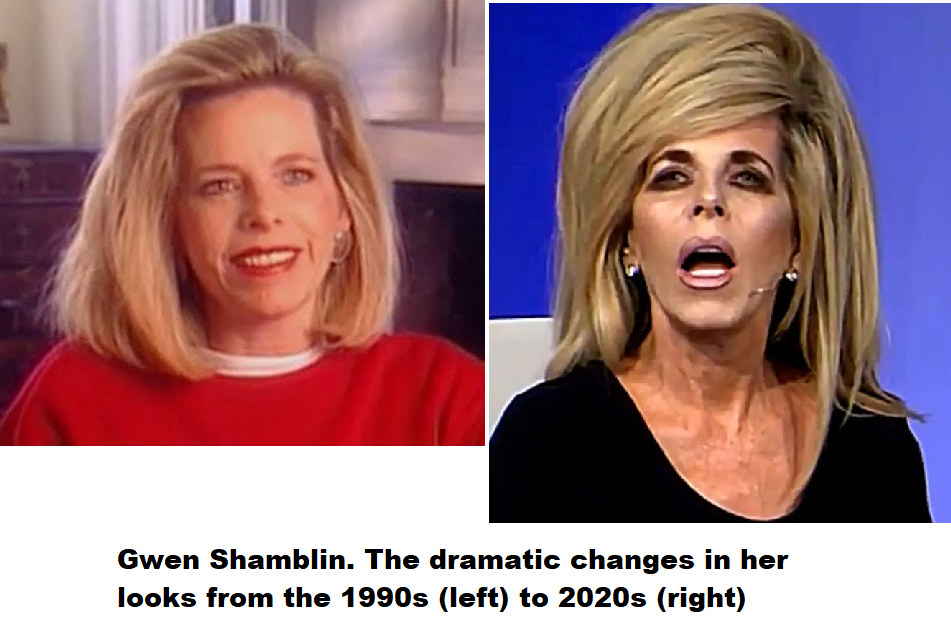
Meanwhile she was enriching herself, living quite an extravagant lifestyle and all the while her hair and makeup styling got more and more bizarre. She would often have her hair teased to be at least 6 inches high. As she seemed to lose more and more weight herself, her hair style seemed to be the way she hid the fact she was shrinking. 

In 2018, Gwen announced that sometimes God does condone divorce, and she divorced her husband of forty years and within weeks married Joe Lara, a handsome actor and wanna-be country music singer. He also was a small plane pilot, licensed to fly by sight not instrumentation. In May of 2021 Gwen, her husband, and five others, were in a plane (probably piloted by Lara) going to a MAGA rally in Florida. They all died when the plane crashed into a lake soon after take-off. In the ironies of all ironies, it is thought that the plane crashed because it was over the weight capacity.

Around the time of her death, Gwen Shamblin was busy making a video series for her church, which has several satellite churches all over the country, about greed. She wanted the members to give everything to the church, all their money and property. Gasp! The HBO series was well into production at the time of her death also, and so had to do some post-production work to include the details of the crash and speculate about where the fellowship would go now without their leader. The initial three episode of the special aired in the fall of 2021. But so many people came out of the woodwork after Gwen's death, HBO decided to add two additional episodes about the aftermath. Those were recently aired.

So why am I so bothered? It was over 22 years ago that I walked away from the Weigh Down Workshop. No harm, no foul. Yet, as I watched the HBO special, and other videos I found on YouTube I started to shiver. How close had I come to tipping all the way over? I had contributed to this woman financially by buying her books and paying for the workshop several times. I may not have been in her cult but I was certainly cult-adjacent at least for a short while. I'd started to buy into her philosophy which equated being overweight to being sinful. Yikes! I've often wondered how someone, anyone could be gullible enough to get involved in a cult and now I know. The truth of it is chilling -- it happens slowly, over time, to vulnerable people who are attracted to people who seem to have the answers. I was one of those potential victims. Egads.

Here are a six ways to avoid religious cults (CBS News), with my take on how Gwen Shamblin was the leader of one:

  1. Beware of any kind of pressure."You must decide now, give up food or go to hell."
  2. Be wary of any leader who proclaims him or herself as having special powers or special insight. And, of course, divinity. In Gwen's case, she thought of herself as a prophet of God with new insights from him. Thinking about all the religious cults I know about, God was shoved aside and the person (in this case, Gwen) became more important.
  3. The leadership of the group is closed, although there may be outside followers, there's usually an inner circle that follows the leader without question, and that maintains a tremendous amount of secrecy. In the case of the Remnant Fellowship, all the leaders were men, but they deferred to Gwen for guidance.
  4. The group uses deceptive means, typically, to recruit new members, and then once recruited will subject its members to an organized program of thought reform, or what most people refer to as brainwashing. The Remnant Fellowship was so big on weight loss that some very overweight people were told to stop eating altogether until they got down to the right weight. (Isn't that called starvation?) Gwen compared the weight loss of her faithful members to the weight loss of Holocaust victims, who all lost weight! (Don't eat=lose weight.)
  5. Typically cults also exploit their members. Within the group, they'll exploit members financially, psychologically, emotionally and, all too often, sexually. And think of the children who were beaten by their parents to save them from sin!
  6. A very important aspect of cult is the idea that if you leave the cult, horrible things will happen to you. In the case of the Remnant Fellowship, people would often lose their livelihood if they left the fellowship because of the tangled up finances and intertwined social networks. It is very hard to leave if it means you will lose all your friends or their financial security.

If you are curious and want to learn more about Gwen Shamblin and the Weigh Down Workshop scam/cult, I recommend you watch the HBO Special: "The Way Down: Greed, and the Cult of Gwen Shamblin." If you don't have HBO, this YouTube video (one hour in length) does a good job highlighting the details, too. In fact, I found it answered several lingering questions I had after watching the HBO series: "The Millionaire Preacher with a Weight-Loss Cult / Gwen Shamblin Documentary."


Well, this is me, signing off on another blog post. This time with a sigh of "whew!" Dodged a big one, folks. I dodged a big one.  

*Ha-ha! When I first typed the word 'Trinity' I made it 'Trilogy'. Guess you can tell what type of topics I usually blog about...Books!

-Anne