Back in 2014 my book group read a bunch of wonderful selections, all books worth pondering over, many were great for reflection, books worthy of discussions that stayed with me long after we'd moved on to other books and other discussions.
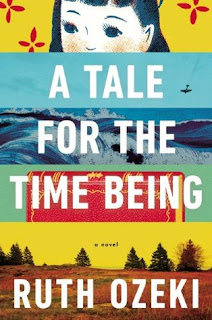
A Tale for the Time Being is one of those books. Seven years after reading it I am still contemplating its meaning and reflecting on its beauty.
Ruth Ozeki is a Japanese American/Canadian author who splits her time between New York, an island off British Columbia -- where her husband works as an artist, -- and Western Massachusetts -- where she teaches creative writing at Smith College. She is a also a Zen Buddhist Priest and a filmmaker. Many believe that A Tale for the Time Being is semi-autobiographical since one of the protagonists, Ruth, is a writer who lives half the year in New York and half in British Columbia with an artist husband. Sound familiar?
The title of the book is very intriguing, maybe more so if the reader understands the concept of time in terms of Zen Buddhism (which, of course, I don't but I'll share what I've learned.)
The story opens with a poem titled "For the Time Being" by Dogen Zenji. I won't copy it here because I don't want to get too far off track, but you can find it on
Wikipedia, the font of all knowledge 😒. Suffice it to say, I think Ozeki is playing around with the concept of time in her marvelous novel. One other gal in book club, Margaret, and I really enjoyed playing around with the title. Did it mean that the character was a "time-being" someone who could move around in time and space? Or was it a more simplistic explanation, "for the time being" as in "for now; temporarily"? Or both? Uji could also mean: "once; on one occasion; at one point; [in the past] once; at one time; once upon a time" which suggests that Ozeki is telling us a fairy tale with a moral at the end. Another reviewer suggested that a time being is "deep time, not linear, chronological time and for all humans the end of time is death."
This is a book about the mysteries of time, how layers of time blend
together, how time hurries by and slows down. It’s about our time, this
big time we are all living in, this time of tsunamis, climate change,
species extinction, undeclared war, Internet technology. And it’s about
this time right now, this moment of hearing a crow calling on a
branch, a moment that’s gone already. It’s about time past, the history
we think we know about—World War II, for example—and about memory, and
how when we look back and remember, or when we read journals and letters
from the past, the layers of time get squashed together in the time
being. Everything exists at once. Everything that has happened, or could
have happened, all possibilities are present now (Tricycle).
Hmm. Lots to think about. So now that I've got that all nailed down (snark), shall I tell you about the book?
The story is about two women: Nao and Ruth. They are separated by space and time. Nao is a teenager living in Japan with her parents. Everyone in her family is miserable. Nao (pronounced "Now") starts writing a diary which begins with these words: "Hi, My name is Nao and I am a time being. Do you know what a time being is? Well, if you give me a moment, I will tell you." She addresses her diary to a future "you" as if she knows that someone will eventually read it. The future reader is Ruth, who finds the diary inside a Hello Kitty lunchbox, inside the cover of Prout's book, In Search of Lost Time. This is all inside a plastic bag wrapped up in seaweed and barnacles found by Ruth on the Pacific beach of the island where she is living at the time. Citizens on the island have all been scouring the beaches for months recovering flotsam that has washed up presumably from the Japanese tsunami two years earlier.
As Ruth begins reading the diary she learns that Nao grew up in Silicon Valley where her father held a good job and everyone was happy. But when the dot.com bubble burst they had to return to Japan where her father has been unable to find another job. He is miserable and has attempted suicide. Nao is bullied at school where she is also miserable and has contemplated suicide herself. But before she does anything drastic she goes to visit her great-grandmother, old Jiko, who is 104-years-old and a practicing Zen nun and the abbess of an ancient temple near Fukushima, very near the spot of the tsunami a few years later. While staying with old Jiko, Nao learns about a great-uncle who was a reluctant kamikaze pilot in WWII. Nao decides that before she kills herself she must first write down their stories. She pens these words, “I will write down everything I know about Jiko’s life in Marcel’s book,
and when I’m done, I’ll just leave it somewhere, and you will find it.
How cool is that? It feels like I’m reaching forward through time to
touch you, and now that you’ve found it, you’re reaching back to touch
me!”
The chapters alternate between the two narrators, though Nao is writing her chapters in second person and refers to herself in first person, and Ruth's chapters are written in third person which is odd, but it works. Ruth's chapters show how she increasingly becomes obsessed with learning about what happened to Nao. Did she commit suicide? Was she swept up in the tsunami? Is she still alive somewhere in Japan? Instead of spending time writing and working on her own memoir, she finds herself spending all her energy on Nao and the "what ifs" of the girl's life. Ruth reads the diary slowly, so that only one chapter or entry reveals itself at a time. By the time that Nao writes her last entry, she has decided that she doesn't want to die after all. And to her great delight she learns that Proust not only wrote the one book, but seven. One of them is titled, Time Regained. She decides that she must find a copy of it because that is a perfect title for a book about old Jiko.
As Ruth finishes the diary she decides she must write to Nao, even though she doesn't know how to contact her. She closes the letter acknowledging this not-knowing:
In your diary you quoted old Jiko saying something about not-knowing, how not-knowing is the most intimate way, or did I just dream that? Anyway, I've been thinking about this a lot, and I think maybe it's true, even though I don't really like the uncertainty. I'd much rather know, but then again, not-knowing keeps all the possibilities open. It keeps the world alive
I can totally relate to this concept of not-knowing. I used to tell my students that my favorite book endings were the ambiguous ones. That I way I got to play around with the "what ifs" myself.
Clearly A Tale for the Time Being is not an easy book and I wouldn't recommend it to just any reader. I listened to the audiobook, which I am sure help me "get" the story easier. It is long and has lots of story lines to keep track of but it sure is worth all the effort in the end. I loved the way Ruth Ozeki played around with the concept of time and I was able to get lost in it for quite a while. Heck, I'm still lost in all the mysteries of this wonderful book.
Did you read A Tale for the Time Being? What did you think of it? Have you read any of Ruth Ozeki's other books? I noticed she published a new book in 2021, The Book of Form and Emptiness, which I hope to get to soon.
-Anne