"Outside a dog a book is man's best friend, inside a dog it is too dark to read!" -Groucho Marx========="The person, be it gentleman or lady, who has not pleasure in a good novel, must be intolerably stupid." -Jane Austen========="I don’t believe in the kind of magic in my books. But I do believe something very magical can happen when you read a good book."-JK Rowling========"I spend a lot of time reading." -Bill Gates=========“Ahhh. Bed, book, kitten, sandwich. All one needed in life, really.” -Jacqueline Kelly=========

Sunday, May 6, 2018

Sunday Salon, May 6


Bird's nest on our porch. If you look carefully at the first photo you can see the nest peeking out of the top of the wreath.
Weather: Lovely spring weather, with light showers predicted but temperatures in the 60s.

Update on my father: My mom was finally able to get my dad into a care facility and the physical therapy has begun. When I spoke to my mom on Friday, she sounded relieved and said that she thought dad was doing well, even walking a few steps with minimal assistance.

Update on my health: I seem to be emerging from the malaise that settled over me with this cold/allergies/cough thing I have been struggling with for two three weeks. Hopefully my ears will clear before we fly to New York the end of this week.

Good news: Carly, our soon-to-be graduate, made a trip out West this week to interview for a position in Tacoma and to visit a site in San Francisco where she'd already been offered a job. With a little salary negotiation, she accepted the job in San Fran. We are so proud of her.

Long, lost friend: I drove down to Vancouver to visit two college friends on Monday. I haven't spent much time with Jan since some time in the early 1980s, over thirty years ago. It was so good to reconnect. And what has taken us so long? We live only two hours apart? Anne Marie and I reconnected last year at this time, and it is always nice to spend time with her. Love you both!

Flower pots planted: for Mother's Day, Don usually gives me a day of planting flowers in the pots after a visit to a local nursery. Since we will be gone for Mother's Day this year, Don and I went out yesterday and bought enough plants to fill up ten pots and then we spent the afternoon planting them. For those of you who don't live in the PacNW, it always seems so late when we can finally get the plants set out, but our nights are usually quite cold, so our soil doesn't warm up enough to plant annuals until mid-May, and sometimes that is too early. Thanks, Don, for my Mother's Day gift!

Book overload: Hilariously four books and six audiobooks all arrived at the library after being on hold for months. I am not sure why this always seems to happen but now I am facing an untenable situation to try and read/listen to too many books in a short three weeks. The list:
  1. Brazen: Rebel Ladies Who Rocked the World by Penelope Baglieu. I should finish this one first since it is a graphic novel about famous/not-so-famous women throughout history. I hope to be a judge for the Cybils again and it is likely that this will be one of the books under consideration. Print.
  2. Thunder Head by Neal Shusterman. Sequel to a Printz honor book, Scythe, I have been waiting for this book for two months. Now that it is here will I have the fortitude to just dig in and read it? Print.
  3. The Astonishing Color of After by Emily X.R. Pan. I've heard wonderful things about this YA novel. Print.
  4. Americanized: Rebel Without a Green Card by Sara Saedi. Another potential Cybils nonfiction selection. Of the four print books, this is the least interesting to me, at least on the surface. Print.
  5. The Bear and the Nightingale by Kate Arden. Many bloggers have recommended this book. I placed it on hold months ago, and now it has arrived with a batch of other audiobooks. I'm guessing this one will go back on my hold list. Audio.
  6. Hag-Seed by Margaret Atwood. I can't even remember anything I've heard about this book other than it is authored by one of my favorites. Audio.
  7. Station Eleven by Emily St. John Mandel. This is a re-read for me but one I need to listen to again for an upcoming book club. I am actually around 50% completed. Audio.
  8. Stranger in a Strange Land by Robert Heinlein. I actually requested this book a week ago when I had nothing in the wings for a next audiobook. This book is on my Classics Club list but since it isn't in demand, I will send it back and request it again some other day. Audio.
  9. Less by Andrew Sean Greer. The recent Pulitzer Prize winner and an upcoming book club selection. This book is up next. Audio.
  10. The Optimist's Daughter by Eudora Welty. See note on Stranger in a Strange Land. Same. Audio.
Books completed this week:
  1. Devotions: Selected Poems of Mary Oliver. I've been working on this 400+ page poetry collection since January. Loved every minute. Print.
  2. Sgt Pepper at Fifty: The Mood, the Look, the Sound, the Legacy of the Beatles' Great Masterpiece. I bought this last year in the midst of my own personal Beatlemania stage. Not especially well-written but I did learn quite a bit. Print.
  3. The Poet X by Elizabeth Acevedo. A YA book written in verse about a young Dominican-American who has a hard time communicating with her mother. Print.
  4. Gulp: Adventures of the Alimentary Canal by Mary Roach. I started this book three years ago and finally got back to it. Interesting and gross information about everything related to digestion. Did you know that it is likely that Elvis died of constipation? Audio.
Birds: The hummingbirds have returned. I thought I killed them by leaving the food out too long so it got moldy. This year we have a pair of Anna's Hummingbirds, a male and a female. A sweet little bird, I think it is a house finch, has made a nest on our porch. I just checked. She is still faithfully sitting on her eggs and gets so put out with us every time we come and go from our own front door.

Best guitar solo EVER? Who knows. Maybe it is. I am not sure how I avoided seeing this video taken at the Rock and Roll Hall of Frame ceremony honoring George Harrison in 2004 after his death. It features so many famous people, several now dead themselves. Keep watching all the way to the end for Prince's solo. OMG. So good.


Wednesday, May 2, 2018

Pachinko by Min Jin Lee

Pachinko is a sweeping saga of a family which takes place first in occupied-Korea and then in Japan from the early 20th century to the late 1980s. The story chronicles the lives of four generations in one family beginning with Yeongdo, a poor but industrious woman who marries a crippled man. They live in a small fishing village in southern Korea. Their only surviving child is a girl, Sunja. She is also very industrious, helping her mother run a boarding house after her father's death. When Sunja is 16 she is seduced by a married man. Pregnant and desperate, Sunja agrees to marry a kindly Presbyterian pastor who knows of her plight and is willing to raise the child as his own. Soon after they wed the pair immigrate to Japan to join Isak's brother and his wife in Osaka, Japan. Noah is born soon after they arrive.

Several years later another boy is born, Mozasu. WWII is raging and Koreans are not well-liked by the Japanese. Isak is rounded up because he is attending a rally and he is thrown in jail. The family is not allowed to visit him and they fear he will die before they see him again. Sunja and her sister-in-law are forced, by necessity, to make money and they make kimchi and candy to sell on the street. When Isak is finally released from jail, after being detained for several years, he is almost unrecognizable. Noah, who is home alone when Isak returns, "can't take his eyes off his father for fear he will disappear."

Noah is a scholar and wishes more than anything that he could become a Japanese citizen. Mozasu is not a good student and is constantly getting into fights at school due to the taunts from bullies aimed at him for his ethnicity. He finally talks his mother into allowing him to drop out and to go and work at the local pachinko parlor.

Pachinko is a slot-machine type game which is popular in Japan. Koreans, who are shut-out of opportunities to work in every sector of Japanese society, often find employment at the pachinko parlors and can, if they work hard enough, become wealthy this way. Mozasu does well and is promoted up to the position of manager as a young age. He also seems to be able to resist the temptations to become a thug, which is very common in the profession. He marries a nice girl and they have a son, named Solomon by his uncle, the family patriarch. (The reader will learn very little about the actual game of pachinko, though the game gives the book its title.)

Solomon, like his uncle Noah, is a good student, but unlike his uncle he is able to attend college in the USA. When he returns to Japan, Solomon naively thinks that his schooling and his skills will shield him from the discrimination against his Korean heritage. But he too finds that this isn't the case.

Krys Lee, writing for the NYT Book Review says this about the novel,
"Like most memorable novels Pachinko resists summary. In this sprawling book, history itself is a character. Pachinko is about outsiders, minorities and the politically disenfranchised. But it is so much more besides. Each time the novel seems to find its locus — Japan’s colonization of Korea, World War II as experienced in East Asia, Christianity, family, love, the changing role of women — it becomes something else. It becomes even more than it was. Despite the compelling sweep of time and history, it is the characters and their tumultuous lives that propel the narrative. Small details subtly reveal the characters’ secret selves and build to powerful moments."
I listened to the audio version of Pachinko read expertly by Allison Hiroto. The audiobook is over 18 hours long.  I lived with the family for weeks. Every time the audiobook started in the car I was transported to Korea or Japan to live a little inside the characters in the story. My favorite bits of the tale were those where the aspects of the unique cultures were described. Small and trivial details related to food, sleeping, clothing, and interactions ignite my imagination and bring their lives into clearer focus.
"In this haunting epic tale, no one story seems too minor to be briefly illuminated. Lee suggests that behind the facades of wildly different people lie countless private desires, hopes and miseries, if we have the patience and compassion to look and listen" (NYT).
Themes related to honor, the role of women, segregation and discrimination as populated the pages. This will be great fodder for our book club discussion later this month. As the 18 hours of listening was coming to an end, I worried a little that there could be no good resolution to this family's story but I assure you that the ending is very satisfying. As the book credits were being read I felt like a foreign exchange student who was very unhappily having to go home after a rewarding and an exciting cultural exchange program abroad. It was an experience that will change me forever.


Sunday, April 29, 2018

Sunday Salon, April 29, 2018

Weather: Sunbreaks. One minute it is sunny, the next it looks like it will rain.

Three weeks: I haven't posted in Sunday Salon for the past three weeks. A lot has been happening. Here is my update...

Family health: My dad had a stroke Thursday night. My mother initially thought it was a little one, another TIA one like he has had before, so she didn't call for an ambulance. Now it appears it was larger than she thought and taking care of him is proving to be a big challenge. My sisters are with my parents now as they try to decide how to proceed. I am not with them because I have a humdinger of a cold with a nasty cough. I don't want to give this to my father. It might kill him. Don is off at Walgreens right now buying me some cough syrup. In an awkward moment in church today while Don asked for prayers for my father, I started coughing and so no one could here what he was saying.
Ugh.

Tulips: Don and I spent last Wednesday up in the Skagit Valley enjoying the tulips which are blooming fairly late this year. Aren't the photos lovely? The tulip fields are so lovely and colorful it is almost impossible to take it all in.

Renewing friendships: With all the problems that we have learned about Facebook and how they gave away our private information which was used by the Russian propaganda machine, I confess that I don't want to give it up. Why? Because, thanks to the networking possible with Facebook, I have reconnected with old friends. Tomorrow I will be lunching with two sorority sisters, Janet and Anne Marie. I haven't seen Janet for at least thirty years. Lunch and coffee date, walks and visits...it has been fun reconnecting with so many friends. Thanks Theo, Carol, Margaret, Kay, and MaryJo.

Double tulips with hyacinths and grape hyacinths 
Book club reorganization: Two months ago I griped here about a club meeting where only three people showed up. The three of us talked about ways we could/should proceed. We put the idea forward to invite some new members and offer a chance for those who want out to leave without it being awkward for them. So far we have three new members and one gal has suspended her membership. I already feel some new energy. After ten+ years I guess it is OK to change things up a bit. I'm guessing it is rare to have a static group which has been together as long as we have.

What have I finished reading the past three weeks?
  • The Girl Who Drew Butterflies: How Maria Merian's Art Changed Science by Joyce Sidman---I  really enjoyed this book about a phenomenal artist and scientist who lived in the 1600s. The book's target audience is upper elementary or middle school students, but I think all adults will love it, too. Click on the title which is hyperlinked for my review. Print.
  • Sing, Unburied, Sing by Jezmyn Ward---I had started this book several months ago and had to return it to the library before finishing it. This time I got the audiobook, which worked much better for me. It is really a remarkable book but so depressing about the effects of racism and poverty on a bi-racial family. The ghosts of slavery keep haunting us for sure. Hyperlinked. Audio.
  • The Librarian of Auschwitz by Antonio Iturbe---Based on a real person, Dita Kraus, who spent part of her time as a prisoner in Auschwitz as the school's librarian. If the Nazis knew they had books, they would have been killed. Another book which I had had to return to the library in February and when I got it back, I had to jump in mid-book and try to catch the thread. It is very good, if not a bit long. Hyperlinked. YA. Print.
  • Manhattan Beach by Jennifer Egan---set during WWII, Anna is a civilian diver for the US Navy. Not sure why people are so high on this one. I thought it was fine but not one I will recommend to others. Audio.
  • The Shakespeare Timeline Wallbook by Christopher Lloyd. So fun. Contains a huge 6-foot poster with highlights of all 37 plays, and then a newpaper-type text of important moments related to Shakespeare's works over the ages. Hyperlinked. Print.
  • A Day in the Life of Marlon Bundo by Jill Wiss---the children's book highlighted by John Oliver in response to Mike Pence's children's book about his bunny. This book is about two male bunnies who fall in love and want to get married. Print.
  • Pachinko by Min Jin Lee---the story of a Korean family over fifty years and a move to Japan. I lived and breathed this book for 16 hours, the length of time it took to listen to the audiobook. My favorite bits were the cultural references. A book club selection. Audio.
What books did I have to return to the library unfinished?
  • The Wizard of Earthsea by Ursula LeGuin---I finished only three or four chapters before this e-book returned itself to the library. I have requested it again and am back in line.
  • Russian Roulette: The Inside Story of Putin's War on America and the Election of Donald Trump by Michael Isikoff and David Corn---I got about half way through this book, which is full of so many details of the way that Russia messed with our elections and the touches that were made by them with the Trump campaign. I could only read it in small portions and could never read it right before bed. When the print book was due at the library, and I wasn't allowed to renew it, I returned it and thanked it for being a good book, but I won't finish it.
What am I currently reading now?
  • The King Years: Historic Moments in the Civil Rights Movement---essays by Taylor Branch, a civil rights historian. I've lost my momentum on this book but still hope to finish it. (Print, 45%)
  • Devotions: Selected Poems by Mary Oliver---I am delightedly making my way through this tome of a book by my favorite poet. No rush. If I read a few a day, I am doing good. (Print, 76%)
  • Gulp: Adventures on the Alimentary Canal by Mary Roach---one of my favorite nonfiction authors tackles the topic of everything having to do with digestion. In her typical style she entertains as well as educates. This is another book that I started at an earlier date, had to set aside, and am finally getting back to it. Audio. 40%
  • The Poet X by Elizabeth Acevedo---a YA book, written in verse about a Dominican-American girl who likes to communicate through poetry. Print. 33%.
  • Sgt Pepper at Fifty: The Mood, the Look, the Sound, the Legacy of the Beatles' Great Masterpiece by Mike McInnerney, Bill DeMain, and Gillian Gaar---no, my personal Beatlemania trip is not over. I watched the video about the making of the album, now I'm reading the book. Print. 20%.

What is Ian up to? Our little grandson is growing so fast. Every day he is learning something new and it is such a joy to watch it unfold right before my eyes. He is very close to figuring out how to crawl, he still doesn't like eating solid food, loves books, balls, and singing.

I took this photo after we got back from an hour walk. It was 80 degrees outside and we were both hot and sweaty.
Movies: We upgraded our cable service so Don and I have been watching more movies lately, as they are easier to find and access. We've watched mostly comedies: "Ghostbusters: Answer the Call"; "The Heat"; "Pitch Perfect 2"; "Table 19"; and one drama, "Fences".

Godspeed: Women's Bible study is exploring the concept of moving at godspeed, a slow enough pace of life that it is possible to make human contact with our neighbors and other people in our "parish". I am really feeling challenged. This is a poem that we contemplated this week:
"Another morning and I wake with thirst for the goodness I do not have. I walk out to the pond and all the way God has given us such beautiful lessons. Oh Lord, I was never a quick scholar but sulked and hunched over my books past the hour and the bell; grant me, in your mercy, a little more time. Love for the earth and love for you are having such a long conversation in my heart. Who knows what will finally happen or where I will be sent, yet already I have given a great many things away, expecting to be told to pack nothing, except the prayers which, with this thirst, I am slowly learning." Thirst, Mary Oliver
Prayers for: My dad and his health and my mother as his caretaker. // My daughter will be deciding this week between two jobs. Life is moving fast for her right now.


Friday, April 27, 2018

The Shakespeare Timeline Wallbook

Back in November of 2017 I was frantically attempting to read all the nominated nonfiction titles for the Cybils Award. I was a judge for the first round of judging. I attempted to get all the books I could from my public library but those that my library didn't have had to be supplied by the publisher. With over 60 books to read, I didn't fuss too much if I couldn't find a book because there were plenty to of others that I could find and they kept me busy. Finally in late November and early December the books from publishers started to arrive and I had a hard time giving them more than a cursory glance just to meet my deadline. But I have kept those books and am trying to finish reading them now so I can honor the publishers that sent me the free copies.

The Shakespeare Timeline Wallbook by Christopher Lloyd and illustrated by Andy Forshaw is one of those books that didn't get my full attention because it arrived so late in the judging process. And what a shame, too, because the book is a treasure. It took me only an hour to read once I sat down to read it and I enjoyed it very much.

The book includes a huge, 6-foot long timeline of all 37 of Shakespeare's plays. The timeline could be detached from the book and displayed on a wall. Each play has a brief summary (one short paragraph) and two or three themes of each are highlighted. The print on the timeline is tiny so if a student wanted to learn more about each play they would have to stand really close to the poster. See the photo of a portion of the timeline below.


The next portion of the book is put together like a newspaper with articles about important aspects of Shakespeare's life and influence, interpretations of the play over time, and other interesting tidbits. For example, I learned that Tchaikovsky, the famous Russian composer, donated his skull to be used in performances of Hamlet. And Charles Dickens, another famous British author, saved Shakespeare's birthplace from being dismantled and moved to America by PT Barnum. It is now restored and safely still situated in its rightful place in Stratford-upon-Avon.  These little articles were very clever and were dated so the reader could learn when the event occurred. Researchers are still discovering new things about Shakespeare today! Did you know that researchers recently dug up the bones of Richard III, who Shakespeare described as a hunchback, but few believed that he was. Well, the bones, discovered in 2012, show that Richard indeed did have a "crookback", as Shakespeare described it.


The last three parts of the book include samples of Shakespeare's sonnets, lists of words and phrases that he coined, and a quiz, which I failed spectacularly.

I really, really like this book. It is clever and fun. It is a quick read yet is full of interesting tidbits. The timeline is hardest for me to read because the print is so small, but if it were larger the whole poster would be unwieldy.  I want to keep the book, for selfish reasons, but know that I should donate to a school library or to an English teacher who will make it available for student use.

If you ever see this book at your public library, check it out and then give yourself an hour or two to delve into it. It would also make a tremendous gift for an English teacher or just someone who loves everything Shakespeare. Though it doesn't have many pages, 24, it is packed with information. The size, 15 inches tall (36 cm.) may be too tall for regular library shelves so it may be hanging out in the oversize section of the library. Ask your librarian for help finding it.

Apparently The Shakespeare Timeline Wallbook is part of a series of Timeline Collections. Other books in the series are: Big History; Nature; Sports; Science; and this one, Shakespeare. I will look for the other books, too.

I reviewed this book from a complementary copy supplied by the publisher,  What On Earth Publishing. This review is an honest and open review of the book by me.


Thursday, April 26, 2018

Friday Quotes: The Poet X

Book Beginnings on Friday is hosted by Rose City Reader. Share the opening quote from the book.
Th
e Friday 56 is hosted at Freda's Voice.  Find a quote from page 56.

Check out the links for the rules and for the posts of the participants each week. Participants don't select their favorite, coolest, or most intellectual books, they just use the one they are currently reading. This is the book I'm reading right now---


Title: The Poet X by Elizabeth Acevedo

Book Beginnings:

Stoop-Sitting

The summer is made for stoop-sitting
and since it's the last week before school starts.
Harlem is opening its eyes to September.

Friday 56:

During Communion

Ever since I was ten,
I've always stood with other parishioners
at the end of Mass to receive the bread and wine.
But today, when everybody thrusts up from their seats
and faces Father Sean, my ass feels bolted to the pew.

Comments: I just started reading this YA book which is about a young teen who can express herself only through her writing, specifically poetry. The whole book is written in verse. Not sure what I think of it yet but it is possible to read very quickly so I won't get bogged down for long if I don't care for the book. I like reading poetry but I often find the poetry in novels written in verse to be not very good. In these examples I find these words very compelling and i am hoping for more good lines like this: Harlem is opening its eyes to September.

Do you like reading novels written in verse?


Wednesday, April 25, 2018

The Librarian of Auschwitz by Antonio Iturbe


The Librarian of Auschwitz by Antonio Iturbe is one of those disturbing Holocaust stories set mainly in the infamous concentration camp in Poland--- Auschwitz. And remarkably, it contains new information. Information based upon a real-life remarkable girl, Dita Kraus. When she was fourteen she and her parents were transferred by the Nazi’s from the Terezin ghetto to the Auschwitz family camp. Apparently the Nazi’s schemed on a plan to trick the Red Cross by placing a few hundred Jewish members in a family camp and allowing the children to attend school. If the Red Cross came to the camp, the Nazis could show them how humanely they were treating families by allowing them to be together and by allowing the children to go to school.  It was in this school in Block 31 that Dita became the librarian of eight precious and illegal books. The Nazis supplied nothing for the school but did allow some adults to teach the children music, patriotic games, etc. If they knew about the books a lot of people would likely be punished. Dita had to be very careful.

The books were a rag-tag collection of works: one atlas, a Russian grammar book, a geometry book, and a few novels, including one by H.G. Wells, and another, The Count of Monte Cristo, published in French. No matter how odd the collection, the books were checked out by the teachers so they could teach students certain concepts.

The school and time spent in Block 31 was a respite for Dita, the teachers, and for the children. Daily life was so terrible. Survival was a struggle for everyone, though even in the worst of conditions, children find ways to have fun and to be silly. In one scene a group of children, led by a brash ten-year-old, made a raid on the kitchen hoping to get potato peels for a snack. “Adults wear themselves out pointlessly searching for a joy they never find. But in children, it bursts out of every pore.”  Death was just a breath away at all times. This time ended good for the participants, but it could have ended badly. One day, one half of the family camp prisoners were put to death, nearly 3000 souls gone in a day. It is too terrible to even think about.

Yet, somehow, Dita and her mother survive even after the school is closed and they are transferred to several other camps within Germany. They survived to realize freedom as the British soldiers rescued their camp. Later Dita married a boy she met in Block 31 and they settled in Palestine in 1949. It was a happy ending to a horrific life.

I had the worst high school education on the topic of world history. As I look back on my education, it is a wonder I know anything at all. I never even heard the word "holocaust" until I was in college, and when I did hear it I had to pretend I knew what it meant until I had a chance to look it up on my own. I did read The Diary of Anne Frank in junior high but I don't recall the teacher ever using the word "holocaust." After college I read The Hiding Place by Corrie ten Boom. It wasn't until years later that I read Elie Wiesel's Night, which was one of the first first hand accounts written by a survivor of a death camp. Since then I have read several other books on the topic, including information books, and felt that I had a pretty good handle on the horrors of the Holocaust. then along comes The Librarian of Auschwitz by Antonio Iturbe. I am shocked to learn that Auschwitz, the worst of all the camps, actually had a little school and there was a girl who was the keeper of the books...a librarian for the smallest collection ever. “Each time someone stops to tell a story and children listen, a school has been established.” It makes me cry to think of the simple beauty of holding and reading a book amid all the suffering and horror of the camp. 

As moved as I was by the book, I found it a difficult book to read. One reason is obvious. It is hard to read books about such terrible event, especially knowing that they happened in a similar fashion in real life. The second reason, I thought the book to be a bit flat in its ability to convey the feelings of the prisoners. I suspect that this is a translation issue. Antonio Iturbe is Spanish and he wrote the book in his mother-tongue. It was translated by Lilit Thwaites, a former professor from Australia. My limited experience with translated works is that they often come across a bit flat. The nuances of the language are lost in translation. And my last issue with The Librarian of Auschwitz was the length of the book. At over 400 pages, it seemed to go on endlessly...but then there was a lot of story to tell. It took me a long time to build up enough of a head of steam to finally push past the half-way point and then I was able to complete it quickly from that point on. My favorite bits of the story talked about the value of reading and of books. They have real power to save and to make the world a bigger, better place.
“Throughout history, all dictators, tyrants, and oppressors, whatever their ideology - whether Aryan, African, Asian, Arab, Slav, or any other racial background; whether defenders of popular revolutions, or the privileges of the upper classes, or God's mandate, or martial law - have had one thing in common: the vicious persecution of the written word. Books are extremely dangerous; they make people think.” 
The end of the book has a biography of "What happened to..." some of the real people referenced in the book. I was dismayed that Dr. Mengele was never found after the war and died of natural causes in Uruguay where we was living in hiding. As of the printing of this book Dita Kraus is still living in Israel but she often returns to Prague, her first home.

Note: all quotes used in this review are from The Librarian of Auschwitz, unfortunately I couldn't supply the page numbers as my source (Goodreads) didn't list them.

-Anne

Tuesday, April 24, 2018

Review: Facing Frederick: The Life of Frederick Douglass


Facing Frederick: The Life of Frederick Douglass: A Monumental American Man by Tonya Bolden is one of those essential books that every middle and high school library should have one their shelves. Published in 2018, it is a highly attractive and authoritative account of the life of one of America’s true heroes.

Last year President Trump gave some little speech in which he mentioned Frederick Douglass and it was pretty obvious from the way he spoke that he knew nothing about Douglass, even making it seem that the famous x-slave was still alive. “Frederick Douglass is an example of somebody who's done an amazing job and is getting recognized more and more, I notice,” Trump said without realizing the man has been dead for over 120 years  (Wash. Post). It was funny at the time, but really sad in retrospect.

Frederick Douglass lived a phenomenal life well beyond being an escaped slave who wrote about his experiences. He was a “reader, teacher, orator, self-emancipator, abolitionist, author, editor, intellectual, civil rights activist, women’s rights activist, public servant, diplomat, statesman, humanitarian, husband, father, grandfather” and I would add, a voting right’s activist---lobbying not only for voting rights for blacks but also for women. Some say that Frederick Douglass was the Martin Luther King, Jr. of the nineteenth century in America. He never stopped trying to make the country a freer and fairer place for all people. When he died in 1895, “a hush fell upon the land”. These words he wrote about the death of Abraham Lincoln but were true at his passing, too.

I love information books like this one authored by Tonya Bolden. It is full of photos, samples of works by Douglass, and illustrations. It is readable, with a target audience of 5-8th grade, though I think high school students would benefit from reading it, too. (Heck, I am an adult I learned a lot from reading it!) It has source notes, a Frederick Douglass timeline, photo credits, and an index which make it useful for research projects.

Check Facing Frederick: The Life of Frederick Douglass: A Monumental American Man out from your local library. I am sure you will find it interesting, too.


Monday, April 23, 2018

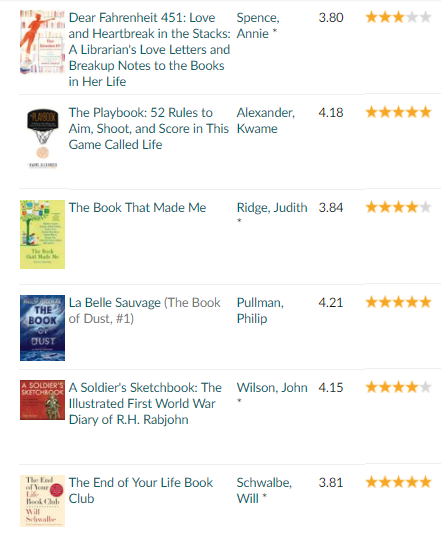
TTT: Frequently found words on titles of books I've read

Top Ten Tuesday: With the use of analytics on Goodreads, these are commonly found words in titles of books I've read.
GIRL(S): 37
The most recently read books with GIRL in the title:

BOOK: 38
The most recently read books with BOOK in the title:

WORLD: 30
Most recently read books with WORLD in the title:

Other words which showed up frequently: America(n)---30; Love--- 22;
Boy(s)---18; Dog(s)--- 10; Moon and Star(s) each----9; Novel--- 8; New(s)--- 7.

Interesting, huh?


Saturday, April 21, 2018

Dear "Dear Fahrenheit 451"

BOOK REVIEW---Spence, Annie
---Critical and complimentary

Dear Dear Fahrenheit 451,
     I wanted to love you. I really did. In fact, I placed you on hold at my public library and had to wait months for my turn to read you. Does it count that I wanted to read you? I hope that makes you feel a little better about yourself. Let me explain.
     You see, your subtitles really got me excited---Love and Heartbreak in the Stacks and A Librarian's Love Letters and Breakup Notes to the Books in Her Life--- because I love reading books about books and I am always interested in finding out what books other people love. I often find excellent book recommendations to add to my reading list that way. And besides, it was super fun to think about reading a book with two subtitles. Who has ever heard of that before?
     Anyway, it was finally my turn and the audiobook of Dear Fahrenheit 451 was available for checkout and, bonus, it was read by your author, Annie Spence. She has a good reading voice and I could tell that she is a real character who dearly loves books and her job as a public librarian. The book is a series of love letters to books that Ms. Spence loves, and breakup notes to books she no longer likes, or must remove from the library shelves.  She explained that after all the normal stuff that people think of librarians doing, like making book recommendations to their patrons and ordering new materials, she also had to do a job called "weeding". Just like in a garden, flowers grow best if the gardener gets rid of the weeds, a library only stays fresh and vital only if the old, ratty, out-of-date materials are weeded and removed from the collection.
     Since I was a librarian, I know how difficult it is to a weed a book out of the library collection. "What if a student comes in looking for a book like this one some day?" or "I purchased this book with my limited funds and now I am removing it and hardly anyone has read it. What a waste." These were frequent thoughts in my mind as I weeded the library. Apparently Annie Spence went one step further and actually justified her actions by writing a breakup note to each book. The first few of these notes were funny. When she broke up with her first book, The Calculating Book: Fun and Games With Your Pocket Calculator, I think I actually laughed out loud. It is hard (and expensive) to keep a library collection up-to-date, but this example seemed hopelessly out-of-date. Why hadn't it been weeded long before that time?
     Many of the love letters really touched me. The first love letter was written to The Goldfinch, which is a book I love, too. The letter begins with an apology from Spence for allowing the book to fall apart. Literally. The book was falling apart with a broken spine and the pages falling out. The reason for the book's state--- Spence kept recommending it to patrons. Time for a new copy. I had that same experience in my library. Not surprisingly the books I recommend the most were usually the most dogeared. Another favorite book of Spence's, The Virgin Suicides, has gone onto my reading list. She couldn't say enough good stuff about the book, I will just have to read for myself to see if I agree. So far you and I were off to a good start. I liked Spence's writing style and tone. I could relate to her examples.
     Then it happened. I started to notice that the breakup notes were getting sillier and I doubted that Spence had read them at all and the love letters weren't quite as thrilling and tantalizing. My brain would start to wander, a real problem when one is listening to a book compared to reading it. Sometimes I couldn't even remember what book she was referencing. Perhaps, I thought, Spence should have stopped when she was ahead. Did she include books in you, Dear Fahrenheit 451, to meet some page requirement? Or was she just making fun of some of the book selections in her library? I'm ashamed to say, that at this point in the book, I actually said something pretty negative about you to another reader. Sorry.
     Just when I was ready to stop listening altogether, the love letters and breakup notes stopped and lists of book pairings appeared. Once again I was hooked and once again I decided that the audio format was wrong. I wanted to look at the lists and spend a little time with them. One cannot do that with an audiobook. I barreled on and finished listening to you but I also went back to the library to request the print version. Back onto the waiting list I went, this time the list was longer and I had wait a really long time before you came in. I just received the print edition the other day and now will have time to look at the suggested book pairings lists, which I do think is such a clever idea. Librarians often ask patrons what books they have previously enjoyed reading and will make their recommendations based on those answers. I really need to scrutinize the list for myself and for my friends who often ask me what they should read next. I hope to take the time this weekend to do this.
     So, dear Dear Fahrenheit 451, I didn't love you completely, but I certainly liked you and got a lot of good from reading you. I gave you three stars out of five on Goodreads but would likely upgrade that to 3.5. Will I tell my friends to read you? Sure, but I will warn them away from the audio version and I will caution them about the middle part of the book seeming a bit silly and/or mundane. You really are quite clever and I did, overall, have a lot of fun with you. But our relationship is nothing serious, even though I do like you, and I won't be taking you home to meet my mother.
     P.S. One of the questions that Annie Spence asked in the book was how to pronounce Pulitzer Prize. I know the answer. I saw the woman make the announcement this past week for the 2018 prize winners and she pronounced it PULL-itzer. I was thinking about you as I listened.

My best and much love,


Thursday, April 19, 2018

Friday Quotes---Dear Fahrenheit 451

Book Beginnings on Friday is hosted by Rose City Reader. Share the opening quote from the book.
Th
e Friday 56 is hosted at Freda's Voice.  Find a quote from page 56.

Check out the links for the rules and for the posts of the participants each week. Participants don't select their favorite, coolest, or most intellectual books, they just use the one they are currently reading. This is the book I'm reading right now---


Title: Dear Fahrenheit 451: Love and Heartbreak in the Stacks: A Librarian's Love Letters and Breakup Notes to the Books in Her Life by Annie Spence

Book Beginnings:
"Dear The Goldfinch, We've grown apart. Or, I guess, you've grown apart. Like, physically. Your spine is torn to crap. The hardest part about this? I'm the one who did it to you. I love you so much, Goldfinch."
Friday 56: 
"Dear The Fledgling...When people say books are full of wonder, we don't take it seriously enough. You are over thirty-five years old. You smell like old paper and smudged fingertips. You've lain dusty and untouched for decades. And you're magic. You are. You can't work wonders for everyone because, like things with magic inside them, you have to wait for the right hands to touch you at just the right moment." 
Comments: The first of this book is so cute with Annie Spence, a public librarian writing letters, mostly loving ones, to books. The second part of the book is her suggested book pairings, a unique way of making reading recommendations. It is a fun, often funny book.

My review: a letter to Dear Fahrenheit 451